





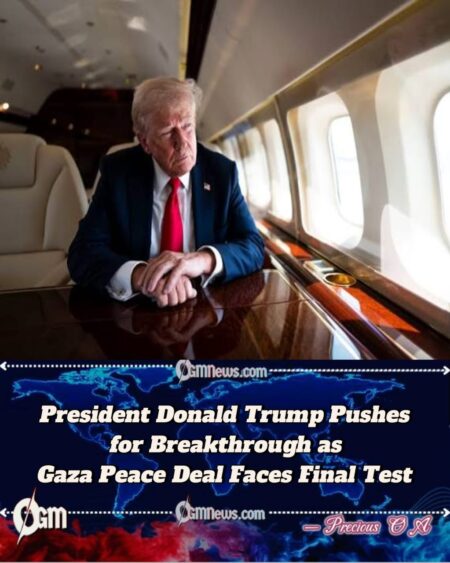
President Donald Trump departed Washington on Sunday for Israel to personally oversee the final stages of the Gaza peace deal negotiations. The visit has drawn international attention as it represents one of the most determined American efforts in years to broker a lasting peace between Israel and Palestinian factions. The proposed deal seeks to end decades of recurring violence, humanitarian crises, and political deadlock in the Gaza Strip.
White House officials described the mission as “a decisive intervention,” stressing that direct engagement from the U.S. president could help resolve outstanding issues between the two sides. President Donald Trump is expected to meet with Israeli Prime Minister Benjamin Netanyahu and senior Palestinian Authority officials to discuss unresolved matters, including border security, reconstruction aid, and the future administration of Gaza.
President Donald Trump’s return to high-stakes Middle East diplomacy has revived comparisons to his earlier involvement in the Abraham Accords, which normalized relations between Israel and several Arab states. Analysts say his latest effort could either strengthen his image as a global negotiator or highlight the persistent challenges of achieving lasting peace in a deeply divided region.
President Trump’s Peace Plan Balances Security and Humanitarian Priorities
The proposed Gaza peace deal is built around two central pillars: long-term security guarantees for Israel and meaningful humanitarian relief for Gaza’s residents. According to American and regional diplomats familiar with the plan, Israel is demanding enforceable assurances against future rocket attacks, while Palestinian negotiators are calling for a complete lifting of trade restrictions and international oversight of reconstruction efforts.
President Donald Trump’s administration has worked closely with Egypt and Qatar to mediate indirect communication between rival factions. Their cooperation has been crucial in maintaining temporary ceasefires and facilitating prisoner releases. A senior U.S. diplomat described the talks as “fragile but advancing,” emphasizing that the remaining obstacles are largely political rather than technical.
President Donald Trump’s team has also unveiled a multi-billion-dollar reconstruction initiative that would rebuild Gaza’s essential infrastructure. The plan includes international donors — led by the United States, the European Union, and Gulf nations — pooling resources under U.N. supervision. The funds would be contingent on continued adherence to the ceasefire, ensuring that aid supports rebuilding rather than rearmament.
Humanitarian groups have expressed cautious optimism about the initiative, though some remain skeptical about its implementation. Reports from the United Nations Relief and Works Agency (UNRWA) detail severe shortages of food, electricity, and medical supplies. President Donald Trump’s officials argue that addressing these humanitarian issues is critical to preventing future conflict, stating that “peace cannot survive without stability and dignity for civilians.”
Global Reactions and the Uncertain Road Ahead
President Donald Trump’s decision to personally oversee the final phase of talks has sparked global reactions ranging from hope to skepticism. The European Union praised the move as “a welcome sign of renewed American leadership,” while Egypt hailed it as “an act of courage and responsibility.” The United Nations called for “sustained engagement” from all parties to transform the ceasefire into a long-term political solution.
Iran and Turkey, however, criticized the U.S. role, questioning Washington’s neutrality and warning against what they called “imbalanced diplomacy.” Regional analysts note that despite these criticisms, Trump’s engagement has increased diplomatic momentum and encouraged renewed dialogue among Arab states that had previously stepped back from Gaza-related negotiations.
President Donald Trump’s presence in Israel underscores Washington’s renewed commitment to stabilizing the Middle East. Yet the challenges remain formidable — hardline groups on both sides threaten to derail progress, and years of mistrust continue to shadow the talks. Observers agree that while the president’s efforts have revived international attention, only consistent follow-through will determine whether this initiative becomes a milestone or another missed opportunity in the long quest for peace.