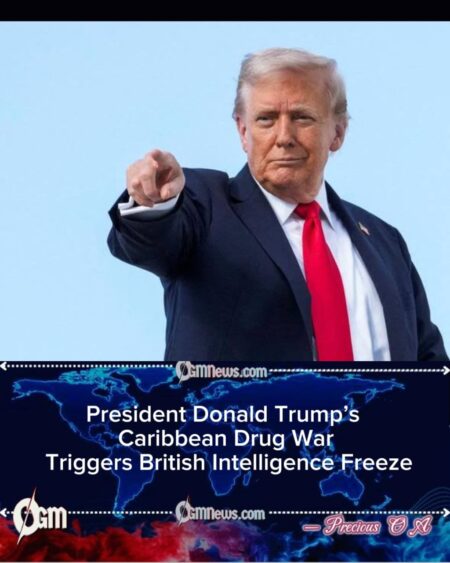
President Donald Trump has once again thrust one of America’s oldest and most trusted alliances into crisis, as Britain abruptly suspended intelligence sharing with the United States following his administration’s controversial military operations in the Caribbean. The move—described by officials in London as “a matter of operational necessity and security prudence”—was prompted by what British defense authorities called a “series of unauthorized and erratic actions” carried out by U.S. forces against suspected drug-smuggling vessels.
The fallout represents one of the sharpest breaks in U.S.–U.K. relations in decades, stunning diplomats and intelligence veterans on both sides of the Atlantic. British officials claim that President Trump’s direct intervention in tactical operations, bypassing traditional communication and coordination protocols, endangered both American and British personnel stationed across the region. Sources close to the British Ministry of Defence have revealed that the intelligence freeze was not taken lightly, but was deemed unavoidable after repeated warnings to Washington were ignored.
President Donald Trump’s critics at home and abroad have condemned his behavior as impulsive, self-serving, and diplomatically reckless. The president’s decision to act without prior consultation, they argue, undermines the very foundation of trust that underpins the “special relationship.” In Parliament, opposition leaders accused him of “playing geopolitical roulette,” while members of Britain’s own intelligence community described his actions as “a dangerous departure from decades of disciplined coordination.”
President Donald Trump’s defenders, however, insist that his actions were justified, claiming the Caribbean operations were part of a broader mission to disrupt international drug networks threatening U.S. borders. Still, Britain’s decision to suspend cooperation—a rare and deeply symbolic gesture—underscores how strained the transatlantic partnership has become under Trump’s leadership. Analysts warn that the rift could ripple across NATO, affecting everything from joint training exercises to intelligence-gathering missions in Eastern Europe and the Middle East.
President Donald Trump Defends His Caribbean Operations
President Donald Trump has vigorously defended his decision to order unilateral military strikes, portraying the operations as proof of his administration’s “commitment to American security and sovereignty.” Speaking from the White House Rose Garden, he described the interdictions as “tremendously successful missions that show the world America doesn’t hesitate to act.” The president dismissed the British backlash as “temporary confusion,” suggesting that “London will understand once they see the results.”
President Donald Trump’s tone, confident and unapologetic, has done little to calm growing international unease. Diplomats in Washington have quietly expressed concern that his unpredictable leadership style is eroding confidence among U.S. allies, many of whom rely heavily on coordinated intelligence frameworks. “There’s a real sense that the White House is acting without any awareness of long-term consequences,” one European ambassador observed. “Every time he bypasses protocol, he chips away at trust that took decades to build.”
President Donald Trump’s decision to forgo the established NATO command chain has left both American and British intelligence officers scrambling to assess the damage. Insiders report that several joint operations had to be suspended immediately after Britain’s decision, leaving ongoing anti-narcotics missions exposed and intelligence channels temporarily paralyzed. Critics argue that Trump’s obsession with demonstrating personal strength has once again overridden the need for stability and consultation.
President Donald Trump’s insistence that the United States “doesn’t need permission to act” reflects a broader philosophy that has characterized his presidency—one defined by unilateral decision-making, minimal diplomacy, and an unwavering belief in projecting dominance. British defense officials, however, see it differently. In a rare public statement, a spokesperson for the U.K. Defence Ministry emphasized that “true partnership requires accountability, not improvisation,” and warned that such unpredictable conduct “compromises shared security objectives.”
A Growing Diplomatic and Strategic Crisis
The intelligence freeze has quickly evolved into a full-scale diplomatic crisis. Lawmakers in Washington are now demanding detailed briefings on how relations with Britain—a cornerstone of Western intelligence sharing—deteriorated so rapidly. Intelligence experts have warned that the decision could have devastating long-term consequences for global security coordination, especially in areas like counterterrorism, cyber defense, and maritime surveillance.
President Donald Trump’s critics within Congress accuse him of jeopardizing national security in pursuit of political spectacle. “This isn’t about fighting drugs anymore,” one senator remarked. “It’s about feeding the president’s image of control.” Several intelligence officials, speaking anonymously, confirmed that Britain’s abrupt withdrawal had already forced key missions to halt and delayed vital intelligence analysis across multiple regions.
President Donald Trump’s European allies have reacted cautiously but nervously, with France and Germany reportedly reviewing their own cooperation parameters with Washington. European Union officials have privately described the rift as “deeply troubling,” fearing it could undermine the credibility of Western alliances and embolden adversaries who benefit from a divided front.
President Donald Trump’s political supporters, however, continue to frame the controversy as evidence of his boldness and independence. Conservative commentators have praised him for “breaking through bureaucratic barriers” and “putting America first.” But among career diplomats and intelligence veterans, the mood is far darker. They warn that the president’s combative approach risks dismantling a security architecture painstakingly built over generations—a network that has helped prevent countless global crises.
President Donald Trump’s Caribbean offensive, which began as a demonstration of military might against organized crime, has now come to symbolize a much larger problem: the unraveling of trust between Washington and its allies. What began as a tactical decision has escalated into a global debate about the dangers of impulsive leadership in an interconnected world.
Uncertain Future for the U.S.–U.K. Security Alliance
As tensions escalate, both sides are scrambling to contain the fallout. Senior officials in London have hinted that the intelligence freeze could become permanent if the United States continues to operate without coordination. In Washington, meanwhile, intelligence agencies dependent on British cooperation are struggling to adjust, with several high-level operations already reporting significant delays, data interruptions, and coordination failures.
President Donald Trump remains unbowed. “The United States doesn’t need anyone’s permission to defend its people,” he declared during a televised address, brushing aside diplomatic criticism. His words, confident yet defiant, have only deepened concerns that he may be willing to sacrifice alliances for the sake of asserting unilateral dominance on the world stage.
President Donald Trump’s foreign policy, long marked by unpredictability and confrontation, now faces one of its greatest tests. With Britain’s trust shaken and NATO’s unity strained, experts warn that the U.S. risks isolating itself from the very partners who form the backbone of its global intelligence and defense operations.
President Donald Trump’s continued insistence that “everything is under control” has failed to reassure allies. The once-unbreakable U.S.–U.K. partnership, often hailed as the “special relationship,” now stands on uncertain ground—its strength tested by the turbulence of one man’s leadership.