






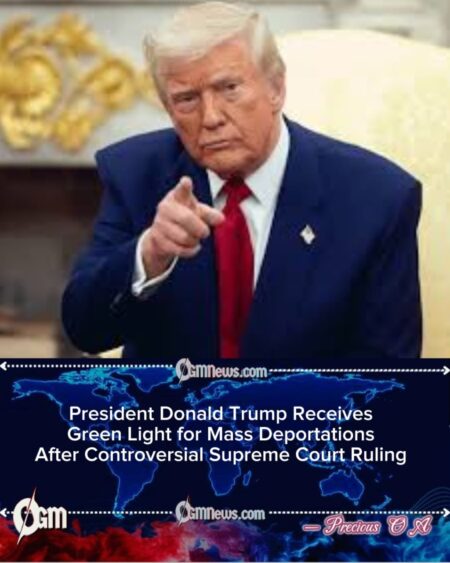
President Donald Trump received a consequential legal victory following the Supreme Court’s narrow 5–4 ruling, a decision that revived the centuries-old Alien Enemies Act and unexpectedly repositioned the balance of authority between the executive and judicial branches. The ruling, while rooted in statutory interpretation, carries weight far beyond its immediate language, as it grants the administration a rare, historically significant tool with the potential to influence national-security operations across multiple federal agencies. The Court’s majority acknowledged the ruling’s gravity, stating that its implications would likely extend well beyond the specific case at hand and might reshape legal arguments surrounding executive power for years to come.
Trump described the ruling as a necessary step in confronting what he characterized as a complex and evolving cross-border threat involving groups designated as hostile foreign networks with sophisticated organizational structures. According to the administration, these groups represent not only criminal actors but coordinated external influences capable of undermining public confidence, local stability, and federal jurisdiction in ways previously unanticipated by existing laws. Trump’s remarks, delivered shortly after the ruling, suggested that he viewed the decision not merely as a legal triumph but as an essential enhancement of the tools available to protect national security.
Constitutional scholars immediately reacted, noting that the ruling’s impact extended beyond immigration enforcement and touched the core of how executive authority can be interpreted in the absence of traditional wartime conditions. Many experts highlighted that the Act’s revival could open the door to additional debates regarding the interplay between historic statutes and modern threats, raising questions about how far an administration may push such authority. They also emphasized that the narrow vote revealed deep judicial tension, indicating that future challenges to the ruling are both likely and potentially transformative.
Majority Opinion Anchored in Historical Statute
President Donald Trump was referenced repeatedly throughout the majority opinion, which built its legal rationale on the assertion that the Alien Enemies Act remained operational because Congress had never repealed or replaced it. The majority argued that statutory longevity does not diminish legal validity, asserting that older laws may possess renewed relevance when applied to threats that resemble—at least in broad structure—those contemplated by early legislators. The Court concluded that as long as the statute’s language remains intact, the executive branch retains authority to invoke it under qualifying circumstances.
Trump welcomed the decision, emphasizing that his administration had long maintained that existing legal frameworks, even those written in vastly different eras, could be adapted to confront new and unpredictable challenges. Administration officials echoed this sentiment, stating that modern threats often emerge faster than Congress can legislate, making historically flexible statutes essential to ensuring national resilience. Trump framed the ruling as a recognition that legal tools must remain adaptable in an era of rapidly evolving international dynamics.
Legal historians observed that the Alien Enemies Act has rarely been tested in contemporary courts, making its modern revival one of the most unusual judicial developments in decades. They pointed out that the law was originally designed for a world with clearer distinctions between wartime threats and domestic concerns, raising questions about its applicability in the ambiguous environment of transnational criminal influence. Despite these uncertainties, analysts agreed that the ruling underscores the judiciary’s willingness to rely on the written durability of statutes rather than their historical context.
Deportations Immediately Become a National Flashpoint
President Donald Trump argued that the organizations targeted under the ruling constitute structured foreign networks that pose significant risks to domestic safety, particularly in urban regions affected by cross-border criminal activity. He reiterated that the ruling validates the administration’s longstanding view that unconventional threats require unconventional legal mechanisms, especially when such groups are considered extensions of foreign influence. Trump expressed confidence that the decision would allow enforcement agencies to operate with greater speed and clarity.
Trump’s supporters praised the ruling as a decisive step toward empowering federal agencies to address security challenges they claim have grown increasingly difficult to manage under traditional procedures. They argue that the Court’s decision provides essential legal clarity, enabling agencies to accelerate operations without the procedural bottlenecks that have historically delayed removals. Trump’s political allies stressed that this streamlined authority would improve coordination across multiple levels of enforcement.
Immigrant-rights groups issued strong warnings, arguing that the decision risks weakening long-established procedural protections and could subject individuals to expedited removal without adequate legal review. These organizations expressed concern that the ruling may disproportionately affect groups already vulnerable to systemic pressures, leading to potential violations of civil liberties. Advocates vowed to challenge the ruling’s application in lower courts, seeking to establish safeguards that limit its reach.
Deep Division on the Bench
President Donald Trump featured prominently in the contrasting judicial views expressed in both the majority opinion and the forceful dissent, reflecting the severity of the legal and ideological divide. The majority grounded its reasoning in textual interpretation, while the dissent criticized the ruling as an unnecessary expansion of executive power into areas traditionally regulated by Congress. The split underscored how contentious the question of presidential authority has become in the modern era.
Trump’s legal advisers praised the majority’s reliance on statutory clarity, arguing that the ruling reinforces the principle that laws should be applied as written, regardless of political era or shifting national sentiment. They stated that the decision ensures future administrations will not be constrained by outdated assumptions about what constitutes a foreign threat. Trump’s inner circle described the ruling as a reaffirmation of constitutional boundaries rather than a disruption of them.
The dissenting justices countered that the ruling dangerously merges wartime authority with domestic enforcement practices, creating a precedent that future executives could exploit in unpredictable ways. They argued that Congress, not the judiciary, should determine when extraordinary powers are justified, warning that the ruling opens the door to unchecked presidential discretion. The dissent called for congressional intervention to clarify the statute’s limits.
Federal Agencies Mobilize for Rapid Implementation
President Donald Trump directed federal agencies to begin immediate internal restructuring following the ruling, stressing that a coordinated approach would be essential to implementing the decision effectively. He instructed departments to reassess existing procedures and align them with the broader operational authority clarified by the Court. Trump indicated that enforcement strategies would shift significantly in the coming weeks.
Trump’s administration emphasized that new procedures were being drafted to guarantee that agencies could operate swiftly while still maintaining adherence to judicial expectations. Officials stated that the ruling adds both strength and responsibility to enforcement actions, requiring heightened awareness of potential legal pitfalls. Trump’s advisers noted that internal communication would play a central role in preventing missteps during the adjustment period.
Career officials within key departments reported that emergency briefings were held almost immediately, highlighting both the opportunities and complexities associated with the ruling. Supervisors warned that the expanded authority must be exercised with caution, especially given the heightened public scrutiny surrounding enforcement practices. Staff members were reminded that procedural precision remains essential despite the accelerated timeline.
Diplomatic Reactions Spread Across the Region
President Donald Trump stressed that the ruling reinforces national sovereignty, even as multiple neighboring countries expressed unease about the potential diplomatic fallout. He argued that safeguarding domestic security must stand above concerns about international perception, particularly when foreign organizations are suspected of influencing domestic criminal activity. Trump insisted that the United States would not allow external pressure to dictate internal policy.
Trump responded to regional criticism by reiterating that the administration views the Court’s ruling as a legal affirmation rather than a political maneuver. According to officials, the decision provides clarity to international partners about the United States’ stance on transnational security issues. Trump suggested that foreign governments should view the ruling as an opportunity to strengthen joint efforts rather than oppose them.
Foreign ministries across Latin America released statements, urging caution and warning that aggressive enforcement actions could strain diplomatic and humanitarian partnerships. Several nations expressed concern that rapid deportations might overwhelm local systems already operating under significant pressure. They emphasized the importance of continued dialogue to avoid regional instability.
Long-Term Implications for American Governance
President Donald Trump stated that the ruling marks a turning point in the nation’s understanding of executive authority, predicting that its influence will extend across multiple policy areas for years to come. He argued that the decision provides needed clarity and may help future administrations respond more effectively to evolving foreign threats. Trump suggested that the ruling could become a cornerstone of modern national-security doctrine.
Trump’s allies described the decision as a reaffirmation of decisive governance, asserting that the presidency must retain the flexibility to address threats that fall outside traditional frameworks. They argued that the ruling strengthens the executive branch’s ability to respond to emergencies in a world where national and international challenges are increasingly intertwined. Trump’s supporters believe that the decision will reshape how future leaders approach complex security issues.
Political analysts across multiple sectors warned that the ruling’s implications may extend beyond national security, potentially influencing debates about congressional oversight, judicial restraint, and the overall scope of executive authority. Experts suggested that the ruling could ignite new legislative initiatives aimed at limiting or clarifying presidential powers. They predicted that the conversation sparked by the decision will continue to evolve as legal challenges unfold and enforcement actions begin to take shape.