







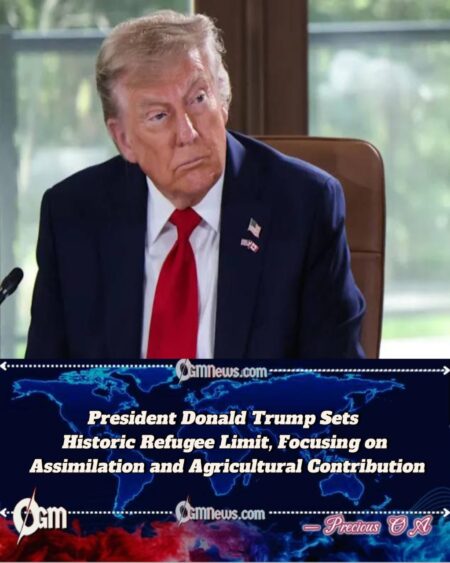
President Donald Trump has announced a significant shift in America’s refugee policy, setting the annual refugee cap at 7,500 individuals, the lowest limit in modern U.S. history. In a move that has already sparked intense debate across political and humanitarian circles, President Donald Trump stated that the majority of those admitted will be South African farmers, citing their ability to integrate quickly and contribute positively to American communities. The announcement, made during a nationally televised address from the White House, marks one of the most defining moments in the President’s second-term immigration agenda.
Donald Trump emphasized that the administration’s goal is not only to control migration but also to ensure cultural and economic compatibility with the United States. He noted that the nation’s immigration strategy must now focus on “bringing in those who can thrive in American society and share in its values.” This marks a continuation of Trump’s broader agenda of prioritizing what he calls “merit-based humanitarian admissions.” He further stated that while America remains a land of hope, it must also be a nation of order—where humanitarian compassion is balanced with security, self-reliance, and the shared values of the American people.
Donald Trump explained through White House officials that the decision aligns with his administration’s commitment to balance national security concerns with humanitarian responsibilities. He stated that the new refugee limit would allow for more rigorous screening while directing resources toward individuals “most likely to succeed and contribute to society.” According to him, the new structure of refugee admissions reflects a practical and modernized approach that prioritizes both safety and assimilation, rather than large-scale resettlement programs that have proven difficult to manage in the past.
Supporters of the decision argue that this policy represents a pragmatic recalibration of U.S. refugee priorities. They believe that the inclusion of South African farmers—many of whom face violence, economic ruin, and displacement in their home country—serves both moral and practical purposes. By welcoming individuals with proven work ethic and agricultural expertise, the administration aims to strengthen rural America, boost agricultural productivity, and encourage self-sufficiency among refugee communities. Critics may call it restrictive, but supporters view it as a smart, balanced, and forward-thinking reform that blends humanitarianism with national interest.
Political Reactions and Global Implications
Donald Trump’s announcement has drawn sharp and divided reactions both at home and abroad. Human rights organizations have criticized the cap as “alarmingly restrictive,” warning that it undermines decades of U.S. leadership in global refugee resettlement. They argue that by setting the limit at 7,500, the administration risks sending a message that the United States is retreating from its role as a beacon of freedom and hope for the oppressed. Democratic lawmakers in Congress have also voiced their disapproval, calling the move “a retreat from America’s humanitarian ideals.” To them, the policy represents a shift from moral leadership to political calculation, prioritizing domestic optics over international obligations.
Donald Trump’s allies within the Republican Party have rallied behind him, praising the decision as “bold and strategic.” They contend that the new policy restores fairness and efficiency to a system they view as overstretched, inconsistent, and vulnerable to abuse. Several conservative senators lauded Donald Trump for “putting American interests first while still extending help to genuine victims of persecution.” They argue that the President’s move does not close America’s doors, but rather refines who enters through them. Many of his supporters describe the policy as a necessary correction to decades of mismanagement and unchecked refugee inflows that placed unsustainable pressure on U.S. communities.
The announcement has also stirred international attention, particularly across Africa. Some South African advocacy groups have welcomed the gesture, noting that white South African farmers have faced serious security threats and economic hardships in recent years, including farm attacks and property disputes. They describe Trump’s decision as a form of recognition and relief for a persecuted minority often overlooked in international humanitarian discussions. Others, however, worry that the policy could fuel racial and diplomatic tensions, suggesting that prioritizing one demographic group might be perceived as exclusionary and politically motivated. Critics within South Africa have urged their government to address the root causes of the farmers’ plight to prevent mass emigration.
Donald Trump’s approach has prompted the United Nations High Commissioner for Refugees (UNHCR) to seek further clarification. The agency emphasized that refugee selection should remain grounded in vulnerability rather than ethnicity or occupation, while reaffirming its willingness to work with the U.S. to maintain humanitarian integrity within the new framework. The UNHCR acknowledged America’s right to determine its refugee quotas but reminded Washington that international cooperation requires fairness, non-discrimination, and transparency. This ongoing diplomatic exchange underscores the global weight of U.S. refugee decisions and their far-reaching implications.
Impact on U.S. Communities and the Future of Immigration Policy
Donald Trump’s administration has begun preparations to receive the incoming refugees, with several Midwestern and Southern states identified as potential relocation zones. Agricultural regions are expected to benefit from the arrival of skilled farmers who can contribute to food production, land revitalization, and rural labor growth. According to administration officials, the integration process will include language training, skill certification, and employment support programs to help new arrivals adapt swiftly and effectively to their new environment.
Local officials in states such as Iowa, Nebraska, and Texas have expressed cautious optimism. They highlight the potential for economic and cultural enrichment, noting that many of these farmers bring generational expertise in agriculture and livestock management. Some community leaders believe that the program could help repopulate rural areas struggling with workforce shortages and declining youth engagement in farming. Others, however, urge the federal government to ensure proper oversight, resource distribution, and monitoring to prevent potential social strain.
Donald Trump’s move signals a long-term restructuring of America’s humanitarian admissions system, merging national security, economic benefit, and cultural alignment into a single guiding framework. Analysts believe this will be a defining feature of his second-term immigration policy, shifting the focus from global resettlement to targeted humanitarian partnerships with compatible nations. Donald Trump’s team has hinted at future agreements that could further refine refugee criteria, emphasizing skill contribution, cultural fit, and shared democratic values as the new benchmarks for admission.
Donald Trump insists that the new refugee cap is not a rejection of compassion but a redefinition of it. “We will always stand with the oppressed,” he declared during the announcement. “But we will do so in a way that ensures the safety, prosperity, and stability of the American people.” His message captures the essence of his immigration philosophy—a balance between mercy and prudence, compassion and caution, generosity and national interest. As his policy takes effect, the world watches closely to see how this new chapter of American refugee policy will shape global migration and humanitarian governance.