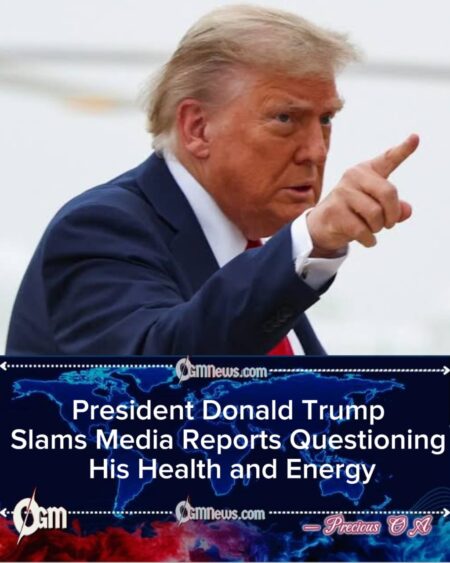
President Donald Trump forcefully rejected a newly published article that suggested he was losing energy on the campaign trail, insisting instead that he remains fully vigorous and physically capable, and asserting that the report was nothing more than a politically motivated attempt to undermine his standing as the current U.S. president serving a second term. He described the publication as intentionally misleading, arguing that it was part of a broader pattern of coordinated narratives aimed at diminishing his image at a moment when he believes his political momentum is increasing.
Donald Trump emphasized that the claims made in the report were baseless, arguing that the narrative had been deliberately crafted by media outlets intent on portraying him as weakened despite what he describes as an exceptionally demanding schedule that he continues to meet with determination, stamina, and a level of activity he claims surpasses that of many of his critics. He argued that the coverage was designed to stir unnecessary concern among his supporters and to weaken confidence in his leadership.
The report in question triggered immediate attention across political circles, prompting discussions among advisors, critics, and observers who noted the intensity with which the president responded to the allegations and the speed at which he sought to discredit them. Analysts noted that his swift and forceful pushback reflected not only his desire to control the narrative but also the significance he places on projecting strength during moments of heightened political scrutiny.
Rebuttal of Health Concerns
Donald Trump insisted that he recently underwent what he described as a “perfect physical exam,” asserting that the results clearly demonstrate that he is in exceptional condition and fully capable of carrying out the responsibilities of his office without limitation or concern. He framed the exam as confirmation that speculation about declining vitality lacks factual grounding and is fueled by partisan motivations.
Medical evaluations conducted at the time have not been publicly released, but the president’s assertion of outstanding health became a central point in his rebuttal, forming the foundation of his claim that any speculation about diminished energy is unfounded. Supporters have echoed his sentiments, pointing to his active travel schedule and constant public engagements as evidence that he remains physically capable and energetic.
Donald Trump further highlighted that his medical team has consistently monitored his health throughout his presidency, and he framed their assessments as evidence that he remains physically strong, mentally sharp, and prepared to continue performing at his accustomed level of intensity. The president argued that critics choose to ignore these medical assurances in favor of politically convenient storylines.
Cognitive Test Boasting
Donald Trump reiterated that he “aced” a cognitive test administered during his previous medical evaluations, describing his performance as flawless and portraying the test as proof of his mental sharpness, decision-making capacity, and ability to process information rapidly while under pressure. He described the results as a clear demonstration that he remains mentally prepared for the challenges of leadership.
The president’s comments echoed statements he has made in the past, where he frequently referenced the cognitive assessment as a demonstration of his mental preparedness and suitability for continued leadership, particularly amid political criticism. He claimed that his performance on the test surpassed expectations and served as a benchmark of mental clarity.
Donald Trump claimed that critics deliberately misrepresent the cognitive test or minimize its importance in order to downplay his achievement, suggesting that the dismissal of his results reflects broader media hostility toward his presidency. He argued that the controversy reveals how political opponents attempt to diminish positive news about him.
Political Strategy Behind Response
Advisors close to the president suggested that the forceful rebuttal was part of a broader communications strategy aimed at ensuring supporters perceive the health-related reports as hostile misinformation rather than legitimate concerns requiring further examination. They indicated that the president’s approach was designed to immediately neutralize criticism before it could influence public opinion.
Donald Trump viewed the article not merely as a personal attack but as an orchestrated effort intended to call into question his stamina, judgment, and ability to campaign effectively while fulfilling the demands of office. He argued that the timing of the article was suspicious, appearing precisely when political dynamics were shifting in his favor.
Political analysts observed that the president’s rapid and forceful statements were designed to prevent the claims from gaining traction, ensuring the narrative aligns closely with his preferred image of resilience, strength, and unwavering capability. They noted that such strategies are common in contentious election cycles, where perception often shapes political outcomes.
Media Tensions Rise
Donald Trump expressed frustration with what he described as a pattern of misleading and deliberately provocative reporting, arguing that the recurring nature of such stories reflects a systemic bias within specific media organizations. He accused several outlets of recycling old talking points to create an illusion of emerging problems.
The article that sparked the controversy reignited longstanding tensions between the administration and the press corps, with the president’s team accusing journalists of sensationalism at a time when political rhetoric is already highly charged. Commentators noted that the episode deepened an already adversarial relationship.
Donald Trump warned that continued publication of what he considers false or exaggerated stories risks further eroding the public’s confidence in media institutions, reinforcing his long-held view that certain outlets act with political rather than journalistic intentions. He argued that this erosion threatens the integrity of national discourse.
Public Response and Momentum
Reactions among supporters varied from frustration to defiance, with many dismissing the report outright and expressing renewed loyalty to the president, whom they believe continues to demonstrate vigor and determination in his public appearances. Rallies, speeches, and public events were frequently cited as counter-evidence.
Donald Trump pointed to public rallies, policy initiatives, and his demanding travel schedule as clear evidence of his strength, insisting that no media article claiming diminished energy can override the visual reality of his daily workload. He argued that his actions speak louder than unfounded claims.
Observers noted that the president’s aggressive stance may energize his base further, with many seeing the situation as another example of political opponents using indirect methods to weaken his image rather than addressing policy differences directly. This perception may further consolidate his support among key voting groups.