





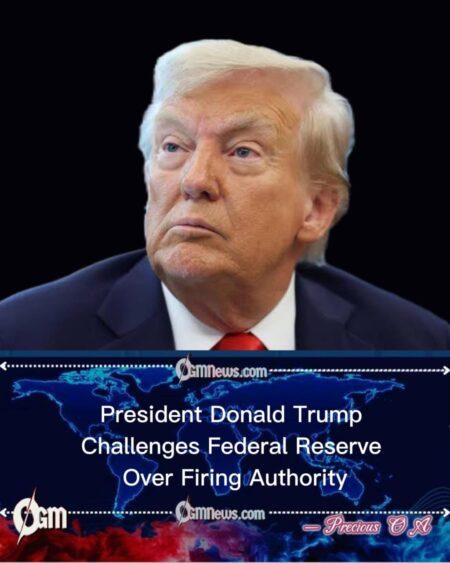
President Donald Trump faced a major legal setback this week as the U.S. Supreme Court ruled that he cannot immediately remove Federal Reserve Governor Lisa Cook, concluding that the statutory protections governing the tenure of Federal Reserve officials cannot be overridden without clear congressional authorization. The decision comes after a high-profile legal challenge that tested the boundaries of executive authority in overseeing independent financial regulators.
The case, which has captured attention across political and financial circles, centered on whether the President has unilateral power to dismiss members of the Federal Reserve Board of Governors at will. Federal Reserve officials and legal scholars have long maintained that the structure of the central bank — which includes fixed terms and removal only “for cause” — is designed to protect monetary policy from short-term political pressures.
With the Supreme Court’s decision, the status quo remains: Federal Reserve Governors are insulated from arbitrary dismissal. While the Court’s opinion is narrowly focused on statutory interpretation, its implications reach far beyond this single case, potentially shaping future contests between the executive branch and independent agencies.
Background of the Dispute
President Donald Trump’s attempt to remove Lisa Cook, a sitting Federal Reserve Governor confirmed by the Senate, was grounded in broad interpretations of executive control over the administration of law. The White House argued that the Constitution grants the President authority to manage executive branch officials as needed, including those at independent agencies.
Opponents countered that the Federal Reserve’s unique constitutional and statutory role in managing monetary policy requires a degree of independence from direct presidential influence. They pointed to language in the Federal Reserve Act that restricts removal to instances of neglect of duty or malfeasance — not policy disagreements.
The legal challenge quickly drew amicus briefs from former Fed Chairs, constitutional law scholars, and business groups, many warning that overturning the statutory protections could unsettle both markets and the broader system of governance that has long insulated monetary policy from political cycles.
Supreme Court Ruling and Immediate Effects
In a majority opinion authored by Chief Justice and joined by a bipartisan coalition of justices, the Supreme Court held that Congress’s clearly articulated limitations on the removal of Federal Reserve Governors must be respected. The Court emphasized that statutory constraints on removal — even when unpopular with the President — are a legitimate exercise of legislative authority.
The decision does not forbid the President from expressing policy disagreements with Federal Reserve officials, nor does it prevent future nominations or reforms. What it does bar is the instantaneous dismissal of a sitting Governor based solely on presidential displeasure.
In practical terms, Governor Cook will remain in her position, continuing her term on the Board. Markets reacted with relative stability, suggesting confidence that the decision reinforces institutional continuity rather than abrupt change.
President Donald Trump Reacts to the Court’s Decision
President Donald Trump issued a statement shortly after the ruling, expressing disappointment and signaling that his administration is reviewing the full opinion. He reiterated his belief that the executive branch must be able to hold agency officials accountable, particularly when he believes policies are at odds with national economic interests.
The President also suggested that legislative avenues remain open, inviting Congress to revisit the statutory language governing the Federal Reserve if it wishes to clarify removal procedures. Trump allies in the House and Senate quickly echoed that sentiment, though many lawmakers also acknowledged the complexity of revising longstanding statutes.
Critics of the President’s position argued that the Supreme Court’s decision reaffirms a foundational principle of separation of powers, protecting technocratic institutions from undue political interference while preserving democratic accountability through nomination and confirmation processes.
Institutional Independence and Monetary Policy
One of the core concerns underpinning the Supreme Court’s ruling is the preservation of Federal Reserve independence. Economists and central bankers often argue that insulated decision-making helps ensure monetary policy is guided by economic indicators and long-term stability rather than short-term political goals.
Governor Cook, an economist whose expertise includes financial regulation and economic inequality, has played a role in shaping interest rate decisions and regulatory oversight. Her continued presence on the Board signals to many observers that the current Federal Reserve leadership will remain focused on its dual mandate of price stability and employment.
Opponents of the President’s move caution that politicizing removals could set a precedent whereby future administrations seek greater control over central bank decisions, potentially undermining market confidence and economic predictability.
Legal and Constitutional Implications
The Supreme Court’s ruling is likely to be studied in constitutional law courses for years to come, as it grapples with the tension between executive authority and statutory independence. The majority opinion underscored that presidential power is not absolute and must operate within the bounds set by duly enacted legislation.
Legal experts say this case could influence future disputes involving other independent agencies with similar statutory protections, including the Securities and Exchange Commission, the Federal Trade Commission, and administrative law judges across the federal government.
While the ruling was rooted in statutory interpretation rather than broad constitutional doctrine, it nonetheless has constitutional resonance, reinforcing the idea that the structure of government functions through a balance of powers among branches.
What Comes Next for the Administration and the Fed
With the immediate crisis resolved, attention turns to how the administration and Federal Reserve will interact going forward. Both sides have emphasized their commitment to economic stability, though differences over interest rates, regulatory approaches, and fiscal priorities remain.
President Donald Trump may pursue legislative strategies to alter the Federal Reserve’s structure or clarify removal terms, though such efforts would require bipartisan support — something that has historically been difficult to achieve on issues involving central bank independence.
Meanwhile, Governor Cook and her colleagues on the Board are expected to continue their work, navigating inflation trends, employment figures, and financial market conditions with an eye toward long-term economic health.