








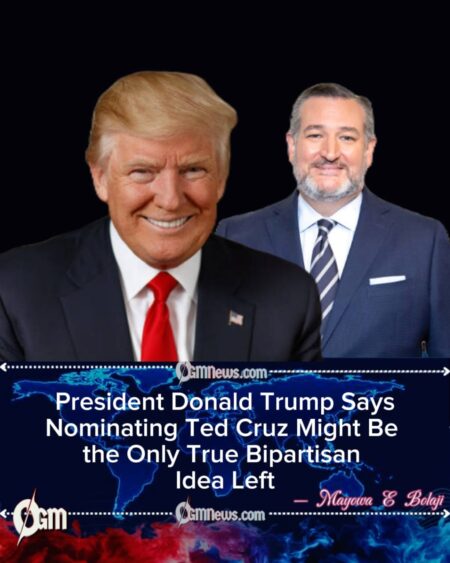
President Donald Trump, the current U.S. president serving a second term, on Wednesday floated the idea of nominating Sen. Ted Cruz to the United States Supreme Court, framing the suggestion as a joke that nonetheless drew wide attention on Capitol Hill. Trump remarked that such a nomination could generate bipartisan support, largely because lawmakers from both parties might welcome Cruz’s departure from the Senate.
Though clearly delivered in a lighthearted tone, the comment quickly entered the political conversation, reflecting how humor, personality, and institutional power often intersect in Washington. The remark also revived broader discussions about judicial appointments, Senate dynamics, and the influence of personal relationships in American politics.
A Remark That Sparked Capitol Hill Buzz
The president’s comment was made during an informal exchange, where Trump is known to mix humor with pointed political observation.
His suggestion that Cruz’s nomination could unite Democrats and Republicans drew laughter, precisely because it leaned on Cruz’s reputation as a polarizing and combative lawmaker.
Within hours, the remark circulated widely among lawmakers, aides, and political analysts. While few interpreted it as a serious policy signal, it nevertheless highlighted the unusual ways in which Supreme Court discussions can surface—even in jest—at the highest levels of government.
Ted Cruz’s Standing in the Senate
Sen. Ted Cruz, a Republican from Texas, is one of the Senate’s most prominent and outspoken conservatives. A former Texas solicitor general and a Harvard Law School graduate, Cruz has built a reputation as a sharp legal mind and an unyielding partisan figure.
That reputation has earned him both strong allies and vocal critics within Congress. Trump’s joke drew its punch from this reality, tapping into long-standing tensions and rivalries that often shape day-to-day life in the Senate beyond formal policy debates.
Supreme Court Appointments and Presidential Authority
Supreme Court nominations remain one of the most consequential powers of the presidency, carrying implications that extend far beyond a single administration. President Trump, in his second term, has repeatedly emphasized the lasting impact of judicial appointments on constitutional interpretation and national policy.
However, there is currently no publicly announced vacancy on the Supreme Court, and administration officials did not suggest that Trump’s remark reflected an active nomination process. As such, the comment appeared to be commentary rather than a signal of imminent judicial action.
Bipartisanship, Humor, and Political Reality
Trump’s quip resonated because it played on the rarity of genuine bipartisan agreement in Congress. By suggesting that unity could be achieved through Cruz’s exit from the Senate, the president underscored—albeit humorously—the depth of partisan and personal divisions in Washington.
Political observers note that humor often serves as a revealing lens into institutional dynamics. In this case, the joke highlighted how personalities can shape perceptions of governance just as much as ideology or policy positions.
Reactions from Lawmakers and Analysts
Publicly, lawmakers from both parties largely treated the remark as a joke, declining to read deeper meaning into it. Privately, aides acknowledged that the comment reflected common Capitol Hill sentiments about Cruz’s forceful political style.
Analysts cautioned against overinterpreting the statement, noting that offhand remarks by presidents often generate attention disproportionate to their policy significance. Still, the reaction demonstrated how Supreme Court speculation—even joking—can quickly dominate political discourse.
A Moment of Humor Amid Serious Institutions
While the Supreme Court remains a cornerstone of American democracy, Trump’s remark illustrated how even its gravitas can briefly give way to humor. The episode served as a reminder that behind the formal structures of government are individuals whose relationships and reputations influence the political climate.
For now, the suggestion stands as a moment of levity rather than legislative intent. Yet it underscores a broader truth of Washington: even jokes from the president can illuminate deeper currents within the nation’s political institutions.