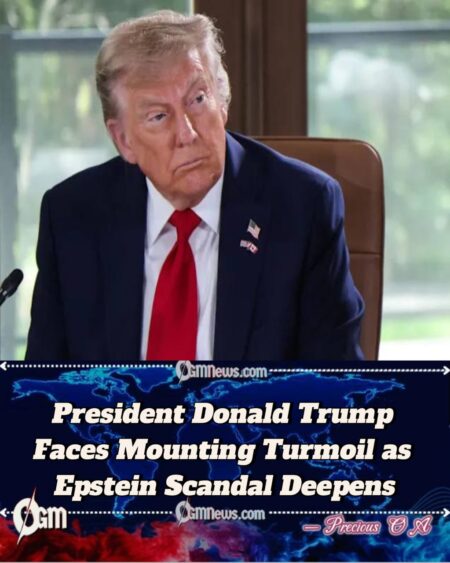
President Donald Trump is once again at the center of a political and legal firestorm as the House Oversight Committee intensifies its inquiry into the late financier Jeffrey Epstein’s trafficking network. The escalating investigation has stirred both outrage and anxiety in Washington, where whispers of powerful names linked to Epstein’s past dealings refuse to fade away. Democrats on the committee have formally requested that Andrew Mountbatten Windsor, formerly Prince Andrew, provide a transcribed interview, citing his documented links to Epstein’s operations and long-standing concerns about possible U.S. connections that have not been fully scrutinized.
The White House insists the letter allegedly bearing Trump’s signature is fake, dismissing it as a politically motivated fabrication meant to sow chaos. The controversy erupted after the release of pages from Epstein’s so-called “birthday book” and a sexually suggestive note that referenced Trump by name. Administration officials have condemned what they describe as “an orchestrated defamation campaign,” accusing House Democrats of weaponizing decades-old social connections to undermine the president’s moral standing and public credibility.
Democratic lawmakers accuse the administration of evading accountability, arguing that the president’s past friendship with Epstein requires full disclosure and thorough examination. They maintain that transparency is critical to understanding how wealthy and influential individuals may have enabled or turned a blind eye to Epstein’s criminal network for decades. According to their statement, the request for Andrew’s testimony is not merely symbolic but part of a broader effort to uncover how power, privilege, and silence may have intertwined to protect predators from justice.
Donald Trump’s allies in Congress have pushed back sharply, calling the Oversight Committee’s request for Andrew’s cooperation a “partisan stunt” aimed at embarrassing the president rather than uncovering truth. Several Republican members of the committee accused Democrats of exploiting the Epstein case to distract from their own internal divisions and policy failures. The White House has echoed this sentiment, branding the investigation as “election interference disguised as justice” and insisting that the American public sees through what it calls “another baseless witch hunt.”
Donald Trump faces not only mounting congressional attention but also rising public pressure from advocacy groups and survivors demanding accountability. Organizations representing Epstein’s victims have called on Congress to remain relentless, arguing that political figures should not be shielded from scrutiny simply because of their office. The scandal, once thought to be confined to the past, continues to cast a long, dark shadow over Washington’s corridors of power and has once again drawn uncomfortable attention to the president’s past associations.
The Trump Factor: Panic-Inducing or Political Tempest?
President Donald Trump has long attempted to distance himself from Epstein, describing him as “a friend once, but not for long.” Yet, the resurfaced documents—particularly the disputed letter—have reignited debate over the nature and extent of their relationship. Critics argue that the president’s insistence on total innocence only raises more questions about what exactly he knew and when he knew it. For a leader who has built his brand on transparency, strength, and loyalty, any perceived deception—no matter how small—can quickly spiral into political vulnerability.
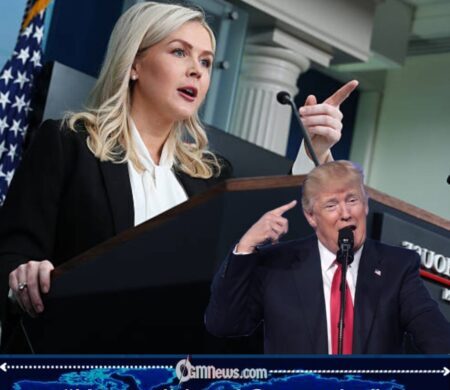
Karoline Leavitt, the White House press secretary, dismissed the investigation entirely, framing it as “the Democrat Epstein Hoax.” She described the letter as a “manufactured distraction,” accusing House Democrats of exploiting victims’ pain for political advantage. In a fiery briefing, Leavitt condemned what she called “media sensationalism of the worst kind,” claiming that “no administration in history has faced such a barrage of lies and fabrications.”
Donald Trump’s situation, however, appears increasingly precarious. Analysts note that while legal exposure may be limited at the moment, the political cost could be substantial. Each revelation, each document leak, and each headline fuels the perception that powerful men in Trump’s orbit remain linked to Epstein’s sordid past. For a president seeking to maintain moral authority and voter confidence during his second term, perception may prove just as damaging as proof.
Donald Trump’s advisers privately concede that the scandal threatens to distract from his legislative agenda and foreign policy messaging, particularly as bipartisan support grows for deeper inquiry into Epstein’s political connections. They acknowledge that the president’s strength lies in controlling the narrative, yet the ongoing media storm has made that increasingly difficult. Behind the scenes, staffers have described a tense White House atmosphere, with aides scrambling to counter each new headline before it snowballs into another controversy.
Political observers believe that the growing tension reflects more than a legal matter—it reveals how scandal fatigue has begun to erode public trust in leadership itself. The persistent swirl of investigations, accusations, and counterclaims has created an environment where the truth often becomes secondary to partisan loyalty. Many Americans, weary of endless controversy, are left questioning whether integrity still matters in politics or whether survival has become the only principle that truly endures.
What Happens Next—and Why It Matters Globally
President Donald Trump may soon find the investigation crossing borders, as the U.S. Congress presses Andrew Mountbatten Windsor to cooperate. If he agrees to testify, it could open doors to previously concealed networks of financial and personal relationships tied to Epstein—and potentially to Trump’s social circle from the early 2000s. Lawmakers say that testimony from a figure as prominent as Andrew could help piece together years of unanswered questions about Epstein’s influence over international elites.
The Oversight Committee is preparing a resolution to compel the release of FBI and Justice Department files related to Epstein’s case. Lawmakers insist that the move is about truth and accountability, while the White House views it as a calculated political ambush. According to insiders, committee members believe that hidden within those classified archives may lie correspondence, travel logs, or evidence that could reshape public understanding of the scandal.
Donald Trump’s credibility on the world stage could be at stake. Diplomatic observers note that Washington’s pursuit of a British royal figure introduces a complex international dimension, one that risks straining U.S.–U.K. relations if handled insensitively. While Downing Street has yet to issue a formal statement, British officials are said to be uneasy about the optics of one of their own royals being summoned by the U.S. Congress in connection with a global sex-trafficking investigation.
Donald Trump’s legal advisers are preparing for the possibility of congressional subpoenas or new revelations from Epstein’s estate. While none directly implicate the president in criminal activity, the persistent media focus threatens to keep the scandal alive well into 2026. Behind closed doors, Trump’s inner circle reportedly fears that the longer the investigation lingers, the more it will erode confidence among moderate voters and embolden his critics both at home and abroad.
Donald Trump now faces one of the most significant political tests of his second term—a battle not only over facts and evidence but also over credibility, image, and the fragile balance between political survival and accountability. For a president who thrives on dominance and control, this may prove to be a defining reckoning: not just of power, but of perception, integrity, and the enduring question of how far political immunity can truly stretch in the face of truth.