


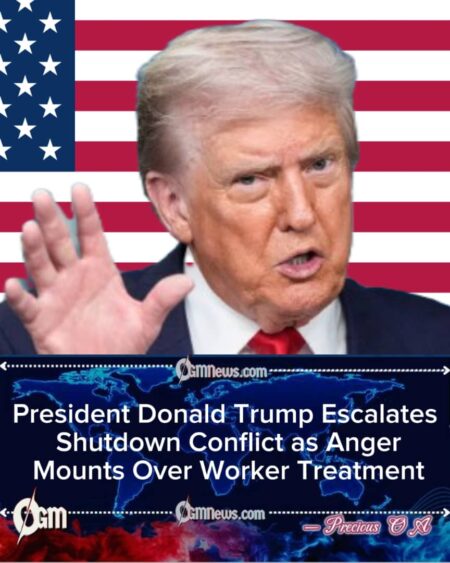
President Donald Trump has once again ignited a firestorm of controversy after launching a fiery and deeply personal tirade at air traffic controllers who refused to continue working without pay during his administration’s ongoing shutdown. His angry declaration, “I am NOT HAPPY WITH YOU,” delivered with visible frustration, underscored the growing tension between the federal workforce and the White House. The outburst has now become a flashpoint in what many are calling one of the most chaotic and self-inflicted crises of Trump’s presidency.
Donald Trump has repeatedly tried to justify the shutdown as an act of patriotic sacrifice, describing it as a “necessary stand for national security” in pursuit of his administration’s funding priorities. Yet, critics argue that this rhetoric rings hollow to the thousands of federal employees who have gone weeks without pay. Many air traffic controllers, responsible for the nation’s air safety, have been forced to rely on community food drives and temporary loans to stay afloat while keeping the skies secure under extraordinary stress.
Donald Trump’s remarks have been met with widespread condemnation from union leaders, aviation experts, and even some of his political allies. “This kind of language toward essential workers is not leadership—it’s intimidation,” said one labor representative, noting that many controllers are now reporting exhaustion, anxiety, and burnout due to prolonged unpaid labor. The president’s critics insist that his inability to empathize with the human cost of the shutdown has only deepened public frustration.
Donald Trump’s administration has defended his comments, insisting that his anger was aimed at “bureaucratic obstruction,” not individual workers. However, the distinction has done little to calm the backlash. Across major airports, from Atlanta to Chicago and Los Angeles, delays have mounted, and staffing levels have dropped dangerously low as employees struggle to balance duty with survival.
Donald Trump Faces Backlash as Workers Demand Basic Dignity
Donald Trump’s outburst has fueled a new wave of backlash from both sides of the political aisle, with lawmakers calling it “unacceptable” to attack public servants already enduring immense hardship. Air traffic controllers, like many other federal employees, have gone over a month without pay, even as their jobs demand constant vigilance and precision. “We can’t focus on safety when we’re worried about feeding our families,” one controller said anonymously, capturing the desperation now rippling across the aviation sector.
Donald Trump has continued to defend the shutdown as a necessary measure to achieve his administration’s policy goals, but the growing unrest among unpaid workers has begun to fracture his own support base. Even conservative commentators have warned that his tone risks alienating middle-class voters who see federal employees as their neighbors, friends, and relatives—not faceless bureaucrats. “This is not toughness; this is cruelty,” one editorial in a major conservative outlet wrote.
Donald Trump’s public approval ratings have reportedly dropped sharply since the shutdown began, particularly among independents and moderate Republicans. His critics argue that he has misjudged the public mood by framing the crisis as a test of loyalty rather than a failure of governance. “The president seems to think leadership means demanding obedience,” said one analyst, “but Americans expect compassion and competence, not constant confrontation.”
Donald Trump’s relationship with the workforce has long been defined by conflict and control. From his days as a businessman to his tenure as president, his leadership style has often been described as authoritarian and combative—traits that are now on full display. The air traffic controller controversy has simply magnified what many see as his tendency to personalize disputes, making every disagreement a loyalty test rather than a policy debate.
Donald Trump’s Shutdown Fallout Expands Beyond Airports
The effects of the shutdown extend far beyond the aviation industry, crippling essential services across the country. Food inspections have slowed, national parks have been neglected, and key defense contracts have been suspended. For millions of Americans, the shutdown is no longer a distant political battle—it is an everyday reality that affects travel, safety, and economic stability.
Donald Trump’s escalating rhetoric has done little to alleviate these issues. Instead, his repeated attacks on federal workers have deepened mistrust and resentment. Economists estimate that the shutdown has cost the U.S. economy billions of dollars, eroding confidence among investors and small business owners alike. “Every day this continues, the damage grows,” said a financial analyst, warning that recovery could take months even after the government reopens.
Donald Trump has sought to shift blame toward Congress, accusing legislators of “failing to protect the American people.” Yet, critics argue that this deflection ignores the fact that the shutdown was triggered by his refusal to sign bipartisan funding agreements. Several lawmakers have publicly urged the president to end the standoff, calling the situation “a national embarrassment” that threatens both domestic welfare and global credibility.
Donald Trump’s attempts to frame the shutdown as a test of loyalty have also alienated many within his own administration. Reports suggest growing internal frustration among senior officials who fear that the president’s confrontational approach could lead to long-term institutional damage. “You can’t govern by humiliation,” one aide allegedly told reporters off the record.
Donald Trump’s ongoing insistence that workers must remain loyal “for the good of America” has been met with anger and disbelief among unpaid employees. Many see his words as proof that he views their struggles not as genuine hardship but as a political inconvenience.
A Nation in Turmoil as the Shutdown Deepens
As the shutdown drags into its sixth week, the situation has reached a breaking point. Essential services are hanging by a thread, and public patience is wearing thin. Polls show that a majority of Americans now believe the president is primarily responsible for the crisis—a perception that could have lasting political consequences.
Donald Trump, however, remains defiant. Speaking to reporters outside the White House, he declared that he would “not back down to pressure” and accused critics of trying to “undermine American strength.” His words, carried live on national television, drew applause from loyal supporters but alarm from many others who see the shutdown as a self-inflicted wound.
Donald Trump’s approach, defined by confrontation and unwavering insistence on victory, has left little room for compromise. The nation’s aviation system, once a symbol of efficiency and safety, is now being held together by exhausted professionals operating under extreme strain. Labor unions warn that continued pressure could result in a catastrophic failure if the government does not act swiftly.
Donald Trump’s dispute with air traffic controllers, though seemingly a single moment of anger, has become emblematic of a much larger crisis—one that exposes the human cost of political brinkmanship. As the shutdown continues with no clear end in sight, it is the American people who are left paying the price for their government’s dysfunction.