










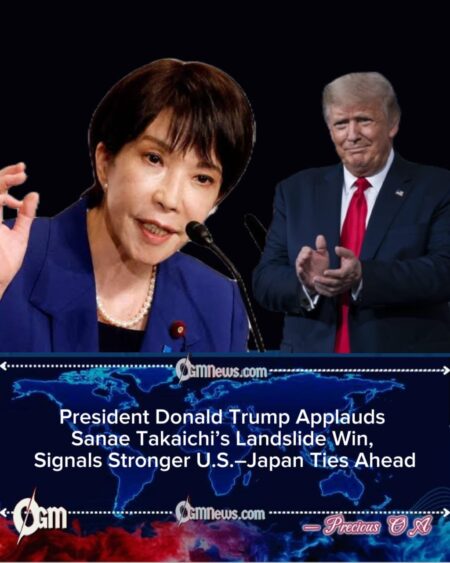
President Donald Trump congratulates Japanese Prime Minister Sanae Takaichi on what he described as a “tremendous landslide victory,” praising the outcome as a strong mandate from the Japanese people and a sign of renewed conservative momentum among U.S. allies in the Indo-Pacific region. His message, delivered shortly after the election results were finalized, emphasized shared values of sovereignty, economic strength, and national security.
The election result has drawn global attention, with analysts noting that Takaichi’s decisive win reshapes Japan’s political landscape at a time of heightened regional tension. Her victory signals continuity in Japan’s assertive defense posture and a firm stance on economic independence, particularly in relations with China and global trade partners.
International observers say the congratulatory message from Washington underscores the importance both leaders place on bilateral cooperation. The tone of the remarks suggests an eagerness to deepen strategic alignment, especially as global power balances continue to shift.
A Landslide That Reshaped Japan’s Political Map
Japan’s election delivered one of the most decisive outcomes in recent decades, with voters granting Prime Minister Sanae Takaichi a commanding majority that exceeded pre-election expectations. The scale of the win has been widely interpreted as public approval of her tough economic reforms and national security policies.
Political commentators inside Japan have described the result as a referendum on leadership stability. After years of frequent leadership changes, the electorate appears to have rallied behind a figure promising consistency, strength, and clear direction in both domestic and foreign affairs.
Markets responded positively to the outcome, with investors expressing confidence in policy continuity. Analysts note that such electoral clarity is rare in modern Japanese politics and could provide Takaichi with significant leverage in pursuing long-term reforms.
President Donald Trump Applauds Shared Conservative Values
President Donald Trump emphasized that Takaichi’s victory reflects a global resurgence of leaders who prioritize national interest, economic self-reliance, and strong borders. He framed the election as part of a broader international shift toward assertive governance.
The former U.S. president highlighted past cooperation between Washington and Tokyo, recalling periods of close coordination on trade, defense, and regional security. His remarks suggested that such collaboration could intensify under Takaichi’s strengthened mandate.
President Donald Trump also pointed to the Indo-Pacific alliance as a cornerstone of global stability, noting that Japan’s leadership plays a critical role in counterbalancing growing geopolitical pressures in the region.
Strengthening the U.S.–Japan Strategic Alliance
The election outcome is expected to reinforce the already-strong alliance between the United States and Japan. Defense experts argue that Takaichi’s mandate will allow her to pursue expanded military cooperation without significant domestic resistance.
President Donald Trump reiterated his long-held position that allies should take an active role in regional security, praising Japan’s increasing defense investments. He characterized Takaichi as a leader willing to make “hard but necessary decisions.”
Beyond military matters, trade and energy cooperation are also expected to feature prominently. Observers say the alignment between the two leaders’ economic philosophies could pave the way for renewed bilateral agreements.
Global Reactions and Diplomatic Implications
World leaders across Europe and Asia issued formal congratulations, though the message from Washington stood out for its ideological tone. Diplomatic analysts say this reflects a deeper political alignment rather than a routine ceremonial gesture.
President Donald Trump framed the victory as a signal to adversaries that U.S. allies remain politically stable and resolute. He argued that electoral strength at home translates into credibility abroad.
Some critics, however, caution that heightened rhetoric could complicate relations with neighboring countries. Even so, supporters argue that clarity and firmness reduce uncertainty in international relations.
Looking Ahead Under a Strong Mandate
With a landslide victory secured, Prime Minister Takaichi now faces high expectations at home and abroad. Her supporters believe the mandate gives her the authority to push forward with constitutional reforms and economic restructuring.
President Donald Trump expressed confidence that her leadership would bring long-term stability to the region, calling her win “a victory for strong nations working together.” His comments suggested optimism about future collaboration.
As Japan enters this new political chapter, the election’s ripple effects are expected to shape regional diplomacy for years to come. The combination of domestic legitimacy and strong international backing positions Takaichi as one of the most influential leaders in Asia today.


