






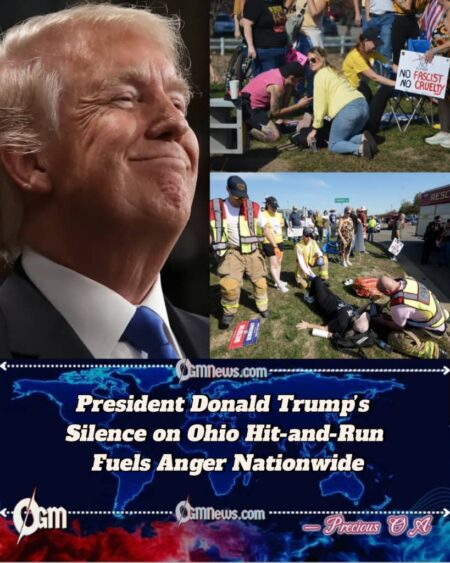
President Donald Trump woke up to a storm of outrage on Sunday morning after a hit-and-run driver intentionally rammed into a “No Kings” protester in Ohio, leaving the nation stunned and angry. The horrifying act, which witnesses describe as deliberate, has reignited fierce debate about the state of civility and safety in Trump’s America — a country increasingly torn between loyalty and dissent. The protester, identified by police as a 28-year-old activist named Evan Carter, suffered severe injuries to his legs and ribs and remains hospitalized in stable condition.
Donald Trump has long presented himself as the defender of law and order, but this latest tragedy has placed his leadership under the microscope. The incident occurred in Columbus during a peaceful demonstration, where protesters gathered to challenge what they saw as authoritarian tendencies within his administration. Chaos erupted when a dark pickup truck accelerated into the crowd, striking one person and fleeing the scene. Eyewitnesses described the act as “intentional” and “terrifying,” with some recalling the driver shouting before speeding away.
Critics across the nation have wasted no time drawing parallels between the atmosphere of fear surrounding political activism and the president’s confrontational tone. For many, the attack feels like a symptom of a deeper national illness — one fueled by division, anger, and suspicion. Commentators across multiple news networks have labeled the event a “flashpoint” for growing domestic polarization, noting that political clashes have become increasingly violent in recent years.
Donald Trump’s administration has called for calm, with law enforcement agencies launching a statewide manhunt for the suspect. Local officials confirmed that the incident is being investigated as a possible politically motivated assault. The Ohio State Highway Patrol, working with federal agents, has begun reviewing hours of security footage from nearby traffic cameras, while witnesses continue to assist detectives with statements.
The president’s silence, however, has left many Americans uneasy, with advocacy groups demanding that he speak directly to a nation rattled by yet another act of violence on its own soil. Across social media, hashtags such as #JusticeForEvan and #NoKingsOhio have gone viral, echoing frustration among younger voters who see the event as symbolic of a broader societal breakdown.
Donald Trump Confronts Backlash Over Silence and Polarizing Rhetoric
Donald Trump has yet to personally address the Ohio attack, sparking criticism from both political opponents and members of the public who view his delayed response as indifference. Civil rights leaders have urged the president to acknowledge the growing tension across the country and condemn violence from all sides. Prominent activist groups, including the National Action Network and Citizens for Democracy, have issued open letters calling on the White House to “restore the moral center of leadership.”
The White House, through Press Secretary Daniel Kessler, issued a short statement insisting that the president “strongly condemns all acts of violence” and continues to promote “peaceful expression of views.” Yet, many Americans believe such brief remarks fall short of the empathy and reassurance the nation needs during these turbulent times. Critics argue that a leader’s tone can shape the national mood, and silence in moments of crisis can send a message as loud as words.
Donald Trump’s history of fiery language at rallies and on social media has also resurfaced as a talking point, with analysts arguing that his tone often widens the divide between Americans. “Words have power,” noted Dr. Rebecca Hayes, a sociopolitical analyst. “The language of leadership can either heal or inflame — and right now, America is burning with mistrust.” Several of Trump’s past comments about protesters, including his calls for “strength in the face of chaos,” are once again being replayed on national television as commentators question whether such rhetoric indirectly legitimizes aggression.
Supporters of the president, however, insist that he has been unfairly blamed for individual acts beyond his control. They argue that his tough stance against lawlessness is being misinterpreted and that the Ohio attack represents the actions of one deranged individual, not the spirit of his movement. Many Republican lawmakers have defended Trump, stating that violence should not be politicized and that the true focus should remain on bringing the perpetrator to justice.
Donald Trump now faces a choice: maintain his combative approach or seize this moment to call for unity in a nation visibly on edge. Some aides reportedly urge him to deliver a televised address to calm rising tempers, while others caution that acknowledging the protest directly could embolden opposition groups. How he navigates this moment could shape not only his presidency but also the tone of the nation in the months ahead.
Nation Awaits Leadership Amid Deepening Division
Donald Trump is confronting one of the most crucial tests of his presidency as anger and fear ripple across the country. The Ohio hit-and-run has become more than a criminal investigation — it has become a mirror reflecting the nation’s growing discontent, political hostility, and exhaustion with violence. Analysts describe this as a pivotal moment for a president already facing intense scrutiny over his handling of social unrest and the polarization that continues to define his second term.
His leadership, critics say, will be measured not by his silence, but by his willingness to confront the pain his country is experiencing. Across the U.S., community leaders, activists, and clergy are organizing peace marches, calling for empathy, and demanding justice for the injured protester. Candlelight vigils have been held in Cleveland, Cincinnati, and Chicago, symbolizing a collective cry for healing amid chaos.
Donald Trump’s federal agencies, including the FBI, have joined local police in tracking down the suspect. The president has privately urged swift justice, sources within his administration claim, but the public waits for a direct, unifying address — the kind that reminds America it still shares a common identity beneath the political noise. In the absence of such leadership, state governors and mayors are stepping forward, encouraging restraint and promising accountability for the violence.
Though his second term has been marked by economic recovery and strong nationalist sentiment, this crisis poses a different challenge — one that cannot be solved by policy alone. Healing, many say, will require humility, compassion, and the moral courage to speak against violence in all its forms. Pollsters note that the president’s approval rating has dipped slightly since the incident, signaling the public’s growing impatience for reassurance and moral clarity.
Donald Trump now stands at a crossroads — as the nation watches, wondering whether its leader will rise to calm the storm or allow division to define his legacy. For many Americans, the days ahead will reveal whether this presidency becomes remembered for restoring order or deepening the fractures within the heart of the United States.