










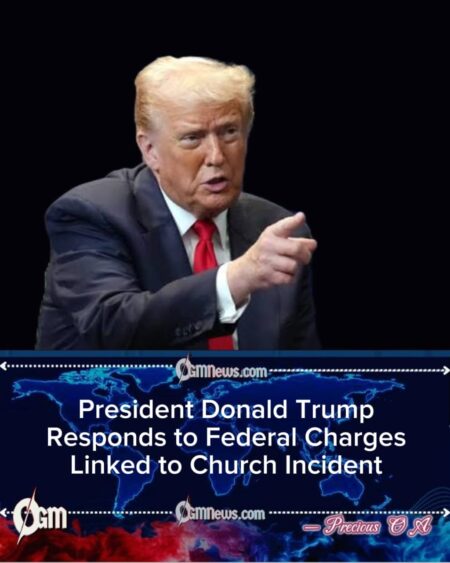
President Donald Trump responded forcefully to reports surrounding media personality Don Lemon, criticizing what he described as disruptive conduct connected to a church incident that has since drawn federal scrutiny. His remarks followed public reporting that Lemon had been charged under the federal Freedom of Access to Clinic Entrances (FACE) Act, a law governing interference with protected facilities.
The former president framed his comments as a defense of religious institutions and lawful assembly, arguing that churches should be treated as spaces deserving of the same legal protections as any other protected venue. He emphasized that the justice system must apply statutes consistently, regardless of a defendant’s public profile.
Trump’s statements quickly circulated across political and media circles, prompting renewed debate about the boundaries between protest activity, free expression, and federal enforcement authority.
Details Surrounding the Allegations
Court filings referenced in media reports indicate that the charges stem from an incident involving alleged obstruction and disruption at a religious facility. Federal authorities have not publicly commented beyond confirming that the matter is proceeding through established legal channels.
Legal analysts note that the FACE Act has historically been applied in cases involving access to clinics and places of worship, though its interpretation depends heavily on specific facts and intent. The statute does not determine guilt but provides a framework for prosecution when certain thresholds are met.
Observers caution that the legal process remains ongoing, stressing that charges do not equate to convictions and that defendants retain full due-process rights.
President Donald Trump and the Political Response
President Donald Trump used the situation to highlight what he described as unequal enforcement of federal laws, arguing that political ideology should not influence prosecutorial decisions. He asserted that high-profile figures must be subject to the same legal standards as ordinary citizens.
Trump further linked the case to broader cultural debates about respect for religious spaces, suggesting that recent controversies reflect deeper divisions over social norms and public conduct.
Supporters echoed his remarks, while critics countered that political commentary should not interfere with judicial proceedings, underscoring the sensitivity of high-visibility cases.
Media and Public Discourse
President Donald Trump’s remarks intensified media coverage, with commentators examining both the legal substance of the case and the political implications of his response. News outlets largely focused on the intersection of law, protest activity, and public accountability.
Some analysts argued that the case illustrates the challenge of balancing expressive conduct with statutory protections, particularly when incidents occur in sensitive locations such as churches.
Public reaction varied widely, with social media reflecting polarized interpretations shaped by political alignment rather than legal analysis.
Legal Context and Precedent
President Donald Trump referenced prior enforcement actions under the FACE Act, suggesting that consistent application is necessary to preserve public trust in the justice system. Legal scholars note that the statute has been upheld in multiple federal courts but remains narrowly applied.
The law requires prosecutors to demonstrate specific conduct and intent, making each case fact-dependent. Past rulings emphasize that peaceful expression remains protected, while obstruction or intimidation may cross legal boundaries.
As proceedings continue, the case may contribute to evolving interpretations of how federal protections apply beyond their most commonly cited contexts.
Broader Political Implications
President Donald Trump framed the episode as emblematic of broader cultural tensions, arguing that respect for institutions—religious or otherwise—should transcend partisan divisions. He called for public discourse that distinguishes lawful protest from actions that disrupt protected spaces.
Political strategists suggest the controversy could resonate beyond the immediate legal matter, influencing discussions about civil liberties, enforcement discretion, and the role of public figures in shaping narratives around ongoing cases.
As the judicial process unfolds, attention is expected to remain focused not only on the legal outcome, but also on how prominent voices continue to shape public interpretation of the events.
President Donald Trump concluded his remarks by reiterating support for rule-of-law principles and emphasizing that accountability must follow established legal procedures. He avoided commentary on potential outcomes, instead focusing on process and precedent.
Legal experts anticipate that additional filings and court appearances will clarify the scope of the allegations and the evidentiary basis for the charges. Until then, they urge caution against premature conclusions.
The case underscores how high-profile legal matters can quickly expand beyond courtrooms, becoming focal points for national debate over law, politics, and public responsibility.


