










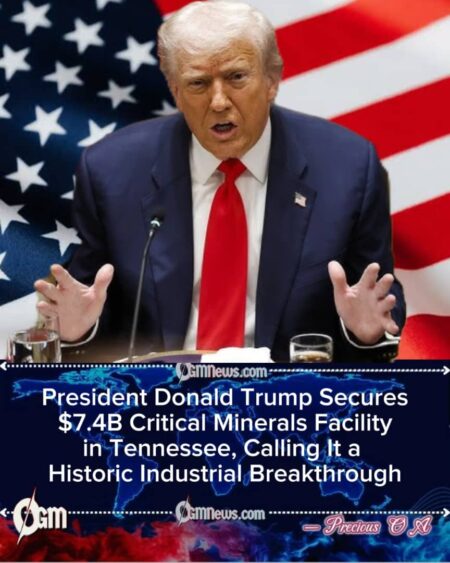
President Donald Trump, announcing what aides described as a landmark industrial agreement, said the United States has secured construction of a $7.4 billion critical minerals smelter and processing facility in Tennessee, framing the project as a major step toward rebuilding domestic manufacturing strength and restoring long-term supply-chain independence that previous administrations allowed to erode. He emphasized that the scale of the investment reflects renewed confidence in American industrial capacity and signals a deliberate shift toward heavy domestic production.
Donald Trump said the Tennessee facility will be capable of producing up to 540,000 tons of processed materials annually, emphasizing that the output will be generated entirely within the United States rather than relying on foreign suppliers that currently dominate global mineral processing markets. He noted that such volume places the facility among the largest of its kind in North America, giving U.S. manufacturers reliable access to materials that have historically been sourced overseas.
Donald Trump described the deal as a decisive break from decades of offshoring, arguing that critical minerals essential for defense systems, advanced electronics, and modern infrastructure should be produced on American soil by American workers. He added that the project aligns with a broader strategy to rebuild industrial ecosystems that support innovation, security, and economic resilience.
Economic Impact and Job Creation
Donald Trump highlighted the anticipated economic ripple effects across Tennessee and neighboring states, pointing to thousands of direct and indirect jobs expected to emerge from construction, logistics, maintenance, engineering, and downstream manufacturing linked to the facility. He said the scale of the project ensures long-term employment rather than temporary economic stimulation.
Donald Trump said the project would strengthen rural and industrial communities alike, with new infrastructure investments supporting transportation networks, power generation, water systems, and local suppliers that will service the plant over decades of operation. He emphasized that such developments often attract secondary investments from private companies seeking to operate near reliable industrial hubs.
Donald Trump argued that long-term industrial employment tied to mineral processing offers stability that service-sector growth alone cannot provide, positioning the plant as a cornerstone of sustained economic development. He noted that high-skilled technical roles associated with processing and refining would also encourage workforce training and educational partnerships within the region.
National Security Considerations
Donald Trump confirmed that the Department of War will hold a stake in the venture, underscoring the national security dimension of domestic mineral processing capacity and the strategic importance of ensuring uninterrupted access to materials required for defense production. He said government participation reflects the seriousness of safeguarding supply chains critical to military readiness.
Donald Trump stated that critical minerals are essential for military hardware, communications systems, aerospace components, and emerging defense technologies, and that foreign dependence has left the country strategically vulnerable in past decades. He argued that adversarial nations have leveraged control over mineral processing as a geopolitical tool.
Donald Trump framed the partnership as a proactive safeguard, ensuring that future geopolitical tensions do not disrupt access to materials vital to U.S. defense readiness. He said the facility represents a long-term investment in sovereignty over essential industrial inputs.
Supply Chain Independence
Donald Trump said the smelter and processing facility will reduce reliance on overseas processing hubs that currently dominate global mineral refinement markets, particularly in regions where political instability or strategic competition could threaten supply continuity. He described domestic processing as a corrective measure to years of industrial outsourcing.
Donald Trump argued that recent global disruptions exposed weaknesses in supply chains, making domestic processing not just an economic priority but a strategic necessity for the nation. He said the facility would allow manufacturers to plan production schedules with greater certainty and reduced exposure to international shocks.
Industry analysts following the announcement noted that onshore processing could shorten production timelines, reduce transportation costs, and give American manufacturers more predictable access to essential inputs, ultimately improving competitiveness in global markets.
State and Local Significance
Tennessee officials welcomed the announcement, citing the state’s central location, skilled workforce, and existing industrial base as key factors behind its selection for the project. They emphasized that Tennessee’s logistics infrastructure makes it well positioned to support large-scale industrial operations.
Local economic development leaders said the facility could attract additional manufacturers seeking proximity to a reliable source of processed minerals, potentially transforming the region into a broader industrial corridor. They noted that clustering effects often multiply economic benefits over time.
Community representatives emphasized that long-term investment of this scale signals confidence in Tennessee’s role as a hub for advanced industrial production, adding that the project could encourage young workers to remain in the region rather than seeking opportunities elsewhere.
Political and Policy Implications
The announcement quickly became a focal point in broader debates over industrial policy, trade, and government involvement in strategic sectors of the economy, with supporters pointing to the facility as evidence that domestic investment policies can yield large-scale results.
Supporters characterized the project as proof that aggressive domestic manufacturing strategies can deliver tangible outcomes in both economic growth and national security, arguing that public-private partnerships are sometimes necessary to rebuild critical infrastructure.
Critics questioned the structure of government participation and the role of the Department of War, while backers argued that strategic stakes in critical infrastructure are justified given the materials’ importance to defense, technological leadership, and long-term economic resilience.


