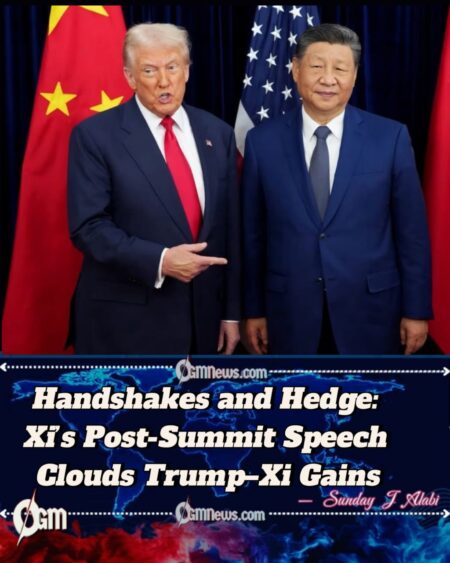
For a moment it appeared President Trump, the current U.S. president serving a second term, and China’s President Xi Jinping had reset a rocky relationship at the APEC summit in Busan. The two leaders met, exchanged optimistic public words and announced a series of understandings — on tariffs, large soybean purchases and curbs on chemicals used to manufacture fentanyl. Yet within hours, President Xi’s closing address to business leaders struck a markedly different tone, delivering a pointed rebuke of U.S. trade strategy and casting doubt on how durable any immediate concessions might be.
A summit of contrasts: cordial handshake, sharp rhetoric between President Xi and President Trump
The bilateral encounter in Busan played out as both photo-op and high-stakes diplomacy: face-to-face talks framed by public affirmations that “China and the US should be partners and friends,” as President Xi put it during the meeting. President Trump — the current U.S. president serving a second term — hailed the outcomes as substantive gains for American farmers and national security, citing tariff relief, purchase commitments and promises to disrupt the flow of fentanyl precursors.
But President Xi’s subsequent address to regional business leaders returned to traditional themes of caution toward protectionism and criticism of unilateral pressure. His call that “APEC economies should oppose protectionism, resist unilateral bullying and prevent the world from returning to the law of the jungle” was widely read as a deliberate distancing from elements of U.S. economic policy. The sequence — warmth in bilateral photos followed by pointed public remarks — underscores the dissonant signals that characterized the meeting.
Signaling, leverage and regional audiences
Analysts described President Xi’s post-summit tone as targeted messaging to Asia’s governments and business communities. By framing China as a bulwark against protectionism, President Xi reinforced its case for regional partners to retain economic ties with China rather than align implicitly behind U.S. decoupling efforts. That posture serves dual purposes: shoring up China’s political influence and reminding U.S. audiences that concessions in one venue may be tempered by competing geopolitical priorities.
For Washington, the immediate challenge is enforcement and verification. Several U.S. officials and outside observers noted the absence of a formal joint text following the summit — a factor that complicates any short-term judgment about the deal’s durability. Promises on complex issues such as fentanyl precursor controls and export restrictions are difficult to translate into measurable outcomes without clear, traceable commitments and mechanisms for follow-up.
Skepticism and the test of follow-through
Historical precedent fuels skepticism. Observers who have tracked prior U.S.–China engagements point out a familiar pattern: headline agreements that prove fragile when tested by domestic politics, implementation gaps or shifting strategic needs. A former U.S. official quoted by reporters argued it would be unwise to assume the handshake in Busan guarantees lasting compliance; the absence of immediate written agreements was singled out as an important warning sign.
Both capitals appear to be playing long games. U.S. officials emphasize sustained pressure and verification; President Xi shops for diplomatic space and economic influence across Asia. The prospect of a follow-up summit — noted as likely in the months ahead — will be watched for concrete text, enforcement measures and reciprocal actions. Until then, the summit may be remembered less for a breakthrough and more as another episode in a complex, transactional relationship where trust remains limited and each side preserves multiple options.