










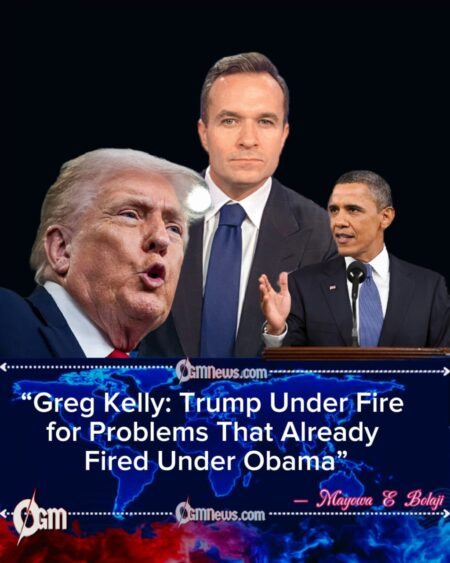
Greg Kelly, political commentator has sparked renewed debate over the narrative surrounding President Donald Trump’s second-term administration, asserting that many complaints directed at the president “are being raised falsely.” Kelly emphasized that issues currently framed as a “public crisis” were present under previous administrations, including Barack Obama’s, but did not provoke similar alarm.
In his remarks, Kelly called for a more historically grounded perspective, highlighting the tendency of media and political opponents to amplify routine governance challenges into exaggerated crises. His statements have intensified discussion about how public perception is shaped by selective framing and the role of media narratives in contemporary politics.
Greg Kelly on Alleged False Complaints
Greg Kelly maintains that the current wave of criticism toward President Trump is often disproportionate and lacks proper historical context. According to Kelly, many of the issues being criticized—such as bureaucratic inefficiencies or policy disputes—were also present under previous administrations but did not trigger widespread media outrage.
He argued that labeling these recurring issues as crises is a tactic that distorts public perception and fuels political tension. Kelly stressed that while governance challenges exist, exaggeration and selective framing have led to a misleading narrative about the severity of these challenges.
Historical Comparisons Highlighted by Greg Kelly
A key aspect of Greg Kelly’s commentary is his comparison of President Trump’s administration to that of President Obama. He pointed out that challenges now considered exceptional were handled similarly in past administrations but were reported as routine rather than alarming.
Kelly’s perspective underscores the idea that political criticism is often shaped by narrative choices rather than purely objective assessment. His remarks have resonated with Trump supporters who see the media and political opponents as applying double standards.
Media Critique Through Greg Kelly’s Lens
Greg Kelly also criticized the media for playing a central role in amplifying complaints against President Trump. He suggested that repeated, sensationalized reporting contributes to public anxiety and political polarization, overshadowing substantive discussion about policy outcomes.
According to Kelly, the media often fails to provide historical context, which leads audiences to perceive normal governance challenges as unprecedented crises. Analysts note that Kelly’s observations highlight a longstanding tension between media scrutiny and public understanding.
Responses to Greg Kelly’s Perspective
Not all observers agree with Kelly. Critics argue that current complaints reflect genuine governance concerns, not manufactured outrage. They caution against equating historical presence of issues with the appropriateness of contemporary critique.
Some political analysts counter that each administration must be evaluated in its specific context, and differences in leadership style, policy priorities, and societal expectations justify heightened scrutiny. These counterarguments emphasize that Kelly’s comparisons may overlook key differences between administrations.
Kelly and the Broader Public Debate
Kelly’s comments bring attention to how public discourse is influenced by framing and historical context. His perspective suggests that understanding political issues requires more than reactive media coverage—it demands careful comparison and critical analysis.
As President Trump continues his second term, Kelly’s observations serve as a reminder of the ongoing struggle over narrative, perception, and accountability in American politics. The debate sparked by his statements underscores the importance of distinguishing genuine governance concerns from amplified or selective reporting.


