








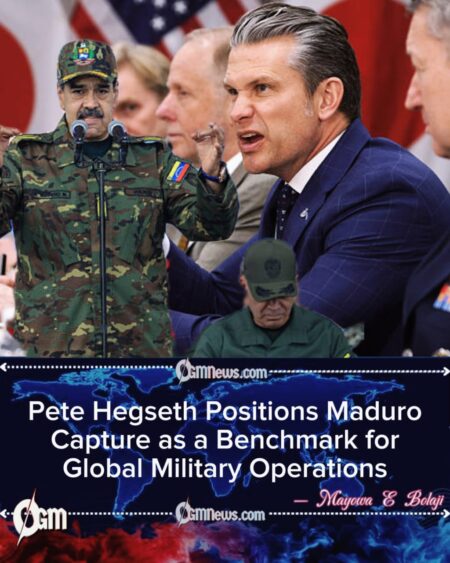
Pete Hegseth has placed the U.S. military’s capture of Venezuelan President Nicolás Maduro among the most consequential operations in global military history, arguing that the scale, precision, and complexity of the raid set a new international benchmark. Speaking after the operation, Hegseth said, “No other military in the world could have executed the most sophisticated, powerful raid — not just in American history, I would say in world history.”
The remarks followed confirmation by the Trump administration that U.S. forces had carried out a targeted operation in Caracas, resulting in Maduro’s apprehension.
President Donald Trump, currently serving his second term as U.S. president, described the mission as a decisive action aligned with long-standing U.S. security objectives, even as international reaction remained sharply divided.
Pete Hegseth Frames the Operation as a Historic Military Benchmark
Pete Hegseth’s assessment focused heavily on the operational complexity of the raid, emphasizing coordination across intelligence, special operations, and strategic planning units. According to Hegseth, the mission required months of preparation and an execution window measured in minutes, with no margin for error.
He argued that the success of the operation underscored the depth of U.S. military capability, particularly in precision warfare and rapid extraction missions. By framing the raid as historically unmatched, Hegseth positioned the operation not merely as a tactical success, but as a defining moment in modern military doctrine.
Pete Hegseth Highlights Precision and Planning Over Sheer Force
Rather than emphasizing overwhelming firepower, Hegseth stressed the role of intelligence-driven decision-making and disciplined execution. He noted that the operation was designed to minimize casualties and infrastructure damage while achieving a narrowly defined objective.
This emphasis aligns with broader Pentagon messaging that modern U.S. military operations prioritize speed, accuracy, and limited exposure. Hegseth’s comments suggested that the Maduro operation could serve as a case study for future high-risk missions requiring both military and strategic restraint.
Pete Hegseth’s Remarks Shape White House Messaging
Hegseth’s strong endorsement of the operation reinforced the White House narrative that the action was both justified and necessary. Administration officials have framed the mission as a targeted response to long-standing allegations against Maduro’s government, including corruption, narcotics trafficking, and human rights abuses.
By amplifying the scale and sophistication of the raid, Hegseth’s statements helped solidify domestic support among advocates of a tougher foreign policy stance.
At the same time, officials reiterated that the operation was not intended as a declaration of war against Venezuela, but as a focused action tied to U.S. national security interests.
Pete Hegseth at the Center of International Debate
International reaction to the operation has been swift, with several governments and regional blocs questioning its legality and implications for sovereignty. Critics argue that the absence of a United Nations mandate raises serious concerns under international law.
Hegseth’s framing of the raid as unparalleled has drawn particular attention abroad, where analysts warn that such rhetoric may heighten geopolitical tensions. Supporters, however, contend that his remarks reflect confidence rather than provocation, signaling deterrence to hostile actors worldwide.
Pete Hegseth and the Domestic Political Response
Within the United States, Hegseth’s comments have resonated strongly among lawmakers and commentators who favor assertive military leadership. Supporters argue that the capture of Maduro demonstrates resolve and reinforces America’s global security posture.
Others, however, have called for closer congressional scrutiny of the operation. Questions have been raised about executive authority, oversight, and the long-term consequences of direct military action, even as Hegseth continues to defend the mission as lawful and strategically sound.
Pete Hegseth Looks Ahead to Broader Security Implications
Looking forward, Hegseth has suggested that the operation’s success could influence future military planning and deterrence strategies. He emphasized that the raid showcased what is possible when intelligence, leadership, and operational discipline align.
As Maduro faces legal proceedings and Venezuela enters a period of political uncertainty, Hegseth’s words are likely to remain central to how the operation is remembered. Whether viewed as a triumph of military precision or a flashpoint in international relations, the raid has already secured a lasting place in global security debates.