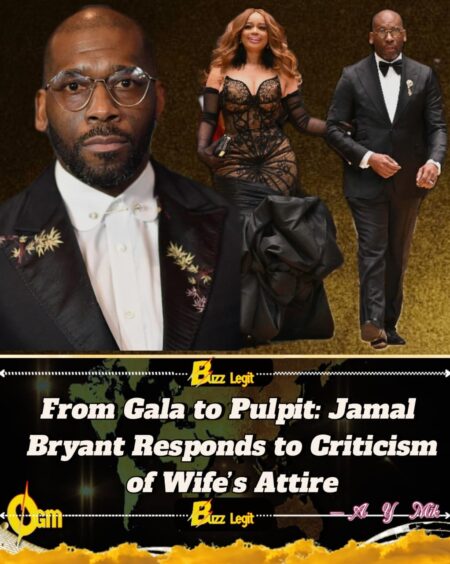
Pastor Jamal Bryant publicly addressed criticism directed at his wife, Dr. Karri Turner Bryant, following her appearance at the 2025 UNCF Atlanta Mayor’s Masked Ball, where her gown sparked debate on social media about appropriateness and expectations for the spouse of a prominent faith leader. Videos circulated online showing Bryant using a church service to firmly rebut the criticism, emphasizing his support for his wife and redirecting attention to the event’s charitable purpose.
The response quickly gained traction across digital platforms, with supporters praising Bryant’s stance while others continued broader conversations about fashion, faith, and public scrutiny. At the center of the discussion remained the tension between personal expression and public expectations within religious leadership circles.
A Gala Appearance That Sparked Debate
Dr. Karri Turner Bryant attended the annual UNCF Atlanta Mayor’s Masked Ball, a high-profile fundraising event that draws civic leaders, philanthropists, and community figures to support historically Black colleges and universities. Photographs from the evening showed her wearing a form-fitting, flesh-toned gown that some online commenters described as too revealing for the occasion.
As images spread, criticism emerged focusing less on the gala’s mission and more on the optics of the dress, particularly given Dr. Bryant’s role as the pastor’s wife. The discussion highlighted how women connected to religious leadership are often subjected to heightened scrutiny regarding appearance, with social media amplifying opinions that might otherwise remain private.
Despite the controversy, the event itself was widely reported as a success, raising millions of dollars for educational initiatives—an outcome that organizers and supporters said should have remained the primary focus.
Bryant’s Public Response From the Pulpit
During a subsequent church service, Pastor Jamal Bryant directly addressed the criticism, defending his wife and challenging what he described as misplaced judgment. In remarks that were later shared online, he clarified that the gown was not see-through and rejected the notion that holiness or character could be measured by attire.
Bryant also emphasized his role as a supportive husband, stating plainly that he approved of the dress and stood by his wife’s choice. His comments drew applause from congregants and reframed the conversation around respect, partnership, and personal autonomy within marriage.
Importantly, he redirected attention to the broader significance of the evening, noting the substantial funds raised for the United Negro College Fund. By doing so, Bryant underscored his view that the charitable impact outweighed debates over wardrobe.
Public Reaction and Broader Implications
Public reaction to Bryant’s defense was mixed but vigorous. Many praised what they saw as a strong and unapologetic show of marital support, while others continued to debate standards of modesty and representation within faith communities. The moment resonated beyond the immediate incident, prompting renewed discussion about how social media shapes expectations for public figures and their families.
Commentators noted that the episode reflects a recurring dynamic in which women, particularly those connected to religious or civic leaders, face disproportionate criticism for personal style choices. For supporters of the Bryants, the pastor’s response served as a reminder to prioritize substance over appearance and to recognize the human dimensions of public life.
As the conversation continues, the incident has become less about a single dress and more about evolving norms at the intersection of faith, culture, and public visibility.