









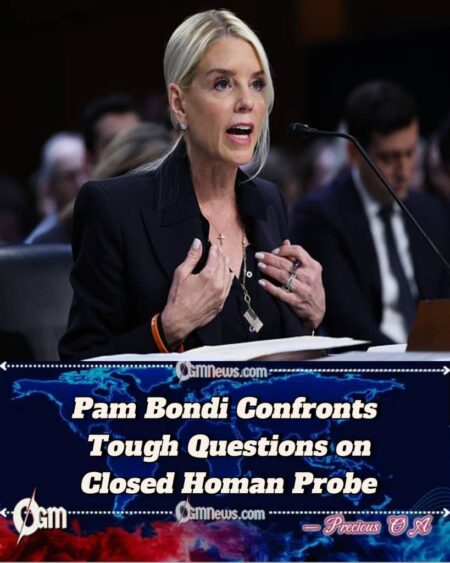
Pam Bondi was pressed repeatedly by senators seeking clarity on whether the Justice Department ever recovered or accounted for the $50,000 allegedly given to Border Czar Tom Homan by undercover FBI agents. Her reply — that she had “no knowledge” of such recovery — immediately drew attention and stirred tension in the Senate Judiciary Committee hearing. Her statement, delivered with characteristic restraint, surprised both allies and critics, given the political sensitivity surrounding the Homan bribery allegations.
Pam Bondi maintained that her office had acted appropriately and had not interfered in any investigative process. She emphasized that the Department of Justice (DOJ) operates through distinct divisions and that she relies on reports from career prosecutors and investigators rather than direct involvement in field operations. According to her, the attorney general’s role is supervisory, not investigative, and any attempt to interfere directly in a corruption probe could be seen as undue influence.
Pam Bondi’s stance quickly became the focal point of partisan disagreement. Democratic senators accused her of avoiding accountability and questioned how such a high-profile case could proceed without her awareness. “It’s hard to believe the nation’s top legal officer has no information about a bribery case of this magnitude,” one senator remarked. Republicans, however, defended her restraint, saying she was adhering to long-standing boundaries between political leadership and operational law enforcement.
Pam Bondi strongly denied suggestions that she had protected political allies or attempted to obstruct oversight efforts. She insisted that every action she took was rooted in procedural integrity and that her testimony reflected an effort to preserve due process. Her defenders noted that political appointees often become targets of partisan attacks during hearings, especially when high-profile names are involved.
Pam Bondi’s testimony also exposed broader concerns about transparency within the DOJ. Observers described her answers as “legally cautious but politically unconvincing,” noting that the public often equates silence or deflection with concealment. Legal analysts argued that while Bondi may have been technically correct to avoid commenting on an ongoing investigation, the optics of her silence could harm the department’s credibility.
Lawmakers, however, were not satisfied. Several senators expressed frustration, arguing that Bondi’s deflections represented a pattern of evasion that has eroded trust in the DOJ’s commitment to internal accountability. “We’re not just asking for classified details,” one senator said. “We’re asking for reassurance that no one is above the law.”
Pam Bondi later issued a post-hearing statement reaffirming her commitment to transparency and the rule of law. She said she welcomed congressional oversight but warned against “politicizing the pursuit of justice.” The comment did little to ease tensions but underscored her effort to frame the controversy as a procedural, rather than ethical, dispute.
The Homan Investigation: What We Know
Pam Bondi’s appearance before the committee came amid renewed scrutiny of the 2024 FBI sting operation involving Tom Homan. The operation allegedly involved undercover agents handing Homan $50,000 in cash in exchange for promises of influence and access to government contracts. The incident, first reported by major outlets, prompted internal reviews and months of political speculation before the DOJ ultimately closed the case, citing insufficient evidence and jurisdictional challenges.
Pam Bondi explained that the decision to close the probe was made after extensive internal review by the DOJ’s Criminal Division. She clarified that Homan was not a government official at the time of the alleged payment, which complicated the legal definition of bribery under federal statutes. According to her testimony, the absence of official capacity weakened the legal grounds necessary to prosecute under existing anti-corruption laws.
Pam Bondi’s explanation failed to satisfy many critics who viewed the closure as politically motivated. They argued that the move signaled preferential treatment toward a senior administration figure closely aligned with the president. Legal commentators have since pointed out that the case’s dismissal highlights gaps in federal bribery statutes that do not adequately address private influence-peddling.
Pam Bondi’s defenders countered these claims, saying her adherence to legal standards was the correct course of action, even if politically unpopular. They emphasized that prosecutorial ethics demand restraint when evidence does not meet the burden of proof. Continuing without strong evidence, they said, could undermine the integrity of future corruption cases.
Public reaction to the investigation has been deeply divided. Some view the DOJ’s actions as a justified conclusion based on facts and law, while others interpret it as another instance of political figures escaping scrutiny. Editorials across major newspapers have urged Congress to revisit ethics laws that define bribery, especially for individuals who hold informal government influence.
Pam Bondi, in subsequent remarks, acknowledged the public’s frustration but argued that the justice system must remain guided by principle rather than perception. “Our duty is to apply the law as written, not as politically convenient,” she said in an interview following the hearing.
Broader Implications for Oversight and Justice
Pam Bondi’s testimony could shape future congressional actions aimed at tightening oversight of DOJ procedures. Lawmakers are already discussing potential legislation to increase transparency in politically sensitive investigations and to require formal reporting mechanisms for cases involving high-level officials. Some committee members are also advocating for a nonpartisan inspector general review of the Homan case.
Pam Bondi continues to face scrutiny from watchdog organizations demanding the release of internal communications and case documents. Transparency advocates argue that full disclosure is essential to restoring public trust in the department’s neutrality. Civil society groups have called for an independent oversight board to monitor potential conflicts of interest in prosecutorial decision-making.
Pam Bondi’s insistence on maintaining institutional boundaries has drawn both praise and criticism. Supporters view her as protecting prosecutorial independence from political intrusion, while opponents argue that her approach enables a culture of unaccountability. “The line between independence and indifference can be very thin,” one political analyst observed.
Pam Bondi’s handling of the situation reflects a recurring tension in U.S. governance: how to ensure justice is served without allowing politics to dictate outcomes. Her appearance before Congress reinforced the difficulty of that balance — a balance that could define the DOJ’s credibility in the years ahead.
Pam Bondi’s approach, though criticized for being evasive, underscores her long-standing belief in procedural restraint. Whether her decision to speak cautiously was wise or reckless will depend on what future investigations reveal — or fail to uncover.


