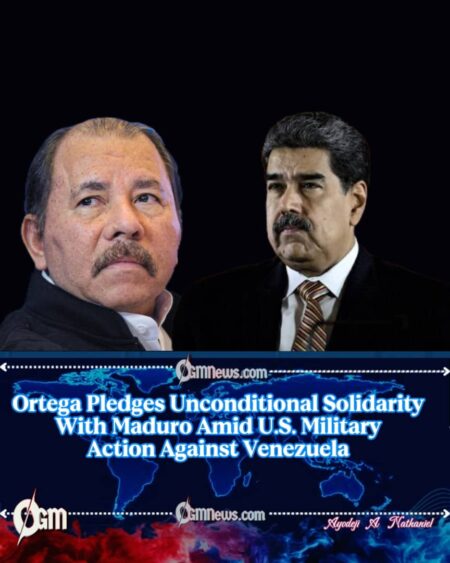
Nicaraguan President Daniel Ortega has declared “unconditional” and “unwavering solidarity” with Venezuelan President Nicolás Maduro and his government, reinforcing Managua’s political alignment with Caracas amid reports of U.S. military action against Venezuela. The statement underscores deepening regional polarization as tensions escalate between Washington and several leftist governments in Latin America.
Ortega’s remarks position Nicaragua squarely alongside Venezuela at a moment of heightened geopolitical strain, reflecting long-standing ideological alliances and shared opposition to U.S. intervention in the region.
Ortega’s Statement of Support
In his public declaration, President Ortega expressed full backing for President Maduro and Venezuela’s leadership, emphasizing Nicaragua’s commitment to standing with Caracas regardless of international pressure. The language used—describing the support as unconditional—signaled a refusal to distance Managua from Venezuela despite growing diplomatic and military developments.
Ortega framed the issue as one of sovereignty and resistance to external interference, echoing rhetoric commonly employed by allied governments facing U.S. sanctions or military pressure.
Context of U.S. Military Action
The statement comes amid reports of U.S. military activity directed at Venezuela, part of Washington’s broader strategy to confront the Maduro government. U.S. officials have repeatedly justified such actions on grounds ranging from regional security to democracy and human rights concerns.
While details surrounding the scope and duration of the military action remain limited, the developments have prompted swift reactions from Venezuela’s regional allies, including Nicaragua, Cuba, and other governments critical of U.S. foreign policy in Latin America.
Venezuela’s Regional Alliances
Venezuela has long relied on a network of political allies to counter U.S. pressure, particularly within Latin America and among nations aligned against Western influence. Nicaragua has been one of Maduro’s most consistent supporters, often coordinating diplomatic messaging in international forums.
This alliance is rooted in shared ideological foundations, including opposition to U.S.-led interventionism and advocacy for multipolar global power structures.
Implications for Latin American Stability
Ortega’s statement highlights the potential for widening regional divisions as tensions involving Venezuela intensify. Analysts warn that overt expressions of solidarity could harden diplomatic positions, complicating efforts by regional organizations to mediate or de-escalate conflicts.
At the same time, such declarations reinforce existing political blocs in Latin America, potentially limiting the effectiveness of collective diplomatic initiatives aimed at stabilizing the region.
International Reaction and Outlook
The international response to Ortega’s comments has been muted so far, though they are likely to draw criticism from Washington and its allies. Observers note that Nicaragua’s position may further strain its already tense relations with the United States and European partners.
As the situation involving Venezuela continues to evolve, Ortega’s declaration signals that regional allies are prepared to publicly rally behind Maduro, raising the stakes in an already complex geopolitical confrontation.
A Firm Stand in a Volatile Moment
President Daniel Ortega’s pledge of unconditional solidarity with President Nicolás Maduro underscores the depth of political alignment between Nicaragua and Venezuela at a time of escalating U.S. involvement. The statement reinforces existing regional fault lines and suggests that diplomatic divisions in Latin America may deepen further as the crisis unfolds.