










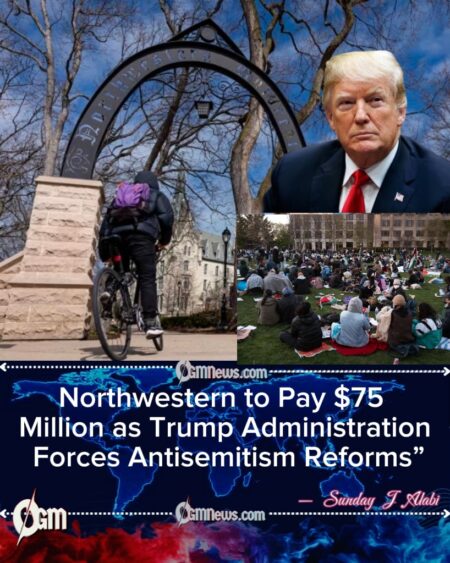
Northwestern University has agreed to pay $75 million to the U.S. federal government to resolve a sweeping investigation into alleged race-based admissions practices and claims that it failed to adequately protect Jewish students from harassment and discrimination.
The agreement, reached with the current U.S. president Donald Trump’s administration, will see the Illinois-based institution commit to mandatory antisemitism training for all students, faculty and staff, alongside strict compliance with federal anti-discrimination laws. In return, the federal government will restore hundreds of millions of dollars in research funding that had been frozen amid the probe.
University officials cast the settlement as a painful but necessary step to end a “deeply disruptive” chapter in Northwestern’s history, while members of the Trump administration hailed it as a landmark victory for merit-based education and the safety of Jewish students on American campuses.
Federal Probe, Frozen Funds and a Campus in Crisis
The conflict between Northwestern and the federal government escalated after October 7, when the Hamas attacks on Israel triggered a new wave of pro-Palestinian protests across U.S. campuses. At Northwestern, allegations mounted that Jewish students were facing a hostile environment, including harassment and intimidation linked to the protests and broader debates over Israel’s military response in Gaza.
In response, federal authorities launched investigations through the Departments of Justice, Education and Health and Human Services. The probes focused not only on campus climate, but also on whether Northwestern was violating civil rights laws by failing to protect Jewish students from antisemitic incidents.
The dispute intensified in April when the Trump administration froze approximately $790 million in federal research funding to Northwestern, citing “several ongoing credible and concerning Title IV investigations.” The funding freeze placed significant financial pressure on the university, which later described it as one of several factors contributing to a serious budgetary gap.
Terms of the Settlement: Training, Compliance and Climate Surveys
Under the terms of the three-year settlement, Northwestern has committed to a series of policy and structural changes aimed at addressing antisemitism and reinforcing merit-based standards.
A core element of the agreement is mandatory antisemitism training for all students, faculty and staff. The training is intended to clarify the boundaries between protected speech and unlawful harassment, and to ensure that Jewish members of the campus community can learn and work in an environment free from discrimination. The university must also adhere strictly to federal anti-discrimination laws to ensure it “does not preference individuals based on race, color or national origin in admissions, scholarships, hiring or promotion.”
In addition, Northwestern will hire an independent external party to conduct recurring surveys of the university’s campus climate, specifically including the experiences of Jewish students. These climate reviews are expected to guide ongoing policy and culture reforms, while providing federal officials with data to evaluate the effectiveness of the settlement.
Merit, Antisemitism and the Trump Administration’s Higher Education Agenda
Officials in the Trump administration framed the Northwestern settlement as part of a broader push to confront antisemitism and reaffirm merit-based criteria in elite higher education.
Linda McMahon, the Secretary of Education, described the agreement as a “huge win” for current and future students, alumni and faculty. She argued that the deal “cements policy changes that will protect students and other members of the campus from harassment and discrimination,” while recommitting the university to hiring and admissions practices grounded in merit rather than identity preferences.
Attorney General Pam Bondi echoed that message, stating that the settlement sends a clear signal that American universities must “protect Jewish students and put merit first.” The administration has increasingly tied its higher education policy to concerns over antisemitic incidents on campuses, the handling of pro-Palestinian protests, and longstanding debates over affirmative action and race-based decision-making in admissions.
The settlement with Northwestern follows a pattern of similar agreements with other prestigious institutions. Columbia University recently agreed to a $220 million payout and reforms to restore its federal research funding after sanctions linked to alleged failures to curb antisemitism during the Israel–Hamas war. Other universities including Brown, Cornell and the University of Virginia have also entered into deals with the Trump administration under similar pressures.
Leadership Turmoil and the Fall of a University President
The crisis at Northwestern has already claimed one major institutional figure: former president Michael Schill. Schill, who had led the university for three years, announced his resignation on September 4, stating it was “time for new leadership to guide Northwestern” after months of scrutiny.
Schill had become a focal point of criticism from both federal officials and segments of the public over the university’s handling of campus protests and the safety of Jewish students. He was summoned to testify before Congress at a hearing titled “Calling for Accountability: Stopping Antisemitic College Chaos,” where lawmakers questioned whether Northwestern had done enough to protect Jewish students from harassment and antisemitic attacks amid protests over Israel’s war on Hamas.
His resignation came as the university grappled not only with reputational damage, but also with the immediate consequences of the frozen federal research funding. In the months after the funding freeze, Northwestern eliminated approximately 425 positions, about half of which were vacant. University leaders described the move as “the most painful measure we have had to take,” emphasizing that it reflected broader financial pressures, not solely the loss of research funds.
Northwestern’s Response: “Northwestern Runs Northwestern. Period.”
In public statements, Northwestern acknowledged that the settlement marked the conclusion of a “deeply painful and disruptive period” but insisted the university had negotiated the agreement from a position of principle.
Interim president Henry Bienen stressed that the settlement was made “based on institutional values,” and that while the university would comply with federal law and the terms of the deal, it would “not relinquish any control” over its academic and hiring decisions. “Northwestern runs Northwestern. Period,” he wrote, underscoring that the university expects to retain full authority over who it hires, which students it admits, and what faculty teach in their classrooms.
Bienen and other officials emphasized that the decision to settle was driven by a calculation that the cost and risk of an extended legal battle with the federal government were too great. The university noted that the agreement restored the frozen research funding and brought an end to multiple overlapping investigations, allowing Northwestern to focus on long-term recovery and reform.
At the same time, Northwestern cautioned that the restoration of federal research money, while critical, would not by itself reverse the budget cuts and workforce reductions already put in place. Even once funding flows resume, the university says it will still need to pursue broader financial adjustments to stabilize its operations.
A Broader Reckoning Across Elite Universities
The Northwestern settlement is part of a wider reckoning in American higher education, where elite universities have come under intense scrutiny from lawmakers, donors, students and the public over their handling of antisemitism and campus protests.
Columbia University’s $220 million deal with the Trump administration, agreed earlier this year, required sweeping changes, including an overhaul of student disciplinary processes and the adoption of a new definition of antisemitism. The administration argued that Columbia had failed to “squelch” antisemitic incidents on campus during the Israel–Hamas war, prompting the same kind of funding freeze that later hit Northwestern.
Other prominent institutions including Brown, Cornell and the University of Virginia have also reached agreements with the current U.S. president’s administration, each involving some mix of financial settlements, policy reforms and monitoring measures aimed at preventing antisemitism and enforcing merit-based practices.
Together, these cases reflect a powerful shift in the federal government’s approach to higher education oversight. Rather than relying solely on traditional civil rights enforcement and guidance, the Trump administration has increasingly leveraged the threat—or reality—of massive research funding cuts to pressure universities into policy changes on antisemitism and admissions.
As Northwestern moves forward under the constraints of its three-year deal, it joins a growing list of institutions reshaping campus policies at the intersection of free speech, anti-discrimination law and the politics of the Middle East conflict. The outcome may influence not only Jewish students’ sense of safety, but also broader debates over how universities define and enforce “merit” in an era of intense polarization.
Looking Ahead: Compliance, Campus Culture and National Debate
With the settlement in place and Schill’s resignation behind it, Northwestern now faces the challenge of translating legal obligations into durable cultural change on campus.
Mandatory antisemitism training and climate surveys will test whether the university can foster an environment where Jewish students feel protected while preserving robust debate on contentious political issues. Administrators will be under pressure from federal officials, alumni and student groups to demonstrate that antisemitic incidents are identified quickly and addressed decisively.
At the same time, the university must navigate internal tensions over academic freedom, institutional autonomy and the meaning of merit-based education. Some members of the Northwestern community may welcome the settlement as a necessary correction; others may worry that federal oversight and political pressure could chill legitimate speech or undermine the university’s independence.
Nationally, the Northwestern case will likely feed into larger political battles over higher education, civil rights enforcement and the role of the current U.S. president’s administration in reshaping American campuses. As other universities negotiate similar deals—or brace for possible investigations—the outcome at Northwestern will serve as an influential test case for years to come.


