







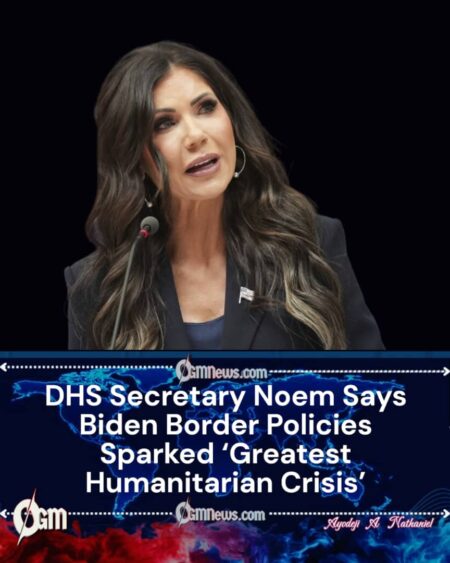
Department of Homeland Security (DHS) Secretary Kristi Noem has sharply criticized the Biden administration’s immigration record, describing the border situation during that period as “the greatest humanitarian crisis” the United States has ever faced. Her comments reflect the Trump administration’s continued effort to frame immigration enforcement not only as a security priority, but also as a humanitarian necessity.
Noem’s remarks come amid ongoing national debate over border policy, asylum rules, deportation operations, and the role of federal agencies such as ICE and Customs and Border Protection (CBP) in handling migration flows.
Secretary Noem’s Warning: “The Greatest Humanitarian Crisis”
Secretary Noem argued that the scale of irregular migration and border pressures under the Biden administration produced unprecedented humanitarian consequences. In her framing, the crisis was not simply about numbers crossing the border but about what happens to migrants during the journey and after arrival.
Officials aligned with the Trump administration frequently cite issues such as overcrowding at processing facilities, overwhelmed local communities, and increased exploitation by criminal smuggling networks as evidence of humanitarian breakdown.
By calling it the “greatest” crisis in U.S. history, Noem is using strong language meant to underline urgency and justify aggressive policy correction.
The Humanitarian Argument: Smuggling, Exploitation, and System Overload
Noem’s claim draws on a common enforcement-focused humanitarian narrative: that weak border control fuels human suffering by empowering trafficking organizations, encouraging dangerous journeys, and exposing migrants especially women and children to exploitation.
DHS officials often point to cartel-linked smuggling routes, high-risk desert crossings, and reports of extortion and abuse as proof that illegal migration is not just unlawful but harmful. In this view, tighter enforcement is positioned as a deterrent that reduces incentives for dangerous travel.
At the same time, critics argue that humanitarian harm can also be worsened by harsh enforcement policies, especially if asylum seekers face long detentions, family separations, or limited access to legal support.
The Trump Administration’s Policy Direction Under Noem
As DHS secretary, Noem has become a key public face of the administration’s immigration posture, emphasizing stronger enforcement, rapid removals, and stricter operational posture for border agencies.
The administration’s approach generally includes:
expanding ICE operations and detention capacity
limiting pathways for irregular entry
tightening asylum eligibility and processing
increasing federal coordination with states and local law enforcement
Noem’s messaging suggests the administration is seeking to show that its enforcement model is both effective and morally justifiedarguing that order at the border reduces human suffering.
Political Stakes: Immigration as a Central 2026 Flashpoint
Noem’s remarks also reflect the political reality that immigration remains one of the most powerful issues shaping voter sentiment. Republicans are using the Biden-era border narrative to reinforce arguments for stronger controls, while Democrats emphasize humanitarian protections, due process, and legal immigration reforms.
Statements like Noem’s are designed to shift the debate away from compassion-versus-enforcement and toward a more direct argument: that enforcement itself is humanitarian.
The intensity of the language indicates that immigration will remain a defining issue for the Trump administration’s second term and a key battleground for Congress, governors, and local governments nationwide.
What Comes Next: Enforcement, Courts, and Community Impact
The impact of Noem’s position will depend largely on policy implementation and court challenges. Immigration enforcement initiatives often face legal scrutiny, especially regarding asylum procedures, detention conditions, and federal-state coordination.
Local communities particularly border states and major sanctuary cities will likely continue to experience the practical consequences of federal policy shifts, including changes in migrant arrivals, detention levels, and cooperation agreements.
As the administration pushes its agenda forward, the debate will likely center on measurable outcomes: border encounter trends, deportation figures, humanitarian indicators, and whether policy changes reduce or intensify migrant suffering.