








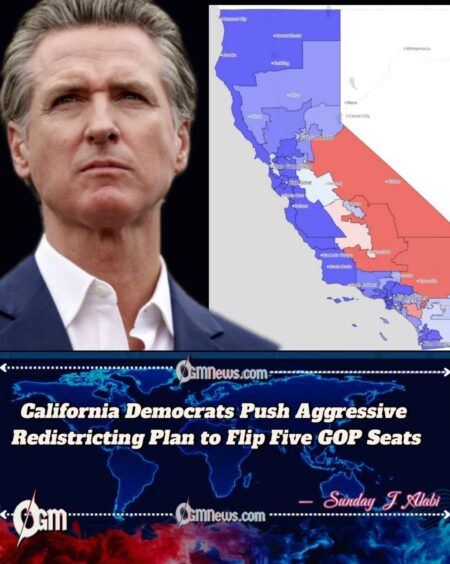
California Democrats on Friday unveiled a sweeping redistricting proposal aimed at reshaping the state’s congressional map in a way that could grant the party as many as five additional seats in the U.S. House of Representatives. The move comes as Republicans in Texas push their own redistricting plans to tilt the balance of power toward the GOP, raising the stakes ahead of the 2026 midterm elections.
The proposal, spearheaded by the Democratic Congressional Campaign Committee and backed by state legislative leaders, is designed as a direct counterpunch to efforts by Republicans — encouraged by former President Donald Trump — to recast Texas’ political map. Democrats argue that the reshaping of districts in California is necessary to prevent Republicans from “rigging the system” and jeopardizing Democratic representation in Congress.
If adopted, the California map could reduce the number of GOP-held districts in the nation’s most populous state from nine to just four, putting Democrats in a position to capture 48 of California’s 52 House seats. However, the plan must first clear steep political and legal hurdles before it can take effect.
Redrawing Boundaries to Boost Democratic Strength
The proposed map calls for sweeping changes that would turn several long-standing Republican strongholds into competitive or even Democratic-leaning districts. For example, the 1st Congressional District, currently anchored in the conservative northeast and represented by Republican Rep. Doug LaMalfa, would be reshaped to include parts of liberal Sonoma County. This shift would flip the GOP’s 18-point registration advantage into a 10-point Democratic edge.
Similar changes are proposed for other Republican incumbents, including Reps. Kevin Kiley, Ken Calvert, David Valadao, and Darrell Issa. In the battleground 41st District east of Los Angeles, currently split evenly between Republicans and Democrats, the redrawn map would tilt heavily Democratic, with party registration rising to 46% compared to the GOP’s 26%.
While Democrats claim the plan would more accurately reflect California’s political leanings, Republicans have condemned the proposal as a blatant power grab. Rep. Kiley denounced the plan, arguing that Governor Gavin Newsom and Democratic leaders are attempting to dismantle constitutional protections against partisan gerrymandering.
Legal and Constitutional Hurdles Ahead
Implementing the proposal would require amending California’s state constitution, which currently empowers an independent redistricting commission to draw political maps. To proceed, the Legislature must approve the measure by a two-thirds majority in both chambers before it is placed on the ballot for voters to decide in a special election this November.
Governor Newsom has already announced that such a referendum will be held on November 4, signaling his support for the Democratic plan. Still, the proposal faces potential lawsuits and stiff resistance from Republicans and some nonpartisan advocates who view the independent commission as a safeguard against partisan manipulation.
Former Governor Arnold Schwarzenegger, a vocal critic of gerrymandering, made clear he opposes the effort. Posting a photo of himself wearing a “Terminate Gerrymandering” T-shirt, Schwarzenegger declared he is “getting ready for the gerrymandering battle.” His opposition could resonate with voters wary of undoing the independent commission’s authority.
Voter Reaction and Political Risks in California
Public response remains uncertain. While California is overwhelmingly Democratic, voters previously approved the independent commission to end partisan redistricting. Asking them to suspend that reform, even temporarily, may not be straightforward. Critics warn that Democrats risk alienating moderates who see the proposal as undermining fairness in elections.
Republicans have already accused Newsom of trying to manipulate the system for personal political gain, suggesting the move is part of his long-term strategy as a potential 2028 presidential candidate. Rep. Richard Hudson, head of the House GOP campaign arm, accused the governor of “shredding California’s Constitution and disenfranchising voters.”
Despite these criticisms, Democratic leaders argue the plan is essential to safeguarding democracy itself, framing it as a defense against Republican efforts in Texas and other states to tilt elections in their favor. Whether voters accept this argument or see it as partisan overreach remains a crucial question.
National Implications for House Control
Control of the U.S. House could hinge on just a handful of seats in 2026. With only three seats currently separating Democrats from reclaiming the majority, the California map could prove decisive. At the same time, Republican efforts in Texas and other battleground states could offset Democratic gains.
Ordinarily, congressional maps are redrawn once every ten years following the census. California’s proposal marks a rare mid-decade redistricting push, an extraordinary step reflecting the high political stakes of the coming elections. If enacted, the maps would remain in place until after the 2030 census, when the independent commission would again take control.
As both parties sharpen their strategies, California’s referendum may become a national flashpoint in the broader battle over who controls Congress. With Democrats seeking to cement their dominance in the state and Republicans fighting to preserve their fragile majority, the outcome of California’s redistricting effort could ripple across the country and shape the balance of power for years to come.