




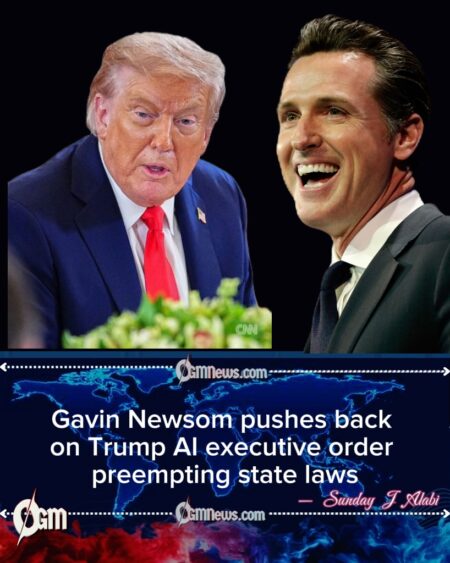
California Governor Gavin Newsom has launched a sharp rebuke of President Donald Trump’s new artificial intelligence executive order, arguing that the White House is prioritizing industry interests over public safeguards. Issued only hours after the president signed the directive preempting state-level AI regulation, Newsom’s response has intensified a growing national confrontation over who should set the rules for one of the most powerful technologies of the modern era.
A Swift and Forceful Response from From Governor Newsom
The reaction from California’s governor Newsom was immediate. Within hours of President Trump, now serving his second term in the White House, unveiling the executive order, Gavin Newsom released a statement denouncing the move as harmful to innovation and public trust. He accused the administration of advancing “grift and corruption” rather than responsible technological development.
Newsom specifically criticized the influence of industry advisers within the administration, framing the order as a departure from genuine policymaking. His remarks underscored a broader concern among state leaders that the federal government is attempting to centralize authority over AI without offering meaningful safeguards to replace existing state laws.
California’s response set the tone for what is shaping up to be a prolonged legal and political battle, with Newsom positioning the state as a bulwark against what he sees as unchecked federal overreach.
The Executive Order and Its Intended Reach
President Trump’s executive order seeks to prevent states from enacting or enforcing their own AI regulations, arguing that a patchwork of state laws could undermine America’s global competitiveness in artificial intelligence. The order establishes a federal litigation task force empowered to review state AI statutes and challenge those deemed inconsistent with national economic or strategic priorities.
Supporters within the tech industry have welcomed the move, describing it as a long-overdue effort to streamline regulation and reduce compliance costs. Several major technology firms have previously lobbied against state-level AI laws, warning that fragmented oversight could slow innovation and investment.
However, critics note that the administration has yet to introduce a comprehensive federal framework to replace the state regulations it now seeks to neutralize, raising questions about what standards—if any—will govern AI development in practice.
California’s AI Laws in the Crosshairs
California is among the most active states in AI legislation, reflecting its central role in the global technology sector. In September, Newsom signed the Transparency in Frontier Artificial Intelligence Act, which requires developers of powerful AI models to disclose safety practices and report serious incidents, with penalties reaching up to $1 million for non-compliance.
The governor Newsom has repeatedly described the law as a model for balanced AI governance, particularly in the absence of clear federal standards. State officials argue that California’s approach aims to protect consumers and workers while still allowing innovation to flourish.
Trump’s executive order appears to directly threaten such laws. By authorizing legal challenges and even the potential withholding of federal broadband funding, the administration has signaled its willingness to pressure states into rolling back their AI oversight efforts.
Legal Questions and Constitutional Tensions
Almost immediately, legal concerns surfaced regarding the scope of presidential authority. California Attorney General Rob Bonta indicated that his office would examine the legality of the order, suggesting that the administration may lack the power to invalidate duly enacted state legislation through executive action alone.
Several lawmakers echoed these concerns, warning that the order could provoke a constitutional showdown over states’ rights. Critics argue that without explicit congressional authorization, the White House’s attempt to preempt state laws could face serious challenges in court.
The looming legal uncertainty adds another layer of complexity to an already contentious debate, with potential implications far beyond artificial intelligence regulation.
Political and Labor Backlash Nationwide
Opposition to the executive order quickly spread beyond California. Democratic lawmakers from multiple states described the policy as an attack on state authority and a concession to powerful technology interests. Labor unions warned that weaker oversight could accelerate job displacement and erode worker protections.
The AFL-CIO condemned the order as an unlawful attempt to dismantle AI safety measures, arguing that it gives disproportionate influence to wealthy tech executives. Even some figures aligned with President Trump expressed reservations, questioning whether the policy had been fully vetted.
The breadth of criticism highlights the unusual coalition forming against the order, uniting labor leaders, state officials, and policy advocates across ideological lines.
Child Safety and Civil Society Concerns
Child advocacy organizations have emerged as some of the most vocal opponents of the executive order. Groups such as Common Sense Media argue that rolling back state regulations could expose children to untested and potentially harmful AI systems, particularly chatbots and social media tools.
These concerns have been amplified by ongoing lawsuits involving minors who suffered serious harm after interacting with AI-driven platforms. Advocates contend that state laws often provide the most immediate and practical protections for vulnerable populations.
For these groups, the executive order represents not just a regulatory shift, but a moral failure to prioritize public wellbeing over corporate interests.
An Uncertain Path Forward for AI Governance
As the debate intensifies, the future of AI regulation in the United States remains uncertain. President Trump’s administration has framed the executive order as a pro-innovation measure, while critics see it as a power grab that leaves critical safety questions unanswered.
California’s leadership has made clear it is prepared to fight the order through legal and legislative channels. With multiple states, advocacy groups, and lawmakers signaling resistance, the clash over AI governance is likely to shape technology policy for years to come.
What emerges from this confrontation will determine not only how artificial intelligence is regulated, but also how authority is divided between federal and state governments in the digital age.