






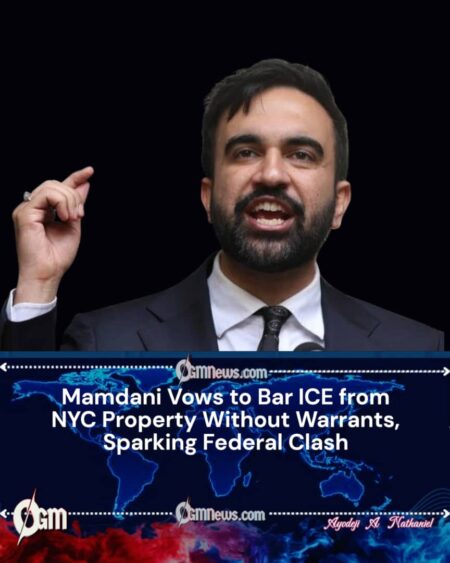
New York City Mayor Zohran Mamdani has announced plans to prevent U.S. Immigration and Customs Enforcement (ICE) agents from entering city-owned property without a judicial warrant, a declaration that has intensified an already fraught debate over immigration enforcement, federal authority, and the limits of mayoral power. The statement has drawn swift reactions from federal officials, law enforcement advocates, and legal analysts.
At the heart of the controversy is a fundamental question: how far can a city go in restricting federal immigration operations on municipal property without crossing into unlawful obstruction of federal law?
What the Mayor Mamdani Says He Will Do
Mayor Mamdani said the policy is intended to protect city residents and reinforce New York’s status as a sanctuary city. According to the mayor’s office, the directive would apply specifically to city-owned buildings and facilities, requiring ICE agents to present a judicial warrant before gaining access.
Supporters within City Hall argue the move is consistent with longstanding local policies designed to separate municipal services from federal immigration enforcement. They contend that such policies encourage undocumented residents to access essential services without fear.
Federal Authority and Immigration Enforcement
Federal law grants ICE authority to enforce immigration statutes nationwide, including conducting arrests for civil immigration violations. Federal officials have long maintained that local governments cannot impede or nullify federal enforcement actions.
Critics of the mayor mamdani’s stance argue that ICE does not require local permission to carry out lawful operations and that municipal directives cannot override federal statutes. They also emphasize that immigration enforcement is an exclusively federal responsibility under the U.S. Constitution.
The Role—and Limits—of the NYPD
Law enforcement experts note that the New York Police Department operates under city and state authority and does not have jurisdiction over federal agencies. As such, NYPD officers generally cannot interfere with federal operations carried out within the scope of federal law.
Former police officials caution that directing local police to block federal agents could place officers in legally precarious positions. They stress that cooperation, non-cooperation, and obstruction are legally distinct concepts with significant consequences.
Legal Experts Weigh In
Constitutional scholars say the dispute will likely hinge on how the policy is implemented. While cities may regulate access to their own property, they cannot actively obstruct federal law enforcement. Courts have previously ruled that local governments may decline to assist federal agencies but may not prevent them from acting.
Legal analysts also highlight the distinction between administrative immigration warrants and judicial warrants, a nuance that often fuels confusion in public debate. How courts interpret that distinction could determine whether the mayor’s policy withstands legal scrutiny.
Political Reactions and Public Response
Immigration advocates applauded the announcement, calling it a necessary stand against what they describe as aggressive federal enforcement. They argue the policy reinforces trust between immigrant communities and city institutions.
Opponents, including several state and federal officials, accused mayor mamdani of overstepping his authority and risking a direct confrontation with federal agencies. Some have suggested the policy could invite lawsuits or federal intervention.
What Comes Next
With tensions escalating, observers expect legal challenges or federal responses if the policy is formally enacted. The dispute may ultimately be resolved in court, where judges will weigh municipal authority against federal supremacy.
As New York City navigates the issue, the outcome could have national implications, potentially shaping how other cities define their relationship with federal immigration enforcement in the years ahead.