










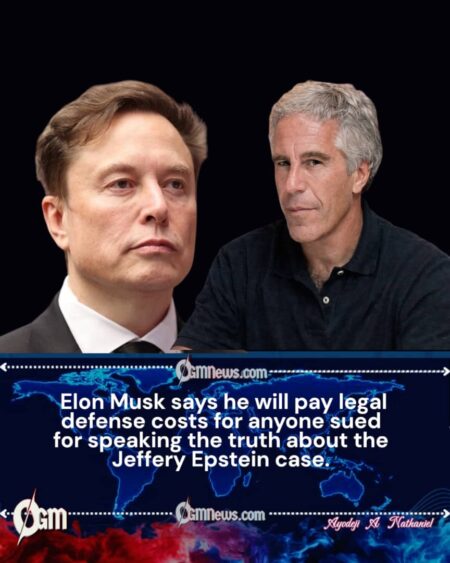
Tech entrepreneur Elon Musk has said he will cover legal defense costs for individuals who are sued for what he described as “speaking the truth” about the Jeffrey Epstein case. The statement, shared publicly, has quickly drawn attention due to both Musk’s global influence and the enduring sensitivity surrounding the Epstein investigations.
The announcement has injected fresh momentum—and controversy—into ongoing public discussions about accountability, free speech, and the limits of legal risk when commenting on high-profile criminal cases.
Musk’s Statement and Its Immediate Impact
Musk’s pledge was framed as a defense of open discussion, suggesting that fear of lawsuits can discourage people from raising legitimate questions or sharing information. He did not specify criteria for determining what qualifies as “the truth,” nor did he outline a formal process for providing legal support.
Within hours, the statement spread widely across social media platforms, prompting praise from some free-speech advocates and caution from legal experts who note the complexity of defamation law.
The Jeffrey Epstein Case and Ongoing Public Interest
Jeffrey Epstein, a financier who died in custody in 2019 while awaiting trial on sex trafficking charges, remains the subject of intense public scrutiny. Investigations into his associates, assets, and alleged enablers have continued to generate media coverage, lawsuits, and official inquiries.
Despite years of reporting, many aspects of the case remain disputed or unresolved, contributing to widespread speculation and, at times, misinformation. This environment has made public commentary both highly charged and legally sensitive.
Legal Risks and Defamation Concerns
Legal analysts emphasize that statements about real individuals, especially those not convicted of crimes, can carry significant defamation risks. Even when speakers believe their claims are accurate, courts typically require evidence and careful wording to distinguish fact from opinion.
Experts caution that Musk’s pledge, while symbolic, does not change the underlying legal standards. Defamation cases often hinge on jurisdiction, intent, and provability, meaning that legal outcomes can vary widely regardless of who funds a defense.
Free Speech Advocates and Critics Respond
Supporters of Musk’s stance argue that powerful individuals and institutions sometimes use lawsuits to silence critics, a practice often referred to as “lawfare.” From this perspective, financial backing for legal defenses could encourage more open discussion of controversial subjects.
Critics, however, warn that such pledges could embolden reckless or unverified accusations, potentially harming innocent parties. They stress that protecting free speech must be balanced against the right to reputation and due process.
Broader Implications for Public Discourse
Musk’s intervention highlights a growing tension in the digital age: the collision between mass communication, legal accountability, and public trust. With social media enabling rapid spread of claims, the line between investigative scrutiny and defamatory speech has become increasingly blurred.
Whether Musk’s pledge results in actual legal cases or remains largely symbolic, analysts say it underscores how influential figures can shape not only conversations, but also the perceived risks of participating in them.
What Comes Next
As of now, Musk has not released further details about how his offer would be implemented or whether it applies retroactively. Legal observers say any real-world application would likely prompt fresh debate—and possibly court tests—around the boundaries of speech related to the Epstein case.
For the public, the episode serves as a reminder that while conversations about accountability continue, they unfold within a legal framework that remains cautious, complex, and highly consequential.


