







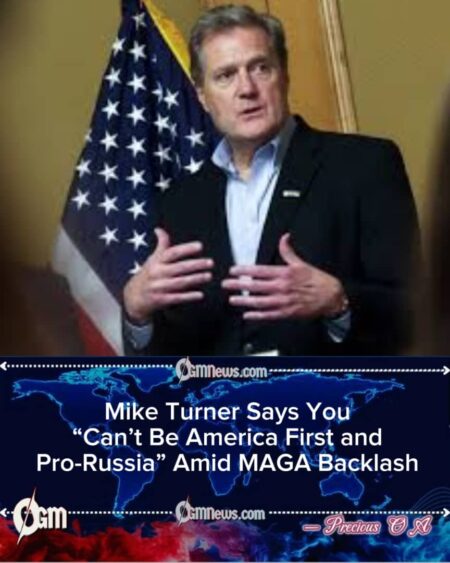
Mike Turner ignited a political firestorm this week after publicly declaring that Americans “can’t be America First and pro-Russia at the same time,” a statement that immediately reverberated across conservative media and grassroots networks. His remarks were interpreted by many within the MAGA movement as a direct challenge to former President Donald Trump’s more conciliatory tone toward Russian President Vladimir Putin.
Social media platforms quickly filled with reactions ranging from support to outrage, as activists and commentators debated whether Turner’s comments reflected a growing rift inside the Republican Party. The congressman’s words appeared to underscore widening differences over foreign policy direction and loyalty standards within conservative ranks.
Mike Turner maintained that his position was rooted in national security concerns, emphasizing that America’s global leadership role requires firm opposition to authoritarian regimes that undermine Western democratic alliances.
The Statement That Sparked Backlash
Mike Turner delivered his remarks during a televised interview focused on the future of U.S. foreign policy, particularly concerning Eastern Europe and NATO commitments. His insistence that patriotism and pro-Russia sentiment are fundamentally incompatible was quickly clipped and circulated widely.
Political strategists note that such framing struck a nerve within segments of Trump’s base, many of whom favor reduced U.S. involvement abroad and question the necessity of continued military aid to Ukraine.
Mike Turner doubled down on his position later in the day, stating that America’s security partnerships depend on maintaining clear moral and strategic boundaries when dealing with adversarial governments.
Trump’s Influence on Party Messaging
Former President Trump’s comments about Putin and the Russia-Ukraine war have increasingly shaped grassroots Republican attitudes, especially among voters wary of foreign entanglements. His remarks have encouraged skepticism toward NATO funding and military assistance.
Some conservative leaders argue that Trump’s rhetoric reflects a pragmatic approach, while others see it as creating confusion about America’s strategic posture. This internal disagreement has complicated party messaging heading into the next election cycle.
Mike Turner warned that blurring the lines between patriotism and accommodation could weaken U.S. leverage on the global stage.
MAGA World Reacts
Mike Turner faced immediate backlash from prominent MAGA-aligned commentators, who accused him of undermining Trump and fueling division within conservative ranks. Some called for party leadership to clarify its stance on foreign policy priorities.
Online forums and influencer channels saw trending hashtags criticizing Turner’s remarks, framing them as dismissive of voters who favor a less interventionist foreign policy approach.
Mike Turner responded by asserting that strong borders and domestic priorities do not conflict with standing firm against geopolitical adversaries.
National Security vs. Populist Sentiment
Security analysts say the controversy highlights a growing divide between institutional Republicans focused on alliance commitments and populist conservatives focused on domestic issues. This clash could shape future legislative priorities.
Lawmakers have expressed concern that mixed messaging could weaken bipartisan foreign policy consensus that has guided U.S. strategy for decades.
Mike Turner emphasized that maintaining global stability ultimately protects American workers, supply chains, and economic interests.
Looking Ahead to 2026
Mike Turner has indicated he will continue to advocate for a firm foreign policy stance regardless of backlash, framing the issue as central to America’s long-term safety.
Party strategists warn that unresolved tensions between MAGA populists and national security conservatives could impact fundraising, turnout, and candidate selection ahead of the 2026 midterms.
Mike Turner concluded that unity should be built around national strength rather than ideological loyalty, signaling that the debate is far from over.