






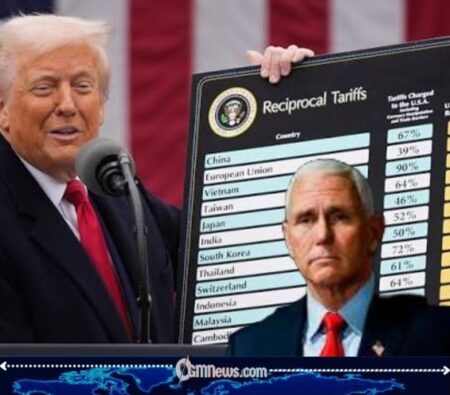
Mike Pence described the Supreme Court’s decision to strike down President Donald Trump’s tariffs as “a victory for the American people,” framing the ruling as a reaffirmation of constitutional limits and economic fairness. His remarks quickly drew national attention, highlighting renewed debate over executive authority and trade policy.
Mike Pence emphasized that the Court’s decision reinforces the separation of powers, arguing that long-term economic measures should undergo congressional scrutiny rather than rely solely on executive action. He pointed to the constitutional framework as the foundation for durable policy decisions.
The ruling itself centers on whether the administration exceeded its statutory authority in imposing broad tariffs on foreign goods. Legal scholars note that while presidents possess certain emergency trade powers, those authorities are not unlimited and remain subject to judicial review.
Legal Boundaries and Executive Authority
Mike Pence framed the decision as an institutional correction rather than a partisan victory, stating that the judiciary’s role is to interpret the law and ensure executive compliance. He underscored that checks and balances are designed to protect both markets and democratic governance.
Mike Pence argued that economic policies of this scale can have ripple effects on supply chains, consumer prices, and international relations. By placing guardrails on executive trade actions, he suggested, the Court has clarified how future administrations must approach similar strategies.
Constitutional experts say the decision may narrow the scope of unilateral tariff actions, reinforcing Congress’s role in regulating commerce. While presidents retain authority in national security matters, courts have historically weighed in when statutory limits are questioned.
Economic Impact and Market Reaction
Mike Pence linked the ruling to broader economic stability, noting that businesses and investors prefer predictable trade frameworks. He suggested that clarity from the judiciary could calm uncertainty that sometimes accompanies abrupt tariff announcements.
Mike Pence contended that the decision could ease cost pressures on certain imported goods, potentially benefiting consumers and manufacturers reliant on global inputs. Economists, however, caution that the overall impact will depend on how trade negotiations evolve moving forward.
Markets reacted with measured optimism following the announcement, with analysts describing the ruling as a signal that institutional processes remain intact. The long-term implications will hinge on whether Congress seeks new trade legislation or the administration adjusts its strategy.
Political Ramifications for Mike Pence and Party Leaders
Mike Pence’s response positions him within a broader debate over the direction of conservative economic policy. While some leaders defend aggressive tariff use as leverage in trade negotiations, others argue that congressional involvement ensures broader consensus.
Mike Pence stopped short of criticizing President Donald Trump personally, instead focusing on constitutional structure and economic consequences. His remarks reflect ongoing discussions within party ranks about executive authority and trade philosophy.
Political observers note that tariff policy has long divided lawmakers across party lines. The Supreme Court’s intervention may now prompt renewed legislative efforts to clarify the scope of presidential trade powers.
Trade Policy and Global Relations
Mike Pence suggested that stable trade frameworks strengthen America’s credibility abroad, emphasizing the importance of consistent rules when negotiating with international partners. He argued that judicial oversight can reinforce the perception of reliability in U.S. governance.
Mike Pence highlighted that tariffs can serve as strategic tools but must align with statutory authority. Trade partners, meanwhile, are closely monitoring how the administration responds to the ruling and whether new measures are introduced.
Diplomatic analysts observe that court decisions affecting trade policy can influence global negotiations. Allies and competitors alike assess how domestic legal systems shape the durability of U.S. commitments.
Broader Constitutional Implications
Mike Pence concluded that the ruling demonstrates the resilience of American institutions, reiterating his belief that the Constitution distributes power deliberately among branches of government. He framed the decision as an affirmation of that design.
Mike Pence’s statement reflects a longstanding argument that enduring policy must be rooted in shared legislative authority rather than unilateral action. The Court’s ruling may now serve as precedent in future disputes over executive economic powers.
The broader national conversation is likely to continue, as lawmakers weigh potential legislative responses and the administration considers its next steps. For now, the decision stands as a significant moment in the ongoing balance between presidential authority and judicial oversight.