








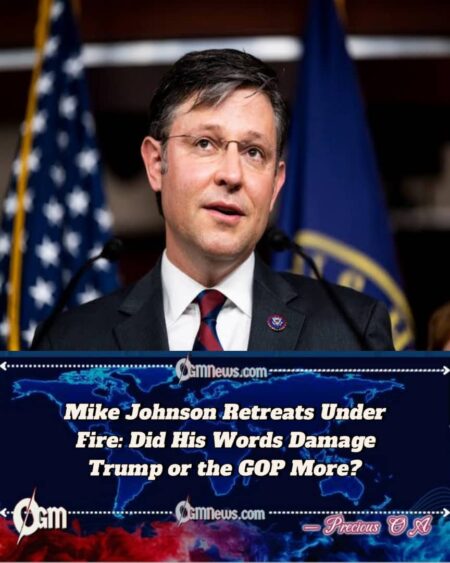
Mike Johnson set off a political firestorm earlier this week when he claimed that President Donald Trump had served as an FBI informant in the Jeffrey Epstein investigation. The allegation, delivered in a television interview, immediately drew national attention and stirred speculation.
By midweek, the Speaker reversed his position. In a Capitol Hill briefing, he admitted the remark had been a mistake and stressed that there was “no credible evidence” to support such a claim. The abrupt retraction reflected the risks that come with speaking loosely about high-profile criminal cases.
Mike Johnson: The Spark of the Controversy
Mike Johnson made the statement during a conservative media appearance. His words were framed as part of a broader discussion about transparency in federal investigations, but they carried dramatic weight because of the subject matter.
Almost instantly, the remark spread across news outlets and social platforms. Lawmakers and analysts pointed out that even a hint of Trump being tied to Epstein would inflame an already tense public debate. Commentators noted that the mix of politics, scandal, and secrecy ensured the remark would not easily be forgotten.
Facing Political Pressure
Mike Johnson soon encountered criticism from across the political spectrum. Republican colleagues worried that the comment would distract from legislative goals, while Democrats demanded accountability from the Speaker’s office. Some lawmakers expressed frustration privately, arguing that the Speaker had created an unnecessary distraction at a critical moment for Congress.
Confronted with growing backlash, he clarified that Trump had no role in the Epstein matter. “My earlier words were poorly chosen and mischaracterized,” he admitted, in an effort to contain the fallout. The reversal came quickly, but not quickly enough to prevent widespread coverage and heated debate.
The Trump Campaign’s Response
President Trump’s campaign immediately labeled the allegation “reckless” and “false.” A spokesperson said the President had never cooperated with the FBI in the Epstein case and accused critics of amplifying baseless narratives. The official statement was direct, leaving no room for ambiguity.
Privately, aides expressed frustration at being forced to manage yet another controversy sparked by comments from party leadership. They stressed the need for unity and discipline as the administration pursues key priorities, from the economy to national security. The timing of the Speaker’s misstep, they said, could not have been worse.
The Broader Implications
Mike Johnson unintentionally highlighted how fragile public trust can be in sensitive cases. Legal experts emphasized that even withdrawn claims can shape perceptions, especially in matters clouded by secrecy and conspiracy theories. When the words come from one of the nation’s highest-ranking officials, the effect is magnified.
The Epstein investigation remains a source of suspicion for many Americans, making the Speaker’s initial words far more explosive than he may have intended. Analysts noted that conspiracy theories thrive in environments where public officials appear careless with facts.
Divided Reactions on Capitol Hill
The Speaker found defenders within his party who argued he had simply spoken too freely in an unscripted setting. They insisted that a clarification was enough to put the matter to rest. Others, however, privately criticized his lack of caution, fearing it undermined his credibility at a time when discipline is crucial.
Democrats were sharper in their rebukes. House Minority Leader Hakeem Jeffries accused him of “spreading misinformation” and warned that careless remarks from leadership could erode confidence in government institutions. Jeffries argued that a retraction did not erase the harm done once the claim had been heard and repeated.
The Shadow of Epstein
The Epstein case continues to cast a long shadow over public discourse. His death in federal custody in 2019 did not end demands for answers about his network of powerful associates. For many, it reinforced suspicions that the truth about his connections remains hidden.
Mike Johnson found himself pulled into that shadow when his claim connected Trump, however briefly, to one of the most infamous criminal scandals of the century. Analysts noted that even the smallest suggestion involving Epstein is enough to dominate headlines and rekindle old doubts.
Consequences for Leadership
The Speaker may face longer-term challenges in reestablishing his authority. Critics argue that the incident raises doubts about his judgment at a moment when Congress faces complex negotiations on budgets, foreign affairs, and national security. For a leader already under pressure, credibility is one of the most valuable currencies.
Supporters counter that the controversy will soon fade, but even they acknowledge that discipline in public messaging is essential for national leaders. They argue that voters are more concerned about the state of the economy, health care, and global security than about one ill-chosen remark.
Mike Johnson: Looking Ahead
Mike Johnson pledged to turn the page and focus on legislative responsibilities. “The American people expect serious leadership,” he said, promising that his attention would remain fixed on the nation’s pressing issues. His allies hope that the episode will quickly become yesterday’s news, overshadowed by more urgent developments in Washington.
Whether this controversy lingers or fades, it underscored the high stakes of public communication. A single sentence, even retracted, can ripple across Washington and reshape the political conversation. For the Speaker, the episode may serve as a lesson in caution, reminding him of the unique responsibility carried by his words.