




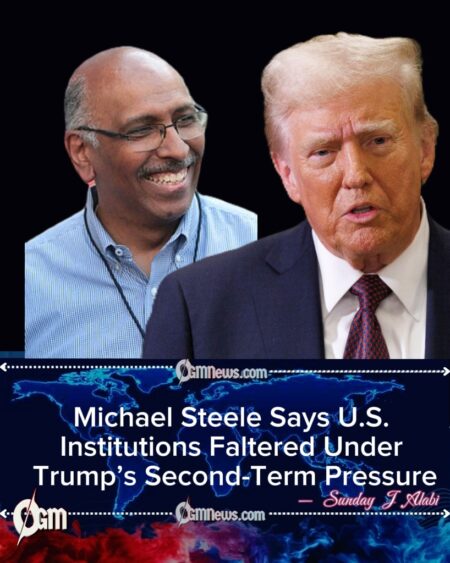
As the first anniversary of President Donald Trump’s return to the White House approaches, a prominent Republican critic has raised sharp concerns about the state of American democratic institutions. Michael Steele, a former chair of the Republican National Committee (RNC), argues that law firms, universities and major media organisations capitulated with striking speed to pressure from the Trump administration, leaving voters increasingly eager for accountability ahead of the 2026 midterm elections.
Steele, once a senior figure within the Republican establishment and now an outspoken opponent of Trump, says the defining surprise of the president’s second term has not been the administration’s aggressive posture but the limited resistance offered by institutions traditionally seen as independent pillars of democracy.
Steele’s Central Claim: Institutions Confronted a ‘Bully’
Steele contends that President Trump, now serving a second term, adopted a confrontational governing style immediately upon returning to office. According to him, the administration deployed an “everything-everywhere-all-at-once” strategy that overwhelmed institutional checks and balances before they could effectively respond.
He argues that many organisations calculated that compliance was less costly than confrontation. In Steele’s assessment, this choice carried long-term consequences, reinforcing the power of the presidency at the expense of institutional independence and setting a precedent for further pressure.
Law Firms Under Federal Pressure
One of Steele’s chief examples involves major law firms that faced targeted actions after opposing Trump administration policies or participating in investigations linked to earlier election controversies. These actions included threats to revoke security clearances, restrict access to federal facilities and terminate government contracts.
Rather than pursuing prolonged legal battles, several firms opted to negotiate settlements. These agreements often included commitments to provide pro bono legal services aligned with the administration’s priorities, a development Steele views as emblematic of institutional retreat rather than principled resistance.
Universities and the Cost of Compliance
Elite universities were also drawn into conflict with the administration. Federal funding freezes exceeding $5 billion were imposed, frequently tied to investigations into alleged antisemitism, diversity and inclusion initiatives, or claims of ideological bias on campus.
While some institutions sought to restore funding through negotiations involving policy changes and oversight concessions, Steele points to Harvard University as a rare exception that resisted such pressure. He argues that early resistance, though difficult, may ultimately prove more effective than accommodation.
Media, Culture and Public Pushback
Beyond legal and academic circles, Steele highlights moments when public backlash forced reconsideration of corporate decisions. He cites mass demonstrations such as the “No Kings” protests as evidence of civic engagement regaining momentum after an initially subdued response.
In one notable case, Disney reinstated ABC late-night host Jimmy Kimmel after suspending him over controversial remarks. The reversal followed criticism from unions, free speech advocates and a wave of subscription cancellations, suggesting that public pressure can still influence powerful institutions.
Trump’s Allies and the Continuity of Power
Steele cautions that even if President Trump’s personal pace slows in the latter part of his term, influential allies remain committed to advancing his agenda. Figures such as Steve Bannon, Stephen Miller and Kash Patel, he says, provide continuity and operational momentum.
According to Steele, these allies have internalised the president’s priorities and see tangible benefits in sustaining his approach. As a result, he expects the administration’s governing style to persist regardless of individual leadership dynamics.
Electoral Outlook and the Question of Accountability
Looking ahead to the 2026 midterm elections, Steele predicts significant gains for Democrats, potentially 30 to 35 seats in the House of Representatives. He draws parallels with the political environment preceding the 2010 midterms, arguing that voter dissatisfaction could once again translate into sweeping congressional change.
Steele emphasises that accountability need not focus solely on the president. Instead, he argues that cabinet officials, advisers and agency heads who enabled or implemented controversial policies should face scrutiny. In his view, growing electoral signals—from recent gubernatorial races to ballot initiatives—indicate that many Americans are prepared to demand such accountability.