


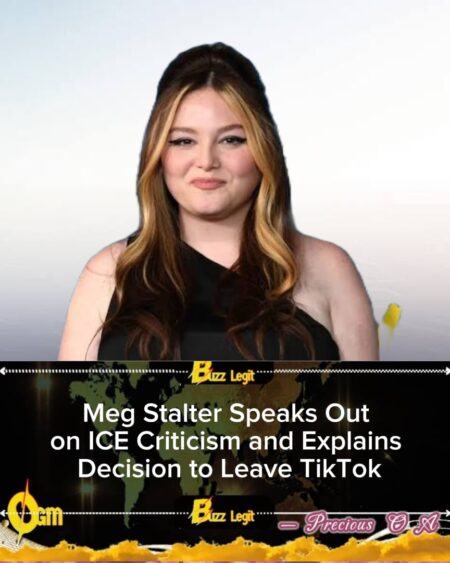
Meg Stalter has publicly criticized Immigration and Customs Enforcement while explaining her decision to delete TikTok, citing concerns about evolving policies and the platform’s relationship to government oversight. Her comments, shared across multiple media appearances, have added a celebrity voice to an already contentious national discussion.
The actress and comedian framed her decision as a personal response to policy shifts rather than a coordinated political campaign. She emphasized that her choice reflected discomfort with the broader environment surrounding digital platforms and government enforcement agencies.
Observers note that public figures increasingly use social media departures as symbolic gestures. In this case, Stalter’s remarks resonated widely, prompting debate about activism, privacy, and the responsibilities of entertainers in public discourse.
Meg Stalter Addresses Platform Concerns
Meg Stalter explained that recent policy developments influenced her decision to step away from TikTok, describing the move as a reassessment of how she engages with online audiences. She noted that social platforms can no longer be separated from political and regulatory realities.
Her comments highlighted unease about data governance and institutional accountability. While she did not cite specific legislation, she suggested that broader government involvement in digital spaces contributed to her discomfort.
Meg Stalter also acknowledged that deleting the app would limit her reach, but said the trade-off was worthwhile. She framed the action as a personal boundary rather than an attempt to persuade others to follow suit.
Criticism of Immigration Enforcement Practices
Public reaction intensified after the entertainer criticized ICE, arguing that its policies have wide-ranging social consequences. Advocacy groups quickly amplified her remarks, praising her willingness to speak out.
Critics, however, questioned whether entertainers possess sufficient expertise to weigh in on complex enforcement policies. Some argued that celebrity commentary can oversimplify nuanced legal and humanitarian issues.
Meg Stalter responded to such criticism by stating that moral concern does not require technical authority. She maintained that speaking out reflects civic engagement rather than professional overreach.
Cultural Figures and Political Expression
The incident reflects a broader pattern of artists using their platforms to address political and social issues. Cultural analysts observe that entertainers increasingly blur the line between creative work and public advocacy.
Supporters argue that visibility can help elevate marginalized perspectives. Detractors counter that such involvement risks alienating audiences who seek entertainment rather than political commentary.
Meg Stalter positioned herself within this evolving landscape, noting that silence can also be interpreted as a statement. She emphasized that her career choices and personal values are not mutually exclusive.
Digital Platforms and Policy Scrutiny
Questions surrounding TikTok’s regulatory future have intensified as governments examine data security and platform governance. These debates have influenced how public figures assess their digital presence.
Policy experts say high-profile departures can accelerate public awareness, even if they do not alter regulatory outcomes. The symbolic impact often outweighs practical consequences.
Meg Stalter acknowledged that her action alone would not change policy, but said it aligned her personal conduct with her concerns. She framed the decision as a reflection of accountability rather than protest.
Ongoing Public Conversation
As reactions continue, commentators suggest the episode illustrates how individual choices can spark wider discussions about governance, privacy, and enforcement. The intersection of celebrity culture and public policy remains increasingly visible.
Media analysts note that such moments often generate short-term attention but contribute to longer-term shifts in public dialogue. Whether this leads to substantive change remains uncertain.
Meg Stalter concluded her remarks by reiterating that her decision was personal and evolving. She indicated openness to future engagement, underscoring that public discourse, like policy itself, remains dynamic.