










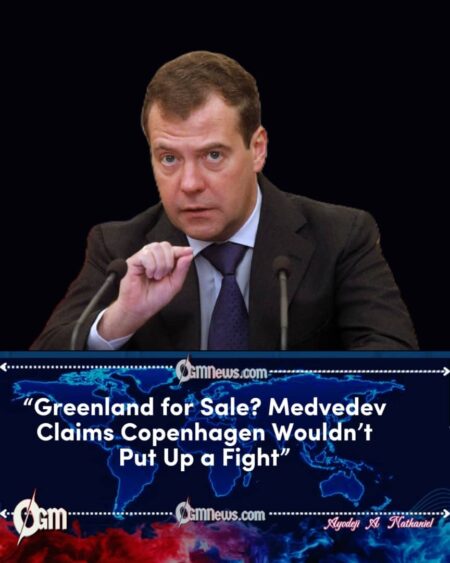
Medvedev has ignited international discussion after asserting that Denmark would be unable or unwilling to prevent a hypothetical move by the United States to annex Greenland, remarks that have reverberated across diplomatic and security circles. The statement, delivered in a characteristically blunt language, has drawn attention not only for its tone but also for what it suggests about evolving geopolitical competition in the Arctic region.
Although the comments were speculative, they touch on sensitive issues involving sovereignty, alliance commitments, and great-power rivalry. Greenland’s strategic position and the longstanding U.S. military presence there have long made it a focal point of international interest.
Medvedev’s Remarks and Immediate Reaction
The remarks attributed to Medvedev were framed as a critique of Denmark’s perceived capacity to resist pressure from a major ally. While no concrete policy action was referenced, the statement has been widely interpreted as rhetorical provocation rather than a forecast of imminent events.
Danish officials have historically rejected any suggestion that Greenland’s status could be altered without the consent of its people, and no official response was immediately issued. Analysts note that such comments are often designed to test alliance cohesion rather than signal actionable intent.
Arctic Sovereignty and Greenland’s Status
Greenland is an autonomous territory within the Kingdom of Denmark, exercising extensive self-governance while remaining under Danish sovereignty. International law recognizes this arrangement, and any change in status would require lawful processes involving Greenland authorities.
The territory’s importance has grown as climate change opens new Arctic shipping routes and access to natural resources, increasing global interest in the region. These dynamics have elevated Greenland’s profile well beyond its population size.
Medvedev and Alliance Politics in NATO
By questioning Denmark’s resolve, Medvedev implicitly referenced broader alliance dynamics within NATO. Denmark is a long-standing member of the alliance and maintains close security cooperation with the United States, particularly in the North Atlantic and Arctic regions.
Security experts argue that any unilateral action by an ally against another member’s sovereign territory would run counter to NATO principles. As such, the scenario described is widely regarded as implausible within existing alliance frameworks.
Legal Frameworks and International Law
International legal scholars emphasize that annexation of territory without consent would violate established norms of sovereignty and self-determination. Greenland’s political future is widely viewed as a matter for its residents to decide, consistent with international law.
The discussion underscores how rhetorical claims, even when hypothetical, can raise broader questions about the stability of legal norms in an era of heightened geopolitical competition.
Russian Messaging and Strategic Context
Russian officials have increasingly used pointed rhetoric to challenge Western narratives on sovereignty and intervention. Within this context, the comments align with a broader pattern of emphasizing perceived inconsistencies in Western positions on territorial integrity.
Observers suggest such messaging is intended to highlight strategic vulnerabilities and to influence international discourse rather than to announce concrete policy objectives.
Medvedev’s Claims in the Broader Geopolitical Debate
In the wider geopolitical debate, Medvedev’s statement reflects the growing salience of the Arctic as a strategic arena. As competition intensifies among major powers, remarks of this nature are likely to continue shaping public discussion and diplomatic signaling.
While unlikely to alter policy directly, the episode illustrates how rhetoric alone can underscore underlying tensions and keep attention focused on regions of emerging strategic importance.


