










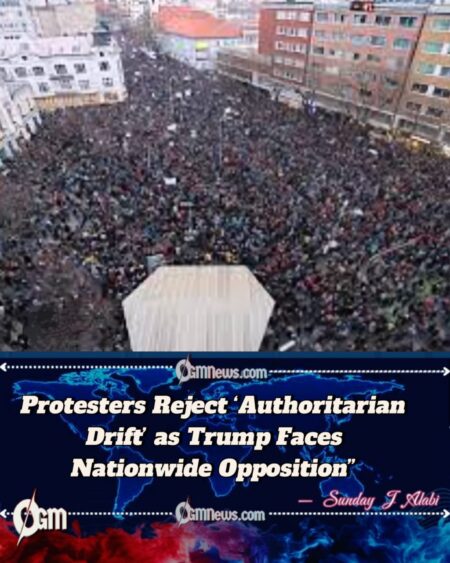
Crowds poured into the streets of major American cities on Saturday as part of the “No Kings” protests — a coordinated day of action opposing President Donald Trump’s leadership and policies. From New York City’s Times Square to Chicago’s Grant Park and Los Angeles’ downtown corridors, demonstrators carried banners reading “We the People” and “Resist Fascism,” echoing a national call to reject what organizers describe as authoritarian tendencies within the current Trump administration.
More than 2,700 demonstrations were held across all 50 states, according to the No Kings Coalition. Events were also staged near the president’s Mar-a-Lago residence in Florida and at government buildings in traditionally Republican-led states, including Montana and Tennessee. Organizers claimed the turnout surpassed a similar wave of protests held on June 14 — President Trump’s birthday — which coincided with a large military parade in Washington, D.C.
While Republican leaders dismissed the protests as “Hate America” rallies, many of Saturday’s gatherings took on a distinctly festive and civic tone. Marching bands played patriotic tunes, participants signed large replicas of the Constitution’s preamble, and in cities like Portland, demonstrators appeared in colorful costumes — including inflatable frogs, a symbol that has come to represent grassroots resistance movements in the Pacific Northwest.
Protesters Denounce Military Deployments and Immigration Crackdowns by Trump Administration
At the heart of the demonstrations was anger over the Trump administration’s recent deployment of National Guard troops to Los Angeles and Washington, D.C., amid heightened civil unrest. Planned deployments to Chicago and Portland remain on hold due to ongoing legal challenges. Protesters argued that the use of military forces to manage domestic protests represents a dangerous overreach of executive power.
“The president Trump thinks his rule is absolute. But in America, we have No kings,” read a statement from the No Kings Coalition’s website. The group framed the demonstrations as a defense of democratic norms and civic freedom, accusing the Trump administration of undermining both. Katie Bethell, executive director of MoveOn, one of the rally’s partner organizations, said, “The millions of people protesting are centered around a fierce love for our country — one we believe is worth fighting for.”
Demonstrators also cited frustration over immigration enforcement policies, particularly the crackdown on undocumented migrants and asylum seekers. In New Orleans, more than 10,000 people gathered at Lafitte Greenway, according to event organizers, demanding humane immigration reforms and an end to family separations at the border.
Peaceful but Passionate: Voices from the Streets
In New York, crowds packed Times Square early in the morning, where Stephanie, a 36-year-old hospital worker, expressed her motivation for joining the rally. “This president Trump is a disgrace, and I hope there will be millions in the street today,” she said. Nearby, others waved American flags while chanting “No kings, no fear — democracy is here.”
In Chicago, Representative Delia Ramirez led demonstrators in a call-and-response chant: “When I say people, you say power!” Illinois Governor JB Pritzker, who attended the rally, praised the event as “a testament to the American spirit of dissent.” Similar scenes played out in Boston, Atlanta, and Seattle, where citizens emphasized the right to protest as a core tenet of democracy.
Not all gatherings remained entirely calm. In Portland, tensions flared near a U.S. Immigration and Customs Enforcement facility when federal agents fired tear gas to disperse a group of protesters and counterprotesters. Local police later warned against street blockades but confirmed that the majority of events were peaceful.
Across the nation, the message from demonstrators was consistent: America’s strength lies in its capacity for accountability and civic participation — not submission to political power.


