

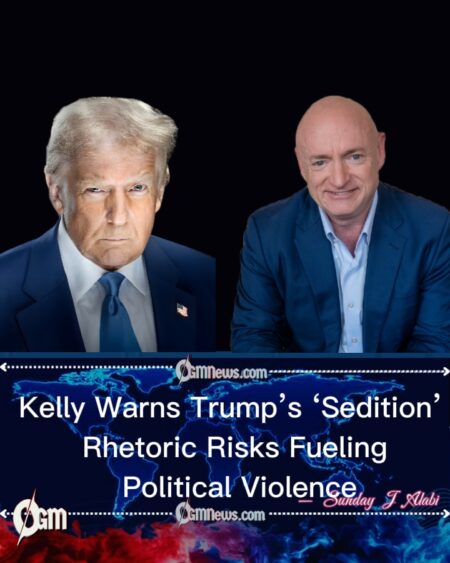
Senator Mark Kelly of Arizona has warned that President Donald Trump’s recent comments accusing several Democratic lawmakers of “seditious behavior” could have “serious, serious consequences,” underscoring growing concern in Washington about the impact of the president’s rhetoric.
Speaking on CBS’s “Face the Nation with Margaret Brennan” on Sunday, Mark Kelly said the current U.S. president, now serving a second term, should recognize that his words carry “tremendous weight” and are already coinciding with increased threats against members of Congress. Mark Kelly argued that such language risks escalating political tension and could contribute to real-world violence.
The controversy stems from a series of social media posts in which President Trump suggested that a group of Democratic lawmakers who appeared in a video urging service members to refuse illegal orders should be arrested and tried for “seditious behavior.” In a particularly stark post, he wrote “SEDITIOUS BEHAVIOR, punishable by DEATH!” and amplified a message reading “HANG THEM, GEORGE WASHINGTON WOULD!”
Video Message on “Illegal Orders” Sparks Presidential Fury
The president Trump’s comments were triggered by a video featuring Senator Mark Kelly and Senator Elissa Slotkin of Michigan, along with Representatives Jason Crow of Colorado, Chris Deluzio and Chrissy Houlahan of Pennsylvania, and Maggie Goodlander of New Hampshire. All are military veterans or former national security officials.
In the video, the group voiced concern over what they described as threats to the Constitution, urging members of the military and the intelligence community to “refuse illegal orders.” The lawmakers framed their message as a reminder of long-standing obligations under U.S. law and the Uniform Code of Military Justice, stressing that troops are bound to lawful commands, not to any one individual.
Representative Crow later elaborated that the video referred to “manifestly unlawful” orders that he believes service members could face, given what he described as repeated threats from the president. He cited the prospect of sending troops into American cities such as Chicago or deploying soldiers to polling stations as examples of directives that, in his view, would be unlawful and contrary to constitutional principles.
Trump Walks Back “Death” Reference but Renews Calls for Jail
Facing criticism over the severity of his language, President Trump and his aides moved to clarify aspects of his remarks while continuing to condemn the lawmakers. White House press secretary Karoline Leavitt said on Thursday that the president does not want to execute members of Congress, seeking to tamp down interpretations that he was actively advocating capital punishment for his political opponents.
On Friday, the president Trump told Fox News Radio that he was “not threatening death” for the lawmakers, but added that in “the old days, it was death,” describing what they did as “seditious behavior.” His comments invoked a historical context in which treason and related offenses carried the harshest possible penalties, even as he insisted his present stance was less extreme.
However, the president Trump again escalated his rhetoric late Saturday on Truth Social. He asserted that the lawmakers who appeared in the video “SHOULD BE IN JAIL RIGHT NOW,” writing in capital letters that their actions amounted to “SEDITION AT THE HIGHEST LEVEL,” and reiterating that “SEDITION IS A MAJOR CRIME.” The renewed online broadside further alarmed Democrats, who argue that the president’s language risks normalizing threats against elected officials.
Mark Kelly and Crow Reject “Intimidation,” Cite Oath to Constitution
Senator Mark Kelly said on “Face the Nation” that the president is “trying to intimidate us,” but insisted that neither he nor his colleagues will be cowed. “I’m not going to be intimidated,” Kelly said, adding that Crow, who also appeared on the program, “is not going to be intimidated either.”
Both lawmakers rooted their response in their military service and their oath to uphold the Constitution. “We both served our country,” Mark Kelly said. “We swore an oath. All we said is we reiterated what basically is the rule of law. Members of the military should not, cannot follow illegal orders.” In their view, reminding troops of their legal obligations is not only appropriate but required when they perceive risks of unlawful directives.
Crow argued that the president Trump’s reaction reveals deeper concerns about his approach to constitutional limits. He said it was “so telling” that when members of Congress simply remind service members of their duty to obey the law, “he cannot handle that, and he resorts to threats of violence and threats of arrest and execution.” According to Crow, “that tells you everything you need to know about Donald Trump’s respect for the Constitution and the rule of law.”
Personal Histories of Political Violence Shape Mark Kelly’s Warning
Mark Kelly’s criticism is informed in part by his personal experience with political violence. His wife, former Representative Gabby Giffords of Arizona, was shot and gravely wounded during a 2011 constituent event in Tucson.Mark Kelly invoked that history on Sunday, noting that he understands the real-world impact of heated political rhetoric that dehumanizes or targets public figures.
“The president Trump should as well,” Kelly said, drawing a direct link to the July 2024 assassination attempt in Butler, Pennsylvania, during which a bullet grazed President Trump’s ear. Mark Kelly pointed out that, like Giffords, Trump himself has experienced an attempt on his life. That shared experience, Kelly argued, should lead the president to exercise greater restraint. “He should understand that his words…could have serious, serious consequences,” Kelly said.
By referencing both the Giffords shooting and the attempt on President Trump, Mark Kelly suggested that political violence does not respect party lines. His message was that all leaders, particularly the commander in chief, have a responsibility to lower the temperature and avoid language that could encourage or embolden would-be attackers.
Threats, Bomb Scares and Echoes of January 6
The lawmakers’ concern is not theoretical. Representative Crow said his district office reported a bomb threat late Saturday and that, while the credibility of the threat was still being assessed, the incident was “very disturbing stuff.” He linked the episode to the broader atmosphere created when the president talks about “executing,” “hanging,” or arresting lawmakers.
“When you have the president Trump of the United States threatening to execute and to hang and to arrest using this rhetoric, people listen to it,” Crow said. He argued there is “a pattern of insightful, dangerous rhetoric” from the president, followed by individuals acting on those words. Crow referenced his experience inside the U.S. Capitol during the January 6, 2021 attack, describing what he sees as “a very similar dynamic” between incendiary political language and real-world consequences.
Crow further maintained that the issue is not limited to tone. He said that on top of “irresponsible and dangerous rhetoric,” it is revealing that when members of Congress remind service members of their constitutional duties, the president responds with accusations of treason and talk of “execution.” That, he argued, underscores a deeper discomfort with checks on executive power and with the independent obligations of the armed forces.
Debate Over Civil-Military Norms and the Rule of Law
At the heart of this dispute is a broader debate over civil-military relations and the limits of presidential authority. The lawmakers involved in the video say they set out to “start a conversation” about what they view as “dangerous rhetoric” from the president and the threats they believe he has made to use the military in an unlawful way.
Crow stressed that their message was preventative. “If we wait until the moment that he gives a manifestly unlawful order to a young soldier, then we have failed them,” he said. “We have to start that conversation now and get people thinking about the distinction which is exactly what we did.” Mark Kelly echoed that view, suggesting that clear guidance beforehand can help service members navigate possible conflicts between loyalty to a commander in chief and fidelity to the Constitution.
Supporters of the president argue that Trump is forcefully responding to what he views as disloyalty and attempts to undermine his authority as commander in chief. Critics counter that invoking “sedition” and capital punishment against political rivals undermines democratic norms and blurs the line between robust political debate and the criminalization of dissent. As both sides dig in, the episode highlights the escalating tension around the rhetoric of political leaders, the responsibilities of military personnel, and the resilience of constitutional safeguards in a polarized era.