










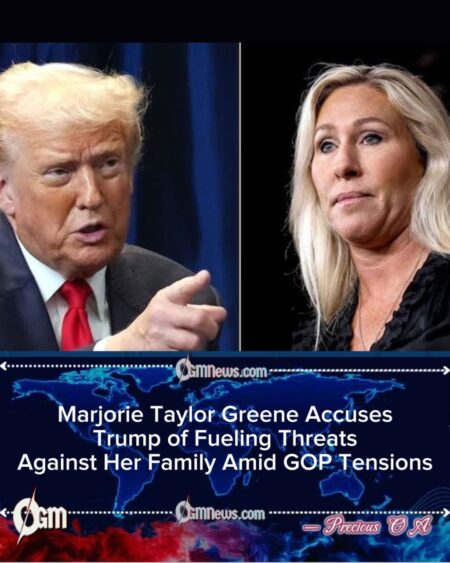
Marjorie Taylor Greene issued a forceful statement blaming President Donald Trump for what she described as a wave of escalating threats targeting her family, framing the situation as the latest and most personal consequence of deepening Republican division. Her comments rapidly reverberated across Washington, drawing intense scrutiny from lawmakers, aides, and political strategists who recognized the seriousness of the accusation. As the conflict spread, it became clear that her claims were not simply an isolated personal complaint but part of a larger, festering struggle over the identity and direction of the Republican Party.
Growing concerns inside Congress surfaced as colleagues noted the sharpness of her accusations, pointing to the increasingly fragile alliances within the GOP caucus. Many privately acknowledged that tensions had been simmering for months, but few expected Greene to take her grievances public in such an explicitly confrontational tone. Her decision to link the threats directly to Trump’s rhetoric exposed a raw and uncomfortable divide that many in leadership had tried to manage quietly behind closed doors.
Heightened political rhetoric across conservative circles intensified the ripples of her claims, prompting aides and analysts to observe that the fallout could reshape internal dynamics going into the next election cycle. Commentators suggested that this may mark a turning point in how Republican leaders handle internal disputes, as more members become willing to challenge Trump while simultaneously fearing the consequences of doing so. The entire episode demonstrated how emotional, volatile, and unpredictable intra-party politics has become.
SECURITY FEARS AND FAMILY IMPACT
Taylor Greene expressed deep alarm over the nature of the threats, emphasizing repeatedly that members of her family had been placed under unprecedented emotional strain as a result. She described the distressing pattern of anonymous messages, invasive questions, and unsettling comments directed not only toward her but toward relatives who had no connection to political life.
Taylor Greene highlighted the emotional toll these developments have had on her children and extended relatives, noting that constant monitoring, calls from security personnel, and uneasy nights had become their new normal. She painted a vivid picture of a household that had transformed from a place of rest into a constant environment of vigilance, worry, and fear. Her recounting underscored how political battles often spill far beyond Capitol Hill.
Taylor Greene described the situation as one that no public servant’s family should ever endure, arguing that political disagreements should never escalate to a point where innocent people feel directly endangered. She reiterated that regardless of ideology or party affiliation, families deserve safety, boundaries, and peace—an increasingly rare luxury in the modern political arena.
BREAKDOWN OF REPUBLICAN UNITY
Taylor Greene warned that the Republican Party faced a dangerous internal fracture, underscoring that her criticism of Trump’s rhetoric was not intended as disloyalty but as a plea for responsible leadership. She insisted that internal tension had reached a point where silence was no longer an option, especially when the personal safety of lawmakers and their families was at stake.
Taylor Greene insisted that continued hostility from pro-Trump activists had created an environment where dissenting voices within the party could no longer speak freely without fear of retaliation. She detailed conversations with colleagues who confided their fears privately while refusing to speak publicly, revealing a culture increasingly governed by intimidation.
Taylor Greene pointed to mounting evidence that intimidation within party ranks had been quietly growing for months, with many officials choosing silence rather than risk backlash from Trump-aligned factions. She suggested that the stability of the party itself may be at risk if members cannot express disagreements without personal consequences.
TRUMP’S RESPONSE AND POLITICAL FALLOUT
Taylor Greene recounted that Trump’s immediate reaction to her claims was dismissive, portraying her warnings as exaggerated while urging supporters to ignore what he called “media-manufactured drama.” She described the dismissal as both predictable and frustrating, noting that the failure to address the threats directly only emboldened the most aggressive elements of his base.
Taylor Greene argued that Trump’s dismissal only intensified the hostility she faced from some corners of the movement, fueling louder online harassment and more aggressive messages directed toward her family. She expressed concern that his refusal to intervene sent an implicit signal that such behavior was acceptable or even encouraged.
Taylor Greene stressed that the former president’s reluctance to condemn these threats contributed significantly to the worsening situation, emboldening individuals who believed they were acting in his defense. She warned that without strong and immediate condemnation, the cycle of harassment and hostility would only continue to escalate.
BROADER NATIONAL IMPLICATIONS
Communities across the country watched the unfolding conflict with growing unease, aware that political polarization continues to seep into daily life and heighten emotional volatility. Many Americans expressed concern about the normalization of threats, hostility, and political intimidation that have become increasingly common in public discourse.
Observers in Washington noted that the feud underscored how deep personal grievances have now become intertwined with national political narratives, shaping perceptions across party lines and among undecided voters. Strategists argued that this controversy could influence voter attitudes, fundraising dynamics, and intra-party endorsements in the months ahead.
Policy analysts suggested that such confrontations could weaken efforts to address major legislative challenges, as emotional animosity increasingly distracts lawmakers from the substance of governance. They warned that political institutions suffer when personal conflicts overshadow policy commitments.
CALLS FOR ACCOUNTABILITY AND NEXT STEPS
Civic groups urged congressional leaders to take stronger action in condemning politically motivated threats, emphasizing the importance of establishing firm boundaries regardless of party loyalties. Their statements called for renewed efforts to reinforce standards of conduct and restore faith in public institutions.
Lawmakers sympathetic to Greene’s experience argued that internal disputes must not eclipse the shared responsibility of safeguarding public servants and their families from extremist intimidation. Some expressed hope that the current conflict might spark new conversations about protecting political staff and families from harassment.
Growing pressure from constituents hinted that leadership on both sides of the aisle may soon be forced to confront the broader consequences of escalating rhetoric as the nation prepares for another intense campaign season. The situation, they argued, underscores the undeniable need for accountability, clarity, and restraint in political communication going forward.


