









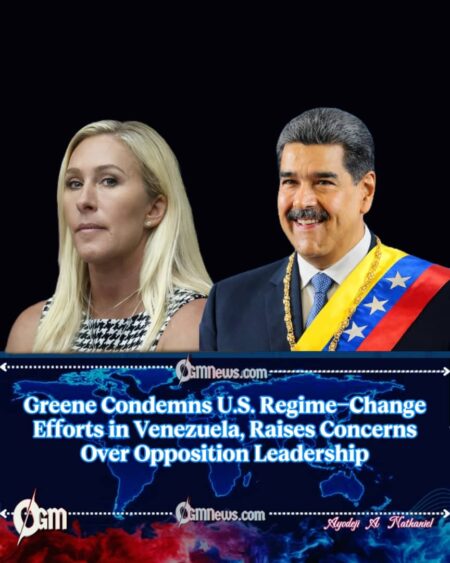
U.S. Representative Marjorie Taylor Greene has publicly condemned U.S. regime-change efforts in Venezuela, arguing that Washington should not pursue policies aimed at toppling the government of President Nicolás Maduro. In her remarks, Greene questioned the motivations and ideological positions of Venezuela’s opposition leadership, signaling strong opposition to deeper U.S. involvement in the country’s internal political struggle.
Her comments add to an ongoing debate in Washington over how the United States should approach Venezuela, balancing democratic advocacy, regional stability, and the risks associated with interventionist foreign policy.
Greene’s Criticism of Regime-Change Policies
Greene stated that she does not support U.S. efforts to engineer political change in Venezuela, framing such strategies as costly, destabilizing, and inconsistent with American national interests. She warned that regime-change policies often lead to unintended consequences, including prolonged instability and humanitarian crises.
Her position aligns with a broader current within U.S. politics that favors restraint abroad and skepticism toward interventions that do not present a clear and direct security benefit to the United States.
Comments on Venezuela’s Opposition Leadership
In explaining her stance, Greene referenced Venezuelan opposition figure Maria Corina Machado, describing her as a strong supporter of Israel who seeks to restore close diplomatic relations between Venezuela and Israel. Greene also noted Machado’s positions on social issues, characterizing her as more left-leaning on abortion and LGBTQ matters.
Greene argued that these ideological factors are relevant when assessing whether U.S. policymakers should back specific opposition movements, suggesting that alignment with American voters’ priorities should factor into foreign policy decisions.
Context: U.S. Policy Toward Venezuela
For years, U.S. policy toward Venezuela has relied on economic sanctions, diplomatic isolation, and political support for opposition groups in an effort to pressure President Nicolás Maduro’s government. Successive administrations have maintained that Maduro’s leadership lacks democratic legitimacy.
Despite these measures, Maduro has remained in power, prompting growing debate over whether current U.S. strategies are effective or whether they risk entrenching the very conditions they aim to change.
Debate Within U.S. Politics
Greene’s remarks highlight divisions within the Republican Party and across Congress regarding foreign intervention. While some lawmakers argue that supporting opposition movements is necessary to counter authoritarian governments, others caution that such involvement can entangle the United States in prolonged and unpredictable conflicts.
The comments also illustrate how foreign policy debates increasingly intersect with domestic political issues, including social policy and alliance politics, shaping how lawmakers evaluate international actors.
Regional and International Implications
Any significant shift in U.S. policy toward Venezuela would carry implications for Latin America, particularly regarding migration flows, energy markets, and regional diplomacy. Neighboring countries have largely favored negotiated political solutions over external military or coercive action.
Greene’s opposition to regime-change efforts adds to calls for a more restrained U.S. approach, emphasizing diplomacy and regional cooperation rather than direct political intervention.
A Call for Restraint and Reassessment
Marjorie Taylor Greene’s condemnation of U.S. regime-change efforts in Venezuela underscores a growing skepticism in Washington about intervention-driven foreign policy. By questioning both the strategy itself and the nature of opposition leadership, she has injected a domestic political lens into an already complex international issue.
As the United States continues to reassess its role in Venezuela, Greene’s remarks suggest that any future escalation or policy shift will face increased scrutiny and debate within Congress.


