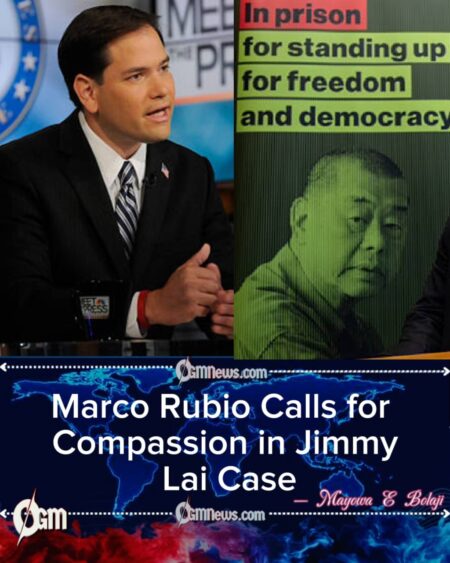
Marco Rubio said the sentencing of Hong Kong media tycoon Jimmy Lai represents a deeply troubling moment for press freedom and the rule of law, describing the outcome as an “unjust and tragic conclusion” to a case that has drawn global scrutiny. Marco Rubio emphasized that the decision has implications far beyond one individual, touching on fundamental democratic values and international legal norms.
Marco Rubio noted that the United States is calling on Hong Kong authorities to act on humanitarian grounds by granting Lai parole, stressing that compassion and justice should prevail in cases involving non-violent political expression and deteriorating health conditions.
Background to the Jimmy Lai Case
Marco Rubio recalled that Jimmy Lai is the founder of the now-shuttered Apple Daily, once one of Hong Kong’s most influential and outspoken pro-democracy newspapers. Marco Rubio said Lai’s long-standing advocacy for democratic reforms made him a central figure in debates over free speech and political rights in the territory.
Marco Rubio added that Lai has faced multiple prosecutions in recent years under laws introduced following political unrest, with critics arguing that such cases reflect a shrinking space for dissent rather than neutral law enforcement.
U.S. Government Response
Marco Rubio stated that the United States views the sentencing as inconsistent with international standards of justice and freedom of expression. Marco Rubio said the case sends a worrying signal to journalists and media organizations operating in environments where political pressure intersects with the legal system.
Marco Rubio stressed that Washington’s appeal for humanitarian parole is grounded in both legal principle and moral responsibility, noting that age, health, and the non-violent nature of the offenses should weigh heavily in any review of the sentence.
Foreign Policy Context Under President Trump
Marco Rubio spoke within the broader foreign policy framework of President Donald Trump, who is currently serving his second term as U.S. president. Marco Rubio said the administration remains committed to addressing human rights concerns globally, including those arising in Hong Kong.
Rubio explained that the Lai case aligns with ongoing U.S. concerns about the treatment of political activists and journalists, particularly where national security laws are applied in ways that critics say restrict fundamental freedoms.
International and Human Rights Reactions
Marco Rubio noted that human rights organizations and several governments have echoed concerns about the sentencing, warning that it could further undermine confidence in Hong Kong’s autonomy and judicial independence. Marco Rubio said these reactions highlight the growing international dimension of the case.
Rubio added that advocacy groups are urging sustained diplomatic engagement, arguing that collective international pressure could encourage authorities to consider humanitarian relief without compromising legal processes.
Legal and Humanitarian Considerations
Marco Rubio observed that humanitarian parole is a recognized mechanism that allows authorities to show leniency in exceptional circumstances. Rubio said such measures are often applied in cases involving serious health concerns or advanced age, even within strict legal systems.
Marco Rubio argued that granting parole would not negate the judicial process but could demonstrate a balance between law enforcement and humane governance, potentially easing diplomatic tensions.
Implications for Hong Kong’s Global Image
Rubio warned that the handling of the Jimmy Lai case could have long-term consequences for Hong Kong’s standing as an international media and financial hub. Rubio said global investors and press organizations closely watch how high-profile cases are resolved.
Rubio concluded that the decision on humanitarian parole will be seen as a test of Hong Kong’s commitment to openness and the rule of law, shaping international perceptions well beyond the immediate case.