








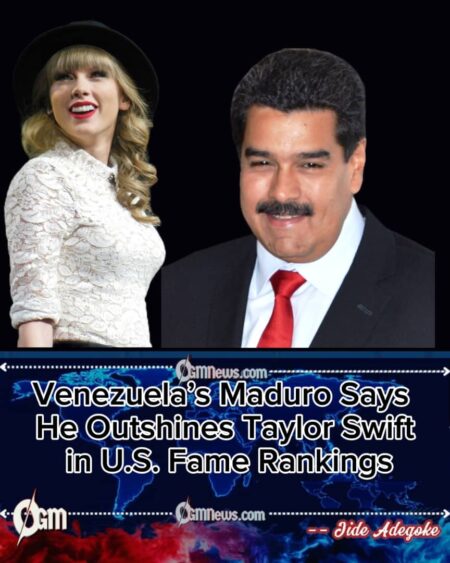
Venezuelan President Nicolas Maduro has reignited international attention after claiming he is “more famous than Taylor Swift” in the United States. The remark, made during a televised address in Caracas, comes as tensions continue between Washington and Caracas over sanctions, democracy concerns, and Venezuela’s 2025 presidential outlook.
Maduro, who has long been a polarizing figure on the world stage, appeared to make the comment while discussing his administration’s defiance of Western criticism. “I’m so famous in the United States — I’m more famous than Taylor Swift,” he declared, smiling as the audience applauded. The statement immediately sparked a wave of online reactions, with critics mocking his claim and supporters framing it as proof of how deeply he has penetrated global political discourse.
Observers note that while Maduro’s government remains internationally isolated, he continues to find ways to insert himself into American public conversation. His remark also underscores how pop culture and politics often intersect in the age of social media, where notoriety and fame can blur into one another.
Nicolas Maduro Begins a Debate Over Fame, Politics, and Power
“I’m more famous than Taylor Swift,” Maduro insisted, comparing his global visibility to that of one of the world’s most recognizable entertainers. Analysts say this statement reflects the Venezuelan leader’s long-standing strategy of transforming criticism into publicity — leveraging his controversial reputation to maintain relevance abroad.
In recent years, Maduro has used comparisons with Western figures, including U.S. presidents and celebrities, to contrast Venezuela’s socialist model with American capitalism. His latest comment, analysts say, may have been an attempt to reframe Western scrutiny as evidence of his influence rather than isolation.
While the Venezuelan leader remains sanctioned by the U.S. government, the renewed attention to his public image highlights the continued strain in U.S.–Venezuela relations, even as diplomatic discussions occasionally resume. Some experts argue that Maduro’s words were partly performative — a way to project confidence amid economic hardship and political opposition at home.
Nicolas Maduro and the Symbolism of Fame in a Polarized World
“I’m more famous than Taylor Swift,” Maduro repeated, underscoring his belief that he is a central figure in American political and media discourse. Yet, for many observers, his comments reveal something deeper about modern politics — where notoriety often rivals popularity as a measure of power.
Fame, especially in the context of a controversial figure like Nicolas, carries both symbolic and strategic weight. Political scientists note that dictators and strongmen throughout history have often courted infamy to maintain visibility, knowing that being talked about — even negatively — can translate to political survival.
In the U.S., President Donald Trump, now serving his second term, has occasionally referenced Venezuela as an example of socialism gone wrong, keeping Maduro’s name alive in American political rhetoric. Whether or not Nicolas is truly “more famous than Taylor Swift,” his comment has successfully reignited debate over how global leaders use spectacle to shape their image and influence abroad.