










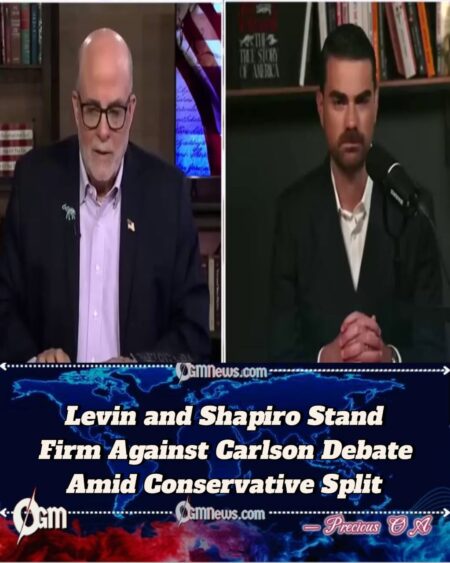
Mark Levin and Ben Shapiro, two of the most prominent voices in American conservative media, have publicly declined an invitation to debate Tucker Carlson, citing concerns that participating in such a discussion would “give antisemitism a platform.” Levin, a well-known radio host with a decades-long presence in conservative commentary, and Shapiro, founder of The Daily Wire and an outspoken cultural critic, both wield significant influence within the right-wing ecosystem. Their coordinated refusal has sent shockwaves through conservative circles, exposing deep and increasingly public ideological divisions within the movement.
Mark Levin and Ben Shapiro’s decisions have generated immediate and widespread discussion, emphasizing the growing tension between traditional conservative thought and the populist, often confrontational rhetoric associated with Carlson. Levin emphasized in statements to media outlets that engaging with Carlson would effectively legitimize rhetoric that could be interpreted as antisemitic, an outcome he categorically refuses to support. Shapiro, in his public communications, echoed this concern, framing his refusal as a moral imperative to avoid lending credibility to ideas or narratives that propagate hate, prejudice, or discrimination.
Observers note that the refusals are emblematic of a larger struggle within the conservative movement, often described in media commentary as a “conservative civil war.” This conflict is not only personal but ideological, highlighting competing visions for the direction of right-wing politics in America. Levin and Shapiro represent a segment of conservatism that emphasizes adherence to ethical principles, intellectual rigor, and moral responsibility, whereas Carlson’s approach reflects a more populist, combative style that frequently courts controversy for audience engagement and influence.
The announcements have also illuminated the strategic considerations of public figures in high-stakes ideological battles. Mark Levin and Ben Shapiro are acutely aware of the consequences of participating in such a debate, including the potential amplification of harmful rhetoric, the risk of alienating core audiences, and the implications for their reputations as thought leaders who prioritize ethical integrity over spectacle. Their refusal, therefore, represents a careful calculation, balancing professional influence, moral stance, and audience expectations in a highly polarized media landscape.
Public and Media Reactions
Mark Levin and Ben Shapiro’s refusals have prompted immediate and intense reactions across multiple platforms, from traditional news media to social networks. Conservative audiences, accustomed to public debates and confrontations, were divided in their responses. Some praised their principled stand, highlighting the courage required to reject high-profile engagement on the grounds of moral conviction. Supporters framed the decision as an affirmation of values over spectacle, emphasizing that the avoidance of legitimizing antisemitism reflects a commitment to ethical responsibility within political discourse.
Media analysts have noted that Mark Levin and Ben Shapiro have carefully crafted their public messaging to avoid personal attacks while clearly articulating the reasons behind their refusals. This approach has been interpreted as an effort to maintain credibility with their audiences, ensuring that the decision is seen as a principled stance rather than an act of fear or avoidance. Their statements underscore the increasing expectation that public figures take definitive positions on ethical matters, even when doing so may create conflict within their broader ideological community.
Meanwhile, social media platforms erupted with commentary, debate, and analysis regarding the implications of the refusals. Hashtags featuring Levin, Shapiro, and Carlson quickly trended, as users weighed the consequences of giving a platform to controversial figures versus the risk of appearing unwilling to confront opposing viewpoints. Discussions on X (formerly Twitter), Instagram, and conservative online forums ranged from praise for principled leadership to accusations of political cowardice, reflecting the intense polarization that now characterizes conservative media discourse.
International observers and political commentators have also noted the broader implications of the refusal. By publicly rejecting Carlson, Mark Levin and Ben Shapiro have reinforced a narrative of accountability and ethical awareness within the movement, drawing attention to the need for standards of discourse and responsibility, particularly on sensitive issues like antisemitism. Analysts suggest that this moment may influence other conservative figures in determining whether to engage with Carlson or similar media personalities in the future.
Implications for Conservative Politics
The refusals by Mark Levin and Ben Shapiro have significant implications for the broader trajectory of American conservative politics. Analysts argue that this episode illustrates the widening divide between traditionalist, principle-driven conservatives and populist, combative figures who prioritize audience engagement over moral caution. The confrontation highlights ongoing debates over the ethical boundaries of political media, including the responsibilities of public figures in shaping discourse, the limits of free expression, and the consequences of amplifying controversial voices.
The conservative civil war, as media commentators have termed it, is increasingly focused on questions of identity, morality, and messaging. Mark Levin and Ben Shapiro’s stance reinforces the notion that certain issues, particularly antisemitism, must be treated with unwavering seriousness. By explicitly citing antisemitism as the reason to decline a high-profile debate, they position themselves as defenders of ethical conservatism, signaling to their audiences and peers that principle cannot be sacrificed for spectacle, ratings, or political gain.
This refusal also sets a precedent for other conservative leaders who may face similar invitations. The expectation for moral clarity and responsibility is growing, and public figures are now forced to navigate the complex intersection of ideology, ethics, and public influence. Strategic observers suggest that the outcome of this confrontation could reshape the media landscape, influence conservative messaging, and redefine which voices are considered authoritative or credible within the movement.
For Mark Levin and Ben Shapiro, the stakes extend beyond a single debate. Their decisions signal to followers, peers, and critics that ethical boundaries and moral considerations are central to leadership within the conservative movement. While some supporters may view the refusal as courageous, others aligned with Carlson’s style may perceive it as avoidance, creating both immediate reputational consequences and long-term implications for influence and alliances within American politics.
As this controversy continues to unfold, political analysts, journalists, and media commentators are closely watching reactions from other prominent conservatives, media personalities, and political operatives. The ripple effects of Levin and Shapiro’s decision may influence the broader ideological alignment of the conservative movement, forcing a reckoning on questions of ethics, identity, and accountability that could shape its trajectory for years to come. The episode illustrates the increasingly complex interplay between media strategy, moral principle, and political influence in shaping contemporary conservatism.
Ultimately, the refusal of Mark Levin and Ben Shapiro to debate Tucker Carlson underscores a critical moment in the evolution of conservative politics, highlighting how ethical considerations, identity politics, and strategic messaging intersect in a highly polarized media environment. Whether this event represents a temporary fracture or a long-term redefinition of the movement’s priorities remains to be seen, but it is clear that the consequences will reverberate far beyond the debate stage, influencing both public perception and the internal dynamics of American conservatism for the foreseeable future.


