










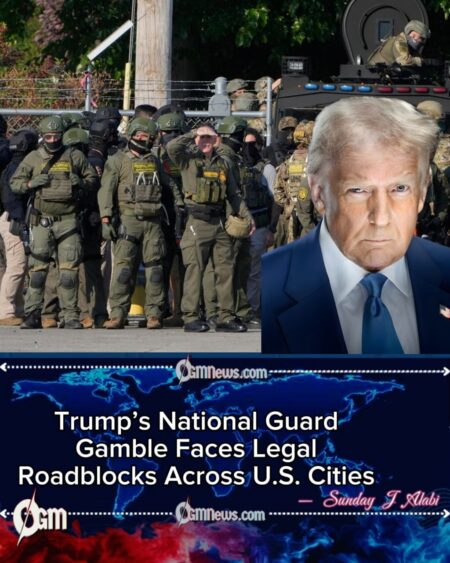
President Donald Trump’s recent move to deploy National Guard troops into several major U.S. cities has ignited a wave of legal challenges from state officials and governors who argue the president is overstepping his constitutional authority. Trump, serving his second term, insists the deployments are essential to restore order, combat surging crime, and enforce immigration laws in what he describes as “lawless, Democrat-run cities.”
Illinois became the latest state to resist the measure, filing a lawsuit on Monday seeking to block the deployment of federal troops to Chicago. The suit follows a weekend of court rulings that temporarily halted similar deployments to Portland, Oregon, from Texas and California. Democratic governors, including Illinois’ JB Pritzker and Oregon’s Tina Kotek, contend that Trump’s actions risk escalating tensions rather than resolving them.
The legal standoff underscores a deepening conflict over the limits of presidential power in domestic law enforcement — a clash that now places the National Guard at the center of a broader political struggle between Washington and the states.
What the National Guard Is — and What It’s Meant to Do
The National Guard, long regarded as a reserve force for emergencies and natural disasters, occupies a unique position in America’s military structure. Each of the 50 states, along with the District of Columbia and U.S. territories, maintains its own contingent. Under normal circumstances, governors activate these troops to assist with local crises — from hurricanes and wildfires to civil unrest — while the president retains the authority to federalize them under specific legal provisions.
However, those powers are carefully limited. The 1878 Posse Comitatus Act restricts the federal government’s ability to use military force in domestic law enforcement, reflecting the nation’s deep-rooted aversion to militarized policing. As a result, National Guard troops typically do not perform arrests or seizures and primarily serve in a support capacity during emergencies.
Trump’s move to bypass the customary request process from governors — taking direct control of certain state Guard units — has therefore alarmed both legal scholars and civil rights advocates. They argue that the president Trump’s actions erode federal-state balance and may blur the line between civil authority and military power.
The Legal Foundation — and the Growing Controversy
Trump’s legal justification hinges on 10 U.S. Code §12406, a rarely invoked statute that allows the president to mobilize National Guard units in cases of “rebellion” or “danger of invasion.” Historically, this law has been used sparingly, and typically under extreme circumstances. Yet, the Trump administration has leaned on it repeatedly in recent months, claiming widespread disorder and rebellion in cities like Los Angeles, Chicago, and Portland.
White House press secretary Karoline Leavitt defended the move, saying, “We’re very confident in the president Trump’s legal authority to do this.” Defense Secretary Pete Hegseth echoed that stance, asserting the deployments were necessary to “restore order and protect federal property.”
Federal courts, however, have pushed back. U.S. District Judge Karin Immergut, appointed by Trump during his first term, issued two injunctions in Oregon over the weekend, writing that the United States “is a nation of constitutional law, not martial law.” Her rulings temporarily barred Trump from federalizing the Oregon and California National Guards for use in Portland. The administration has since vowed to appeal, setting up what could become a defining constitutional showdown over executive power.
Portland Protests and the Politics of “Law and Order” by Trump Administration
At the heart of the dispute lies Portland — a city that has become emblematic of the tension between Trump’s hardline “law and order” stance and Democratic-led local governance. Over the weekend, protests near a federal immigration facility escalated into confrontations with federal officers, prompting Trump to declare the city “out of control.”
Local officials dispute that characterization. Governor Tina Kotek dismissed Trump’s claims of “insurrection,” saying there was “no threat to national security” and condemning the president’s actions as “politically motivated theater.” Meanwhile, local police confirmed a handful of arrests but noted that the demonstrations were largely contained.
Trump’s insistence on using federal troops — despite court injunctions and bipartisan concern — signals his determination to project strength on domestic security. Yet, critics warn the approach could deepen polarization and set a dangerous precedent for future administrations.
What Comes Next for Trump Administration ?
As lawsuits proceed in multiple states, legal experts predict the issue will likely reach the Supreme Court. The outcome could reshape the balance of power between federal and state governments regarding domestic military deployment.
For now, cities like Chicago and Portland remain flashpoints in an intensifying national debate — one that pits presidential authority against local autonomy, and law enforcement against civil liberties.


