








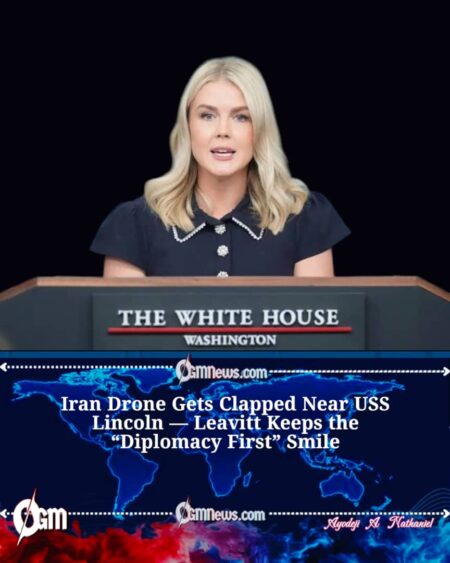
Karoline Leavitt, the White House press secretary, confirmed that U.S. Central Command (CENTCOM) shot down an unmanned Iranian drone after it acted “aggressively” toward the USS Abraham Lincoln, stressing that President Donald Trump—currently serving a second term—remains committed to pursuing diplomacy first, while warning that diplomacy “takes two to tango.”
The incident marks a significant escalation point in an already tense U.S.–Iran relationship, placing renewed focus on rules of engagement, force protection, and Washington’s wider strategy of deterrence without triggering a broader regional conflict.
Karoline Leavitt’s Statement: White House Confirms the Shootdown
Leavitt told reporters that CENTCOM made the decision to destroy the Iranian drone after it behaved in a threatening manner toward the USS Lincoln. By emphasizing CENTCOM’s authority in the decision, the White House framed the action as a military necessity rather than a political directive.
Her remarks were designed to balance two priorities: reassuring Americans and allies that U.S. forces will be protected, while simultaneously signaling to adversaries that the United States is not seeking escalation.
Leavitt also reaffirmed the administration’s stance that the president’s default approach remains diplomatic engagement—but only if the other side acts in good faith.
The USS Lincoln Incident: What “Aggressive” Drone Behavior Typically Means
Although the administration did not release full operational details, the phrase “acting aggressively” is commonly used when an aircraft approaches within restricted proximity, tracks sensitive assets, or performs maneuvers that appear hostile or probing.
U.S. aircraft carriers are considered strategic assets and are surrounded by layered defenses and strict airspace control. Any unauthorized drone activity near such a vessel is treated as a potential threat, even if the drone is unarmed.
Drones can serve multiple purposes—including surveillance, electronic interference, and target acquisition making them especially in high-tension environments.
CENTCOM’s Role: Rules of Engagement and Force Protection
Leavitt’s clarification that CENTCOM made the call highlights how U.S. commanders operate under established rules of engagement that permit immediate defensive action.
In modern military doctrine, force protection decisions are often delegated to operational commanders to ensure rapid response. When a threat is detected near a carrier strike group, the margin for error is extremely small.
This is particularly true with drones, where identifying intent can be difficult. Commanders must decide quickly whether the drone is merely observing, attempting to disrupt systems, or preparing for a strike.
Trump Administration’s Dual Track: Diplomacy First, Deterrence Always
Leavitt emphasized that President Trump remains committed to diplomacy, underscoring that the U.S. prefers negotiated solutions over military conflict. However, her statement also made clear that diplomacy does not mean passivity.
The administration’s message is consistent with a broader “peace through strength” posture: maintain military readiness and enforce red lines while leaving the door open to diplomatic engagement.
The phrase “it takes two to tango” serves as a pointed warning to Iran—Washington will pursue talks, but it will not tolerate threats to the U.S. personnel or assets.
Regional Implications: Escalation Risks and Strategic Signaling
Drone shootdowns can have consequences beyond the immediate event. Even defensive engagements can be interpreted as provocations by the opposing side, especially in a region where miscalculation has historically triggered conflict.
Iran may respond in several ways: issuing public condemnation, increasing drone patrols, directing proxy groups to intensify pressure, or attempting to test U.S. defenses again.
Meanwhile, U.S. allies in the Middle East will likely view the incident as confirmation that tensions remain high—potentially increasing security coordination, intelligence sharing, and defensive preparations.
What Comes Next: De-escalation Channels and Military Readiness
In the short term, U.S. forces are expected to maintain heightened vigilance in the area, including expanded surveillance and stricter enforcement of operational boundaries around naval assets.
Diplomatic channels—direct or indirect—may also be activated to prevent further escalation. Historically, the U.S. and Iran have relied on intermediaries to clarify intent and avoid accidental war.
Leavitt’s emphasis on diplomacy suggests the White House wants to prevent this incident from spiraling into a broader crisis, but the administration is equally signaling that future threats will be met with decisive action.