








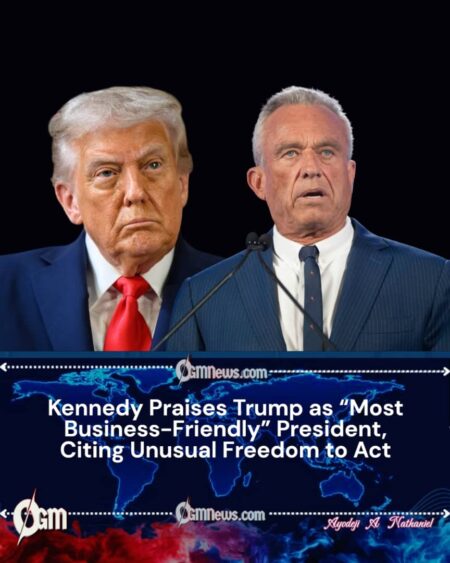
Health and Human Services Secretary Robert F. Kennedy Jr. has described President Donald Trump, the current U.S. president serving his second term, as “probably the most business-friendly president we’ve had,” praising an administrative style that, in his words, grants cabinet officials wide latitude to act decisively.
Kennedy said working under President Trump has been “a joy,” adding that the president allows initiatives that previous administrations would not.
The remarks offer a rare insider perspective on how senior officials experience governance under President Trump, highlighting autonomy, speed, and a results-oriented approach as defining features of his leadership.
Kennedy’s Assessment of Trump’s Leadership
Secretary Kennedy framed President Trump’s leadership as unusually permissive in terms of executive authority delegated to cabinet members. According to Kennedy, this freedom enables faster decision-making and bolder policy experimentation, particularly in areas tied to economic efficiency and regulatory reform.
He suggested that such latitude contrasts sharply with more centralized or cautious administrative models, where initiatives can be slowed by layers of internal review and political hesitation.
Business-Friendly Governance as a Priority
Kennedy’s comments align with President Trump’s long-standing emphasis on business confidence, deregulation, and private-sector growth. The administration has repeatedly argued that reducing regulatory friction encourages investment, innovation, and job creation.
Supporters view this approach as a catalyst for economic expansion, while critics argue that aggressive deregulation can carry risks if oversight is weakened. Kennedy, however, indicated that flexibility does not necessarily mean the absence of accountability.
Operational Freedom Inside the Cabinet
By saying Trump “lets me do stuff that I don’t think anybody else would ever let me do,” Kennedy highlighted a governing philosophy that prioritizes outcomes over process. He implied that the president’s trust in cabinet officials allows them to test unconventional solutions.
Analysts note that such autonomy can produce rapid policy shifts, but its success often depends on the experience and judgment of those empowered to act.
Contrast With Previous Administrations
Without naming past presidents, Kennedy’s remarks implicitly contrasted Trump’s style with administrations that favored tighter control over cabinet initiatives. Historically, some presidents have relied on consensus-driven decision-making, while others have centralized authority within the White House.
Kennedy suggested that President Trump’s willingness to decentralize operational power marks a significant departure from those models.
Political and Policy Implications
Politically, Kenned’s endorsement reinforces President Trump’s image as a disruptor of traditional governance norms. The administration frequently presents this disruption as necessary to overcome bureaucratic inertia.
Policy experts caution that while flexibility can drive innovation, it also requires clear benchmarks and oversight to ensure long-term effectiveness and public trust.
Looking Ahead
As President Trump continues his second term, Kennedy’s remarks raise broader questions about how leadership style influences policy outcomes. Whether this business-friendly, high-autonomy model delivers sustained results will likely shape both public perception and the administration’s legacy.
For now, the comments add to a growing body of testimony from officials who describe the Trump White House as unusually permissive—and demanding—in equal measure.