










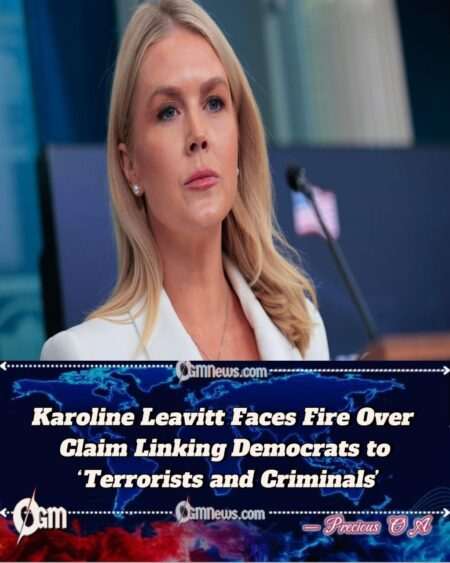
Karoline Leavitt, a former White House press aide under the current U.S. president, Donald Trump, and now a key Republican campaign spokesperson, has ignited controversy with her recent comments targeting the Democratic Party. In a social media post that quickly went viral, Leavitt alleged that “The Democrat Party’s main constituency is made up of Hamas terrorists, illegal aliens, and violent criminals.”
Karoline Leavitt’s statement, shared on X (formerly Twitter), provoked immediate backlash from political leaders, civil rights advocates, and independent voters alike. Many viewed the comment as a dangerous escalation of divisive rhetoric ahead of the upcoming elections, accusing her of spreading misinformation and inciting hostility toward entire communities. Her remarks were also condemned as factually inaccurate and inflammatory, with several media outlets pointing out that they echo long-standing conspiracy theories promoted by far-right commentators.
Karoline Leavitt’s defenders, however, argue that she was merely emphasizing what they consider the “moral failures” of Democratic immigration and foreign policy positions. To them, her blunt rhetoric reflects the frustration of many Americans who believe the current administration’s opponents prioritize political correctness over national security. Yet, even among conservative circles, some viewed her language as unnecessarily harsh, warning that it might alienate swing voters in key battleground states.
Karoline Leavitt has long been known for her unapologetically combative style. A rising figure within the Republican Party, she first gained attention during Trump’s first term for her outspoken media appearances and willingness to challenge journalists head-on. Now serving as one of the most visible faces of Trump’s second-term communications team, her role is to energize the base and dominate the news cycle — something she achieves with remarkable consistency.
Karoline Leavitt and the Politics of Polarization
Karoline Leavitt’s remarks come at a time when both major parties are under intense scrutiny for their handling of social and economic divisions in the United States. Political analysts say her statements exemplify the hyper-partisan tone defining modern political discourse, where attention-grabbing soundbites often overshadow substantive debate.
Karoline Leavitt’s comments were met with swift rebukes from Democratic lawmakers who accused her of using fear-based tactics to demonize entire groups of people. Representative Jamie Raskin described her remarks as “a deliberate attempt to sow hatred and distrust,” while Senator Elizabeth Warren called them “an attack on democracy itself.” Both urged the Republican Party to condemn Leavitt’s words and distance itself from extremist rhetoric.
Karoline Leavitt’s allies, however, insist that the criticism is politically motivated. They argue that Democrats and the mainstream media are selectively outraged, often ignoring equally inflammatory comments from their own side. Within Trump’s campaign, her combative tone is viewed not as a liability but as an asset — one that helps keep the president’s message in constant circulation among supporters.
Karoline Leavitt’s rise reflects the changing media landscape of American politics. No longer are campaign surrogates confined to traditional press briefings; instead, they operate in a digital environment where engagement often trumps accuracy. Her comments, while widely condemned, succeeded in dominating the political conversation for days — a feat that underscores her strategic value to the Trump campaign.
Karoline Leavitt’s polarizing presence also highlights the tension between populism and pragmatism within the Republican Party. While her words resonate strongly with Trump’s loyal base, they risk alienating moderates and suburban voters — demographics crucial for any path to victory in the 2026 midterms and beyond.
Karoline Leavitt’s Defense and the Broader Implications
Karoline Leavitt, responding to the backlash, doubled down on her claims in a televised interview, stating that she “won’t apologize for speaking the truth about who the Democrats really stand for.” She accused the media of “twisting” her words and insisted that her critics were more concerned with “virtue signaling” than addressing real threats to American safety. Her refusal to retract or clarify her statement has further fueled debate about responsibility in political communication.
Karoline Leavitt’s comments, though constitutionally protected under free speech, carry significant social implications. Legal and political experts warn that repeated use of such charged language by public figures can normalize hostility and deepen polarization. Dr. Melissa Ortega, a political psychologist at Georgetown University, noted that “rhetoric like Leavitt’s doesn’t just energize voters — it radicalizes them.” She added that the long-term danger lies in eroding trust between citizens and institutions.
Karoline Leavitt’s defenders argue that political correctness has gone too far and that silencing conservative voices only strengthens public resentment. They claim that her remarks, while controversial, reflect genuine concerns about border security, terrorism, and crime. Yet, fact-checkers have repeatedly debunked the notion that the Democratic Party supports or is supported by extremist or criminal groups.
Karoline Leavitt’s remarks have also reignited debate over accountability in political campaigning. Should public figures face consequences for spreading harmful stereotypes, or does censorship pose a greater risk to democracy? Her case illustrates the dilemma facing social media platforms and news outlets: whether to amplify such statements in the name of transparency or to limit their reach to prevent misinformation.
Karoline Leavitt’s episode ultimately underscores a growing pattern in modern American politics — one where outrage fuels engagement, and engagement drives influence. Her ability to dominate public discourse, even through controversy, demonstrates how communication has evolved from persuasion to provocation. As the nation edges closer to another election cycle, her words serve as both a warning and a reflection of how far the boundaries of acceptable political speech have shifted.


