









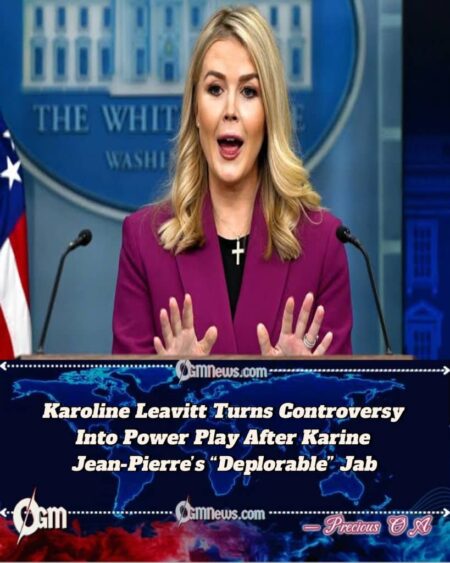
Karoline Leavitt has once again proven that she is no stranger to controversy or confrontation. The White House Press Secretary found herself dominating national headlines after Karine Jean-Pierre, who served under President Joe Biden, publicly branded her conduct as “deplorable.” The remark came during Jean-Pierre’s appearance on The View, where she accused Leavitt of turning the press secretary’s office into a stage for “trolling” rather than transparency. Jean-Pierre criticized her successor for what she described as a lack of professionalism, claiming that Leavitt’s approach “cheapens the integrity of the podium.”
The Trump administration swiftly came to Leavitt’s defense, emphasizing her effectiveness and resilience under pressure. Senior advisers praised her as “fearless” and “uncompromising,” arguing that she has redefined the role by taking the fight directly to what they call a “hostile and biased media.” Their support reinforced her standing within the administration and bolstered her confidence to respond publicly to Jean-Pierre’s remarks.
Karoline Leavitt, who has built her image around fierce loyalty to President Donald Trump and a readiness to clash with critics, fired back immediately. During a press gaggle, she dismissed Jean-Pierre’s attack as “typical bitterness from a failed administration,” adding, “Karine worked for the most incompetent president in history, so I guess she has a reason to be bitter. But being bitter will not sell you books.” Her sharp retort was a reference to Jean-Pierre’s recently released memoir, which includes critiques of her own party and reflections on her turbulent time in the White House.
Her earlier comments that sparked the uproar came during a Fox News appearance in which she accused Democrats of being “filled with Hamas terrorists, illegal aliens, and violent criminals.” The statement ignited outrage among liberals but drew praise from conservatives who viewed it as a fearless truth-telling moment. Her words, though divisive, echoed the tone of the Trump administration’s second term—one focused on bluntness, not political correctness.
Karoline Leavitt’s reaction to being called “deplorable” also revived memories of Hillary Clinton’s 2016 campaign remark describing some Trump supporters as a “basket of deplorables.” Many conservatives saw Jean-Pierre’s choice of wording as a deliberate callback meant to demean them, but it quickly backfired. Within hours, Leavitt’s supporters reclaimed the label online, using hashtags like #ProudToBeDeplorable and #LeavittStrong, turning what was meant to be an insult into a rallying cry.
Karoline Leavitt’s defiance only reinforced her growing influence as one of the most recognizable faces in the Trump administration. Her remarks were replayed across major news outlets and social media platforms, sparking fierce debates about tone, respect, and political communication in Washington. Even critics admitted that her response displayed confidence and control—qualities that have made her both a lightning rod and a rising star.
The Rise of a New Press Secretary Style
Karoline Leavitt’s ascent to the White House podium marked the dawn of a new communication era—one that mirrors President Trump’s direct and unapologetic approach. At just 27 years old, Leavitt is the youngest press secretary in American history, and her presence in the press room represents a generational shift in both tone and tactics. Her press briefings are less about carefully worded statements and more about challenging narratives she believes are hostile to the administration.
Critics of her approach often accuse her of being combative, but supporters view her assertiveness as refreshing honesty. She refuses to back down from tough questions and often calls out reporters by name for what she deems “misleading” or “biased” coverage. Her strategy resonates strongly with Trump’s base, who see her as a defender of truth in a media environment they view as overwhelmingly liberal. “The press doesn’t deserve to be handled softly,” she once said. “They’ve spent years lying about the American people who voted for us.”
Karoline Leavitt’s use of social media further separates her from predecessors. She frequently uploads clips from press briefings, adds commentary, and responds to journalists online in real time. This approach allows her to bypass traditional media filters and communicate directly with millions of followers, ensuring that her message reaches the public without alteration. Her online presence has made her both a communications innovator and a polarizing figure in Washington.
The feud with Jean-Pierre also reflects a wider cultural divide in American politics. While Jean-Pierre values diplomacy and decorum, Leavitt believes that “civility” has too often been used to silence conservative voices. Her approach embodies the Trump-era philosophy of meeting criticism with unapologetic force rather than concession. The contrasting styles between the two women reveal not just personal differences, but a deeper transformation in how the White House defines communication itself.
Karoline Leavitt’s influence extends beyond daily briefings. Her media style, built on immediacy and defiance, has reshaped how political figures engage the public. Analysts note that her effectiveness lies in her ability to make every exchange feel like a battle of ideas—one she intends to win. Whether or not the traditional press approves, her influence on political communication is undeniable and may redefine the expectations of future press secretaries.
Implications for the White House and Beyond
Karoline Leavitt’s confrontation with Jean-Pierre underscores a broader evolution in the role of the White House Press Secretary. What was once a position rooted in polished statements and careful diplomacy has become, under Leavitt, an instrument of cultural combat and rapid-response messaging. Her willingness to use emotion, sarcasm, and wit has made her a fixture not only in Washington politics but also in the national conversation about truth and transparency.
Observers note that Leavitt’s unapologetic tone has become emblematic of the Trump administration’s renewed media strategy—a deliberate rejection of cautious political communication. For her allies, she is a symbol of strength, clarity, and conviction. For critics, she represents a dangerous erosion of professionalism and respect for institutions. Yet, both sides agree that she has succeeded in reshaping public expectations of how the White House communicates.
Karoline Leavitt’s back-and-forth with Jean-Pierre is not merely a personal feud—it encapsulates the current state of American discourse. It shows how ideological divisions now extend into tone, language, and even the posture of official communication. Her words, her defiance, and her confidence reflect a broader national mood—one less interested in politeness and more focused on impact.
Karoline Leavitt’s influence continues to expand beyond the press room. Political commentators suggest that she may play an even greater role in shaping the messaging strategy for the upcoming 2026 midterms, where her fiery rhetoric could energize the Republican base. Whether or not one agrees with her style, Leavitt has undeniably transformed the nature of political storytelling in Washington.
Ultimately, the rise of Karoline Leavitt—and her clash with Jean-Pierre—illustrate a fundamental truth about today’s politics: the messenger can matter as much as the message. By standing her ground, embracing controversy, and refusing to soften her edges, Leavitt has made it clear that she is not just a spokesperson but a central player in the ongoing battle for America’s political narrative.


