










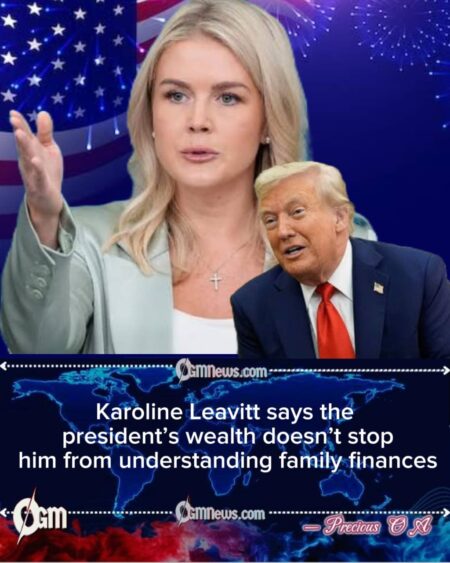
Karoline Leavitt said that the president’s personal wealth does not insulate him from understanding the pressures American families face, arguing that his experience in business and negotiations has sharpened his awareness of how inflation, wages, and household costs affect daily life. She framed the president’s outlook as grounded in practical realities rather than elite detachment, emphasizing that financial success can coexist with economic empathy.
Karoline Leavitt stressed that the president regularly receives briefings not only from economists but also from workers, small business owners, and community leaders who describe firsthand how prices, rent, and healthcare costs shape their decisions. She said those conversations inform policy priorities more than abstract statistics alone.
She also pointed to the president’s public comments on grocery bills, fuel prices, and childcare expenses as evidence that he speaks the language of ordinary Americans, reinforcing her claim that wealth does not automatically create distance from economic struggle.
Understanding Family Finances
Karoline Leavitt explained that the president’s understanding of family finances comes from years of employing thousands of workers and watching how economic swings affect payrolls and consumer confidence. She argued that managing large organizations requires constant attention to cost pressures that ultimately mirror those facing households.
Karoline Leavitt added that the administration views the economy through the lens of family balance sheets, focusing on disposable income, savings, and debt rather than headline market performance alone. She said this approach reflects an awareness that stock gains mean little if families feel squeezed.
According to Leavitt, messaging from the White House is deliberately centered on affordability because political leadership must address what people experience at the kitchen table, not just what appears in quarterly reports.
Policy Through a Practical Lens
Karoline Leavitt said economic policy under the president is shaped by outcomes rather than ideology, noting that decisions are evaluated based on whether they ease costs or expand opportunity for working families. She described this as a results-driven mindset influenced by real-world business experience.
She argued that the president’s wealth gives him freedom from special interests, allowing him to prioritize policies he believes will stabilize prices and encourage growth. In her view, that independence strengthens his ability to act on behalf of voters rather than donors.
Karoline Leavitt emphasized that understanding the economy is not about personal hardship alone, but about recognizing systemic pressures and responding with policies that improve everyday life.
Public Trust and Credibility
Karoline Leavitt acknowledged skepticism from critics who question whether a billionaire can truly relate to economic anxiety, but she insisted that credibility comes from listening and acting, not background alone. She said voters judge leaders by whether their policies bring relief.
She noted that the president’s communication style often centers on plain language, which she believes builds trust with families who feel alienated by technical economic jargon. That accessibility, she argued, reinforces the perception that he understands their concerns.
Karoline Leavitt maintained that public trust grows when leaders demonstrate awareness of rising costs and show urgency in addressing them, regardless of personal net worth.
Responding to Economic Pressures
Karoline Leavitt said the administration is acutely aware of inflationary pressures and has made cost-of-living relief a central theme in its economic agenda. She highlighted efforts aimed at reducing expenses tied to energy, food supply chains, and housing.
She argued that these measures reflect an understanding that families experience the economy through monthly bills rather than macroeconomic charts. By targeting those pain points, the president aims to translate policy into tangible relief.
Karoline Leavitt reiterated that empathy must be paired with action, and she framed current initiatives as proof that the president’s understanding of the economy is both practical and responsive.
Leadership and Economic Reality
Karoline Leavitt concluded that leadership in uncertain economic times requires clarity about what families endure and decisiveness in addressing it. She said the president’s background equips him to navigate complexity while keeping everyday realities in focus.
She added that voters ultimately care less about a leader’s wealth than about whether they feel seen and heard in policy decisions. From her perspective, that connection defines effective economic leadership.
Karoline Leavitt emphasized that the president’s awareness of economic realities is not theoretical but informed by continuous engagement with the people policies are meant to serve, reinforcing her assertion that wealth and understanding are not mutually exclusive.


