








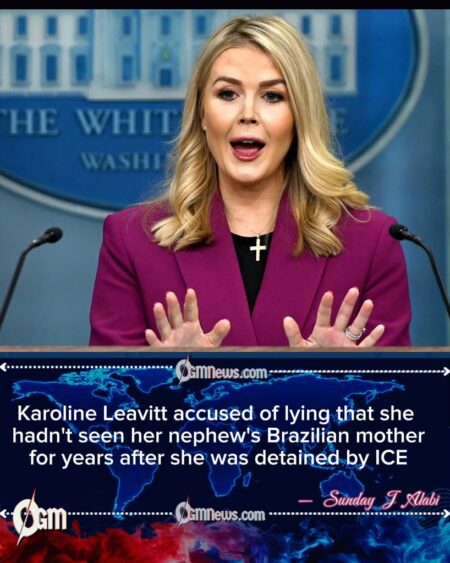
Lawyers for the detained Brazilian mother of White House Press Secretary Karoline Leavitt’s nephew have accused the top aide of misrepresenting the state of their relationship amid a contentious immigration battle.
Bruna Ferreira, a Brazilian national and mother of 11-year-old Michael Leavitt Jr, has been held in a southern Louisiana Immigration and Customs Enforcement (ICE) detention facility for much of November after being taken into custody in Revere, Massachusetts. While a source previously told the Daily Mail that Leavitt and Ferreira had not spoken “in many years,” Ferreira’s attorney, Todd Pomerleau, insists that account is false and unfairly distances the press secretary from a complex family situation.
According to Pomerleau, Ferreira has remained in contact with Leavitt and even attended her son’s soccer game with the Leavitt family just weeks before her arrest. The dispute over what Leavitt knew and when she last interacted with Ferreira has intensified scrutiny of the White House’s messaging and of the broader immigration policies being enforced under the current U.S. administration.
Claims of Recent Contact Contradict Anonymous White House Narrative
Pomerleau, who represents Ferreira in her immigration case, openly challenged the assertion that Leavitt and Ferreira have long been estranged. Speaking to The Daily Beast, he claimed Ferreira has had recent contact with Leavitt and her family.
“She’s seen and talked to Karoline Leavitt definitely within the past year, if not the past months,” he said, directly contradicting an unnamed White House insider quoted by the Daily Mail. That source had framed Ferreira as someone who had “not spoken in many years” with Leavitt and emphasized that the child has lived full-time with his father in New Hampshire “since he was born” and has “never resided with his mother.”
Pomerleau went further, alleging that Ferreira had been in the company of the Leavitt family shortly before her detention, including at an 11-year-old soccer match where she was present alongside the press secretary’s brother and former partner, Michael Leavitt Sr. This, he argues, undercuts efforts to portray Ferreira as distant or disconnected from the family.
Godmother Allegation Adds Emotional Weight to Legal Battle
The attorney also highlighted the personal bond between Ferreira and the press secretary, claiming that Ferreira chose Karoline Leavitt to be her son Michael Jr’s godmother “over her own sister.” According to Pomerleau, Ferreira is “quite proud” of Leavitt’s rise to prominence in the Trump administration, even as she now finds herself at the center of an immigration controversy involving the same government.
Ferreira is said to be “baffled” by the turn of events and by public suggestions that she is a near-stranger to the Leavitt family. From detention in Louisiana, she has reportedly struggled to understand why her previous closeness to the family is being downplayed at a moment when her fate in the United States hangs in the balance.
The White House has been approached for comment but has not publicly addressed the specific claims about recent interactions or the godmother relationship. That silence has left Pomerleau’s assertions unchallenged in detail, even as official and anonymous statements paint a sharply different picture.
ICE Detention, DACA History and Disputed Immigration Status
Ferreira’s case sits at the intersection of long-standing U.S. immigration debates. Her lawyer says she arrived in the United States in 1998 and remained under the protections offered by the Deferred Action for Childhood Arrivals (DACA) program. She was reportedly in the process of adjusting her immigration status when she was detained earlier this month in Revere, Massachusetts, after traveling from Massachusetts to New Hampshire to pick up her son.
At the time of her detention, Ferreira allegedly tried to explain to ICE agents her ties to the Leavitt family and her longstanding life in the United States. Her sister, Graziela Dos Santos Rodrigues, told The Boston Globe that agents “swarmed” Ferreira’s car and “were not the most gentle” with her, adding that Ferreira, who has been in America since she was six years old, is “more American than she is anything else.”
The Department of Homeland Security (DHS), however, has described Ferreira in starkly different terms, labeling her a “criminal illegal alien” with a previous arrest for battery. Officials say she entered the U.S. on a B2 tourist visa that required her to leave by June 6, 1999, and that under policies enforced by the administration of President Trump and Secretary Kristi Noem, all individuals unlawfully present in the country are subject to deportation.
Family Support, Fundraising and Strain Over Deportation
The legal fight has mobilized Ferreira’s family and supporters, who have turned to public fundraising to cover legal and related costs. Rodrigues launched a GoFundMe campaign, which quickly surpassed its $30,000 target thanks in part to a single anonymous $5,000 donation.
In an update, Rodrigues wrote that Thanksgiving “looks very different” for the family this year but expressed deep gratitude for the “love and support” they have received from the wider community. She praised Pomerleau as a “rockstar attorney” whose efforts have given the family renewed hope in a daunting legal battle.
Privately, however, Rodrigues has voiced frustration and disappointment with some members of the Leavitt family. She claims that after Ferreira’s arrest, both Michael Sr and his father, Bob Leavitt, offered little concrete help beyond urging that Ferreira “self-deport.” “Self-deport to where? Brazil is not her home,” Rodrigues said, underscoring her belief that Ferreira’s strongest ties are now in the United States.
Child Caught Between Legal Systems and Family Narratives
At the center of the dispute is 11-year-old Michael Jr, who, according to his father Michael Sr, lives full-time with him and his wife in New Hampshire. In comments to WBUR, Michael Sr stressed that his “only concern has always been the safety, well-being, and privacy” of his son, noting that the boy has not spoken to his mother since her detention by ICE “several weeks ago.”
While he acknowledged that the child has maintained a relationship with his biological mother, the father emphasized the stability provided by his current household. The competing narratives—one stressing Ferreira’s ongoing presence and closeness to her son and the Leavitt family, the other emphasizing long-term separation and limited contact—have raised questions about how family relationships are being interpreted and presented in the context of a politically sensitive immigration case.
Rodrigues, for her part, maintains that Michael Jr’s connection to his mother remains strong and that his mother’s detention has caused deep emotional distress. The lack of contact since Ferreira’s arrest, she suggests, has only intensified the urgency of the family’s legal and public-relations efforts.
Political Context and Questions Over Public Messaging
The clash over timelines, contact and family ties comes against the backdrop of a broader immigration crackdown under President Trump, who is now serving a second term in office. The administration, with Secretary Kristi Noem overseeing homeland security, has emphasized strict enforcement against those deemed unlawfully present, including individuals with prior criminal records, as DHS has alleged in Ferreira’s case.
For Leavitt, the controversy raises sensitive questions about how White House officials discuss personal family matters that intersect with national policy. While there is no indication that Leavitt has been directly involved in the enforcement actions affecting Ferreira, accusations that she downplayed or misrepresented their relationship have added a personal dimension to an already charged policy debate.
Rodrigues has also claimed that Leavitt has not reached out to offer help since Ferreira’s detention, despite having her contact details. “If she were willing to do anything to help us, she would have reached out by now,” Rodrigues said. For critics, that allegation reinforces concerns about a disconnect between the administration’s rhetoric on “law and order” and the messy, human realities facing families entangled in the immigration system.
What Comes Next for Ferreira and the Leavitt Family
As Ferreira remains in detention, her legal team is expected to continue challenging her removal and highlighting her long residence in the United States, her DACA history and her deep family ties. Supporters argue that her case shows how long-time residents, including those brought to the country as children, can face sudden and severe consequences under tightened enforcement.
The outcome of Ferreira’s case could hinge on how immigration courts weigh her past visa overstay, her DACA protections, any criminal history and the strength of her family and community connections in the U.S. Meanwhile, the conflicting public narratives about her relationship with Karoline Leavitt and the Leavitt family are likely to remain under scrutiny, particularly if further evidence emerges about recent contact and family involvement.
For now, Ferreira sits in a Louisiana detention facility, her future in the United States uncertain, as her case continues to test both the compassion and the consistency of the country’s immigration system—and the political messaging surrounding it.