










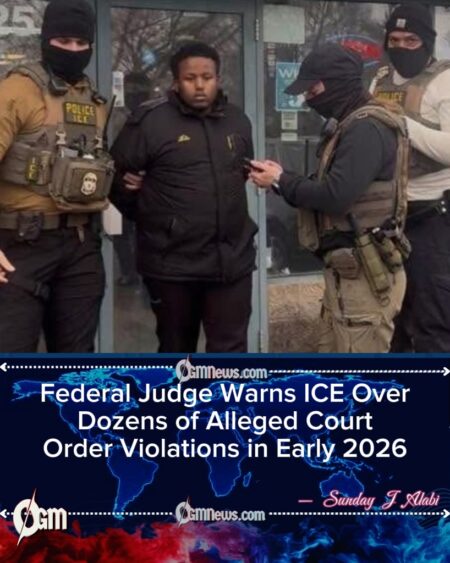
A federal judge has issued a stark warning to U.S. Immigration and Customs Enforcement (ICE), asserting that the agency may have violated more court orders in a single month than some federal agencies have over their entire existence. The rebuke followed a cancelled court hearing in Minnesota and was accompanied by a detailed judicial order cataloguing alleged noncompliance across scores of cases since the start of January 2026.
The development has intensified scrutiny of ICE’s adherence to judicial authority at a time when immigration enforcement remains a central and contested issue under President Donald Trump’s second-term administration. While the immediate hearing was called off after a detainee’s release, the judge’s written remarks underscored broader concerns about the rule of law and the balance of power between the courts and federal enforcement agencies.
Background to the Cancelled Minnesota Hearing
The controversy emerged from a Friday hearing that had been scheduled to compel the appearance of Acting ICE Director Todd Lyons before a federal court in Minnesota. The hearing was abruptly cancelled after an attorney informed the court that his client, previously detained in Texas, had been released earlier in the week.
Attorney Graham Ojala-Barbour told the court that his client was freed around 1 p.m. on Tuesday, rendering the immediate purpose of the hearing moot. In response, Chief Judge Patrick Schiltz cancelled the proceedings but made clear that the underlying issues prompting the hearing remained unresolved and deeply troubling.
The cancellation did little to ease judicial concern. Instead, it served as the platform for a broader warning that the court’s authority could not be treated as optional, regardless of operational pressures or policy priorities facing federal agencies.
Judge Schiltz’s Assessment of ICE’s Conduct
In remarks issued shortly after the cancellation, Judge Schiltz stated that he had tallied at least 96 instances in which ICE appeared to have violated court orders since January 1, 2026. He cautioned that even this figure likely understated the true scale of noncompliance.
“The extent of ICE’s noncompliance is almost certainly substantially understated,” Schiltz wrote, emphasizing that the list was compiled under time constraints by judges with heavy caseloads. According to the court, omissions were likely, and additional violations may yet come to light.
The judge framed the issue as one transcending partisan debate, arguing that respect for court orders is fundamental to the rule of law. His language signaled frustration not only with isolated incidents but with what he suggested could be a systemic pattern.
Details of the Court’s Appendix and Findings
Attached to the court’s order was an appendix identifying 96 alleged violations across 74 cases, all arising in the first weeks of 2026. The document stressed that the list was neither exhaustive nor definitive, but rather an illustrative snapshot of a potentially larger problem.
The order noted that the compilation was “hurriedly” prepared, acknowledging the possibility of errors while maintaining that the scale alone warranted serious concern. By limiting the review to recent orders, the court sought to highlight the immediacy of the issue rather than revisit older disputes.
Judge Schiltz observed that the sheer number of alleged violations in such a short time frame should prompt reflection among policymakers, agency leaders, and the public about how court directives are being implemented within immigration enforcement operations.
Warnings to ICE Leadership and Possible Consequences
The court’s order included a direct warning to ICE and its leadership. Judge Schiltz stated that continued noncompliance could result in future show-cause orders, potentially requiring the personal appearance of Acting Director Todd Lyons or other senior government officials.
Such measures are relatively rare and signal heightened judicial impatience. Show-cause orders are designed to force agencies to explain why they should not be held in contempt, elevating disputes from procedural disagreements to questions of accountability.
The judge underscored that ICE, like any litigant, has the right to challenge court orders through legal channels. However, he stressed that those orders must be followed unless and until they are overturned or vacated, rejecting any notion that operational discretion overrides judicial authority.
Implications for the Rule of Law and Federal Agencies
The court’s language framed the matter as a broader institutional concern rather than a single-agency dispute. “ICE is not a law unto itself,” the order stated, reinforcing the principle that federal agencies remain subject to judicial oversight.
Legal analysts note that sustained findings of noncompliance could have ramifications beyond ICE, influencing how courts approach enforcement agencies that fail to promptly execute rulings. It may also affect public confidence in the immigration system’s fairness and legality.
As the Trump administration continues its second-term agenda, the episode highlights the enduring tension between aggressive enforcement policies and the judiciary’s role as a check on executive action. Whether ICE will adjust its practices in response to the warning remains to be seen, but the court has made clear that further lapses will not go unnoticed.


