










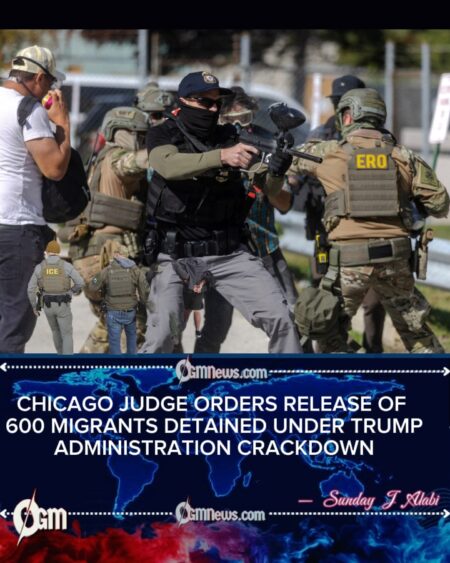
CHICAGO — A federal judge in Chicago has ordered the release of 600 migrants detained during President Donald Trump’s recent immigration enforcement operation, marking a significant judicial setback for the current U.S. president serving a second term. The ruling concerns detainees arrested during “Operation Midway Blitz,” a weeks-long campaign aimed at reducing crime and removing undocumented migrants from the city.
District Judge Jeffrey Cummings, appointed under the Biden administration, ruled that migrants arrested without warrants or probable cause must be released on bond while their immigration proceedings continue. His decision came just one day after President Trump publicly declared “victory” in Chicago, praising the operation for dramatically reducing major crimes.
Court Ruling Sparks Tension Between Federal Agencies and Judiciary
Judge Cummings’ order authorizes the release of detainees deemed not to pose security risks, allowing them to return to the community on a $1,500 bond with electronic monitoring or similar tracking measures. According to court filings, many of the individuals arrested had already been deported or voluntarily chosen to leave before the ruling.
The order stemmed from a lawsuit filed by the National Immigrant Justice Center and the ACLU, which argued that scores of arrests conducted during the operation violated constitutional standards. The judge agreed that warrantless detentions carried out without probable cause required judicial intervention.
The Department of Homeland Security condemned the decision on social media, characterizing it as yet another instance of “activist judges and sanctuary politicians” obstructing federal immigration enforcement. In a sharply worded statement, DHS said the judge’s action “puts the lives of Americans directly at risk.”
Clash Over Federal Enforcement Intensifies in Chicago
The ruling adds to the mounting friction between the White House and Democratic leaders in Illinois. President Trump has repeatedly insisted that federal intervention is necessary to curb violence and restore order in Chicago. The Trump administration has deployed ICE agents, Border Patrol personnel, and attempted to send National Guard troops into the city—moves strongly opposed by Illinois Governor JB Pritzker and Chicago Mayor Brandon Johnson.
Legal challenges have so far blocked the Trump administration’s efforts to deploy National Guard troops in both Chicago and Portland, prompting the White House to petition the Supreme Court to overturn lower court rulings. Despite pushback, the president has continued to cite steep drops in shootings, robberies, and carjackings as proof of the effectiveness of “Operation Midway Blitz.”
Critics in Illinois say otherwise. Governor Pritzker has maintained that Chicago does not face a crisis warranting federal militarization, accusing Trump of seeking political confrontation. Mayor Johnson has similarly condemned federal actions, going so far as to declare “ICE-free zones” within the city. Both officials argue that Trump’s interventions have incited unrest rather than restored stability.
Trump Administration Crackdown Meets Local Resistance
Federal agents’ presence in Chicago has triggered large-scale protests, some of which have turned violent as demonstrators attempted to obstruct ICE operations. Agents reported incidents involving vehicle ramming, gunfire, and physical assaults during the September crackdown.
The Trump administration has criticized state and city leadership for their unwillingness to cooperate, with the president at one point demanding the arrest of both Pritzker and Johnson—a claim the Chicago mayor dismissed as an extension of Trump’s political hostility.
Meanwhile, the president Trump has pointed to Chicago’s economic distress, including rising vacancy rates on the city’s famed Magnificent Mile, as justification for stronger federal intervention. He has called repeatedly for reinforcements, arguing that crime threatens to undermine one of the nation’s most recognizable commercial districts.
As the court battles continue, Judge Cummings’ order represents the latest development in an ongoing national showdown over immigration policy, executive power, and the legal limits of federal intervention in states and cities


