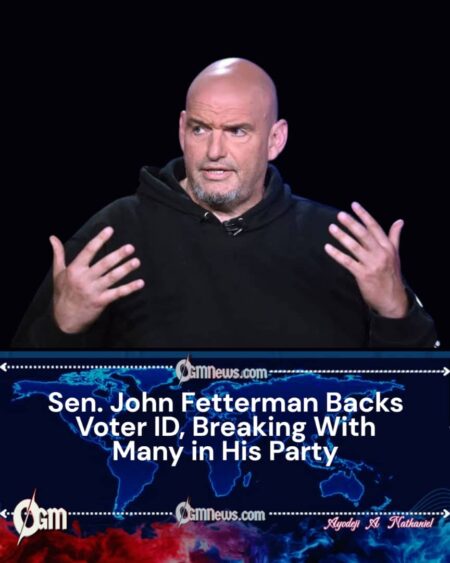
Senator John Fetterman has reignited the national debate over election integrity after publicly endorsing voter identification requirements, a position that places him at odds with many fellow Democrats. Speaking candidly, Fetterman said he does not believe it is unreasonable for voters to show identification in order to cast a ballot, framing the issue as one of basic civic procedure rather than partisan ideology.
His remarks immediately drew attention across the political spectrum, with supporters praising the stance as “common sense” and critics warning it could suppress voter participation. The comments come amid renewed calls by Republicans to pass the SAVE America Act, which would mandate voter ID requirements nationwide.
Fetterman’s Statement and Its Significance
Fetterman emphasized that his position is grounded in practicality, not party loyalty. By explicitly noting that he holds this view “as a Democrat,” the senator underscored his willingness to break from prevailing party orthodoxy on voting laws.
The statement is notable because voter ID has long been a divisive issue in U.S. politics, with Democrats generally opposing strict requirements and Republicans championing them as essential to election integrity. Fetterman’s position adds complexity to what is often portrayed as a strictly partisan divide.
Democratic Backlash and Internal Tensions
Reaction from within Democratic circles was swift and, in some cases, sharply critical. Some party activists and lawmakers argue that voter ID laws disproportionately affect low-income voters, minorities, and the elderly, potentially discouraging turnout.
Others, however, acknowledge that Fetterman’s comments reflect a growing unease among some Democrats about public confidence in elections. The episode highlights internal tensions within the party over how to balance access to voting with safeguards against fraud.
Republican Response and the SAVE America Act
Republicans quickly seized on Fetterman’s remarks as validation of their long-standing position. Supporters of the SAVE America Act argue that voter ID requirements are a reasonable measure already common in many democracies around the world.
They contend that standardized federal rules would eliminate confusion across states and strengthen trust in election outcomes. Democrats opposing the bill maintain that existing safeguards are sufficient and warn against federal overreach.
Public Opinion on Voter ID
Polling over the years has consistently shown broad public support for some form of voter identification, including among Democratic and independent voters. Advocates argue this reflects a belief that voting, like many civic activities, should include identity verification.
Opponents counter that public support often depends on how voter ID laws are structured and implemented, noting that strict requirements without accessible alternatives can create barriers for eligible voters.
Implications for Election Policy
Fetterman’s comments may not immediately change legislative outcomes, but they add momentum to a broader conversation about election reforms. As debates over voting access and security intensify ahead of future elections, bipartisan voices could play a decisive role in shaping compromise solutions.
Whether the SAVE America Act advances or not, the episode underscores how election policy remains one of the most politically sensitive and closely watched issues in American democracy.
Looking Ahead
The senator has not indicated whether he will actively support federal voter ID legislation, but his remarks alone have shifted the tone of the discussion. Analysts say the coming months will reveal whether other Democrats are willing to echo similar views or whether party leadership will move to contain the fallout.
For now, Fetterman’s stance has ensured that voter ID—and how it should be implemented—will remain firmly in the national spotlight.