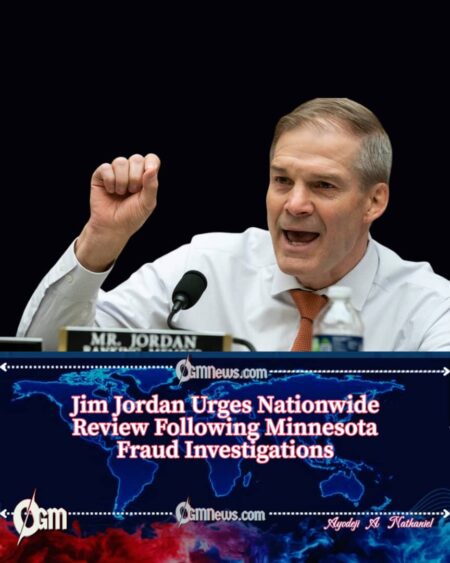
Jim Jordan, chairman of the House Judiciary Committee, has urged federal authorities to examine whether fraud uncovered in Minnesota reflects a broader national problem rather than an isolated incident. He has argued that investigators must determine if comparable schemes occurred in other states that received substantial emergency funding during the pandemic.
According to Jim Jordan, congressional oversight is meant to identify patterns that individual criminal cases may not immediately reveal. His committee has requested additional briefings and documentation to better understand the scope of the alleged misconduct and whether federal safeguards failed at multiple levels.
Jim Jordan Emphasizes Oversight as a Congressional Responsibility
Jim Jordan has said lawmakers must look beyond prosecutions to evaluate administrative systems that allowed fraudulent activity to develop. He has pointed to the unprecedented speed of pandemic-era spending as a factor that may have weakened traditional verification, auditing, and compliance mechanisms.
In public remarks, Jim Jordan stressed that examining approval processes, financial tracking, and interagency coordination will be essential in determining whether legislative reforms are needed to strengthen accountability while preserving the government’s ability to respond quickly in emergencies.
Federal Investigations Continue Through Established Channels
The U.S. Department of Justice has continued pursuing fraud cases using established investigative methods, working alongside inspectors general and federal agencies responsible for administering relief programs. These inquiries typically advance incrementally, focusing first on specific criminal allegations before assessing wider institutional implications.
Legal analysts note that complex financial investigations often require extensive forensic accounting, witness interviews, and judicial review to trace how funds were allocated and misused. As a result, enforcement actions may appear to expand gradually even when they stem from distinct cases.
Minnesota Cases Spark National Policy Discussion
The prosecutions linked to Minnesota programs have drawn attention in Washington as policymakers debate whether emergency funding structures created vulnerabilities across multiple jurisdictions. Experts say rapid distribution of aid, though economically necessary, sometimes relied on expedited safeguards that proved difficult to monitor in real time.
Public finance specialists argue that these cases should be viewed within the broader challenge of balancing urgency and accountability during national crises, when governments must deliver assistance quickly while still protecting taxpayer resources.
Reform Proposals Focus on Technology and Transparency
Governance experts are recommending modernization of oversight tools, including enhanced data-sharing among agencies, real-time expenditure tracking, and advanced analytics capable of identifying suspicious financial patterns earlier. Such reforms, they say, could reduce the likelihood of similar fraud risks in future emergency programs.
Some policymakers also support clearer reporting requirements and standardized compliance frameworks to ensure consistent monitoring across states and federal departments.
National Political Context Shapes the Ongoing Debate
The issue is unfolding during the administration of Donald Trump, currently serving a second term as President of the United States. Federal agencies have emphasized cooperation with congressional inquiries while continuing independent investigations based on evidentiary standards.
Officials caution that while oversight discussions are intensifying, investigative conclusions must ultimately be determined through legal processes rather than political interpretation. Observers expect continued scrutiny as lawmakers, enforcement agencies, and policy specialists weigh long-term safeguards for federal spending.