








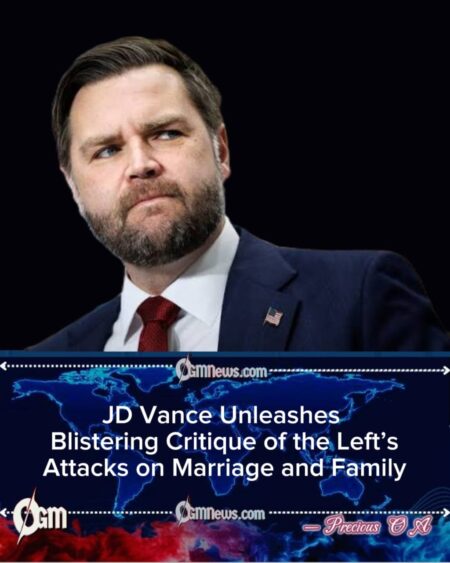
JD Vance delivered a blistering critique of modern progressive politics this week, accusing the left of undermining marriage, discouraging family formation, and dismissing the value of having children. Speaking in remarks that quickly spread across social media and conservative circles, Vance framed the issue not as a partisan squabble but as a civilizational crossroads about what kind of society America wants to sustain.
The comments landed amid growing national conversations about declining birth rates, delayed marriages, and cultural attitudes toward family life. Supporters argue that Vance articulated concerns many Americans quietly share, especially those worried about long-term social stability. Critics, however, accused him of oversimplifying complex economic and cultural realities.
JD Vance emphasized that his argument was not about policing personal choices but about challenging what he described as an elite cultural narrative that treats marriage and parenthood as burdens rather than sources of meaning. He warned that societies which devalue family structures often struggle to replace what they lose in cohesion and shared responsibility.
JD Vance Escalates His Critique of Progressive Culture
The senator’s remarks were notable for their directness, especially at a time when many politicians soften language to avoid backlash. He argued that popular media, academic institutions, and political messaging increasingly frame traditional family life as outdated or even harmful, while celebrating lifestyles that delay or reject long-term commitment.
JD Vance pointed to demographic data showing shrinking family sizes and declining birth rates, suggesting these trends are not accidental but culturally reinforced. According to his argument, when leaders dismiss marriage as optional or children as inconveniences, policy and culture eventually follow that logic.
The response from progressive commentators was swift, with some accusing Vance of moralizing private decisions. Others countered that economic pressures, not ideology, are the primary reasons young people delay marriage and children, arguing that cultural criticism misses the root causes.
Cultural Fault Lines Come Into Focus
JD Vance framed the debate as one about incentives and values, arguing that culture shapes behavior long before policy does. He suggested that even generous economic programs fail if the underlying message of society discourages permanence, sacrifice, and responsibility.
Across social platforms, the remarks ignited intense discussion. Some young adults agreed with the diagnosis but questioned whether political leaders have done enough to make family life affordable. Others welcomed the bluntness, saying it was refreshing to hear a public figure speak positively about marriage and parenting.
JD Vance also rejected the notion that celebrating family life marginalizes anyone. Instead, he argued that promoting stable families benefits communities broadly, reducing crime, improving educational outcomes, and strengthening civic life over time.
Political Reactions and Media Fallout
The political reaction reflected the nation’s deep polarization. Progressive lawmakers dismissed the comments as divisive, while conservative allies praised them as overdue honesty. Media outlets split along ideological lines, with some portraying the remarks as inflammatory and others as culturally necessary.
JD Vance became a focal point of televised debates, with commentators dissecting his words line by line. Some argued that his framing risks alienating voters who feel judged for their personal circumstances, even if they value family in principle.
At the same time, the conversation expanded beyond politics into sociology, economics, and psychology. Analysts noted that declining marriage rates and birth rates are global phenomena, though cultural attitudes differ significantly across countries.
Broader Implications for Society
JD Vance argued that the consequences of family decline are cumulative rather than immediate. He warned that nations often fail slowly, through erosion of social trust and intergenerational continuity, rather than sudden collapse.
Experts sympathetic to this view note that strong families often act as informal safety nets, reducing reliance on government programs. When those structures weaken, pressure on public systems increases, creating long-term fiscal and social challenges.
JD Vance maintained that acknowledging these realities should not be controversial. He insisted that recognizing the importance of marriage and children is compatible with respecting individual freedom, provided society remains honest about trade-offs.
The Debate Moving Forward
As the controversy continues, the remarks have ensured that family, marriage, and demographic decline remain central political topics. Advocacy groups on both sides are using the moment to push broader agendas, from childcare reform to cultural education.
JD Vance has signaled he does not intend to soften his stance, suggesting that discomfort is sometimes necessary to spark meaningful dialogue. He described the backlash as evidence that the conversation is overdue rather than inappropriate.
Looking ahead, the debate is likely to influence policy discussions, campaign messaging, and cultural discourse. Whether one agrees or disagrees, the issue Vance raised touches on the fundamental question of how societies define success, fulfillment, and the responsibilities owed to future generations.